

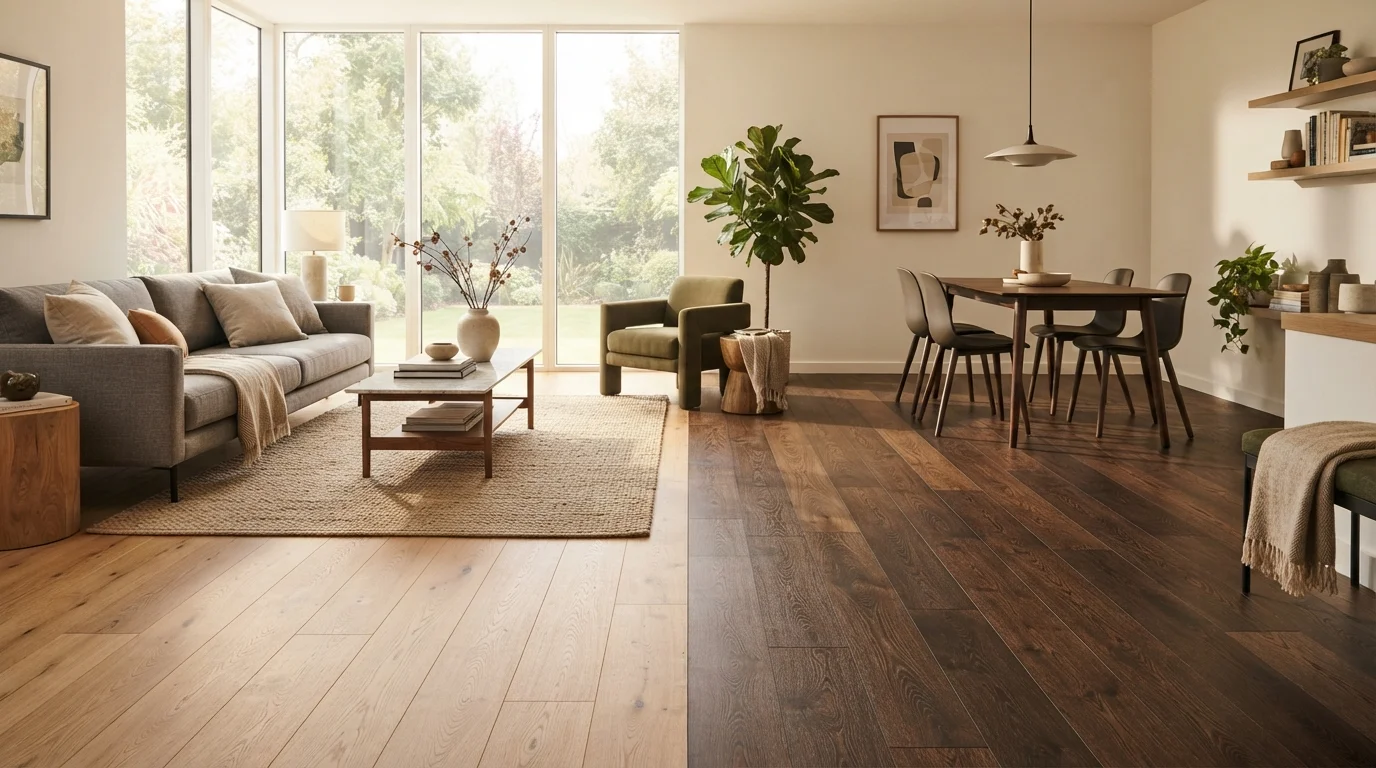
Key Takeaways
Option A
Engineered Hardwood
The moisture-resilient, versatile modern choice.
Best for: Homeowners installing flooring below grade, over radiant heat, or in rooms with variable humidity levels.
Option B
Solid Hardwood
The timeless, refinishable classic for long-term value.
Best for: Above-grade installations in stable, dry climates where longevity and repeated refinishing are priorities.
If you're finishing a basement or installing over a concrete slab
Engineered Hardwood
Its multi-layer plywood core resists moisture-related expansion and contraction, making it structurally appropriate for below-grade and slab applications where solid wood would warp.
If you want a floor that lasts decades and can be refinished repeatedly
Solid Hardwood
Solid planks are typically ¾ inch thick and can be sanded and restained multiple times, extending the floor's life well beyond what engineered options typically allow.
If your home has radiant in-floor heating
Engineered Hardwood
Engineered construction tolerates the thermal cycling of radiant heat systems without the gaps and cupping that affect solid wood over time.
If resale value and classic aesthetics matter most
Solid Hardwood
Solid hardwood is widely recognized by home appraisers and buyers as a premium material, and its refinishability means it can be refreshed before listing.
How They're Built - And Why It Matters
The construction difference between these two flooring types is more than a manufacturing detail - it determines where each floor can go and how it will perform over time.
Solid hardwood is milled from a single piece of wood, typically ¾ inch thick. That uniform structure gives it strength and refinishability, but also makes it sensitive to changes in moisture and temperature. Wood expands and contracts with humidity shifts, which is why installers leave expansion gaps at walls and why solid hardwood is limited to above-grade installations.
Engineered hardwood is constructed from a real hardwood veneer bonded over multiple layers of cross-ply plywood or high-density fiberboard (HDF). The cross-grain layering counteracts the natural tendency of wood to move with humidity, giving engineered floors significantly greater dimensional stability. The top veneer - which is the only visible surface - can be the same species and finish as solid hardwood.
| Criterion | Engineered Hardwood | Solid Hardwood |
|---|---|---|
| Construction | Veneer over plywood/HDF core | Single solid wood plank |
| Moisture resistance | Good - suitable for variable humidity | Poor - expands and contracts significantly |
| Installation locations | Above, on, or below grade | Above grade only |
| Subfloor compatibility | Concrete, wood, or floating | Wood subfloor only |
| Refinishing potential | 1-2 times (varies by wear layer) | 3-5+ times |
| Radiant heat compatible | Yes, generally | Limited or not recommended |
| Typical plank thickness | 3/8" - 9/16" | 3/4" |
| Appearance | Real wood surface, nearly identical look | Full-depth real wood grain |
Installation, Subfloor Compatibility, and Moisture Considerations
Subfloor type and room location are the most practical factors when choosing between these two options.
Solid hardwood must be nailed or stapled to a wood subfloor and should only be installed on or above grade. It's not recommended over concrete slabs or in basements where ground moisture is a persistent concern. Most manufacturers also advise against it in bathrooms or laundry rooms.
Engineered hardwood can be glued down to concrete, floated over a variety of subfloors, or nailed to wood - giving contractors and DIYers far more flexibility. It's the appropriate choice for slab foundations, below-grade spaces, and rooms with radiant heat systems. That said, engineered hardwood is still a wood product and is not waterproof; standing water or chronic high humidity will damage it.
Acclimation Is Non-Negotiable
Both solid and engineered hardwood must acclimate to the room's temperature and humidity before installation - typically 48 to 72 hours, though manufacturer specs vary. Failing to acclimate is one of the most common causes of post-installation warping, gapping, and cupping. Store planks flat, not stacked vertically, in the room where they'll be installed.
Both flooring types require acclimation before installation. Store planks in the installation room for 48-72 hours (or per manufacturer guidelines) to allow the wood to adjust to local temperature and humidity conditions. Skipping this step is a common cause of post-installation gapping or cupping.
Refinishing, Longevity, and Lifecycle Costs
One of the most frequent questions homeowners ask is how many times each floor can be refinished - and this is where solid hardwood holds a clear structural advantage.
Because solid planks are ¾ inch thick, they can typically be sanded and refinished three to five times or more over their lifespan, depending on how much wood is removed each cycle. This means a solid hardwood floor installed today could serve a home for 50-100 years with proper maintenance.
Engineered hardwood has a thinner wear layer - usually between 2mm and 6mm depending on grade - which limits refinishing to one or two cycles at most. Lower-cost engineered products with thin veneers may not be refinishable at all. However, high-quality engineered floors with a thick wear layer can provide a similar refinishing window to lower-end solid hardwood.
2mm-6mm
Typical engineered hardwood wear layer thickness
Wear layer depth determines how many times an engineered floor can be sanded; thicker veneers allow more refinishing cycles.
3/4"
Standard solid hardwood plank thickness
This consistent depth allows solid hardwood to be sanded and refinished multiple times over a floor's multi-decade lifespan.
50-100 years
Potential lifespan of solid hardwood with refinishing
Floors regularly maintained, refinished, and protected from moisture damage can remain structurally sound and visually appealing for generations.
When calculating lifecycle cost, factor in the installation scenario: if engineered hardwood is the only structurally sound option for your subfloor or climate, its cost-per-year can still compare favorably to solid hardwood in above-grade rooms where either product would work.