

Key Takeaways
Option A
50/30/20 Rule
The simple, percentage-based framework for everyday budgeting.
Best for: People who want a low-maintenance system with broad spending categories and built-in flexibility.
Option B
Zero-Based Budgeting
The detail-oriented method that assigns every dollar a specific job.
Best for: People who want precise control over spending and are willing to plan each budget period from scratch.
If you have a steady income and want a low-effort budgeting habit
50/30/20 Rule
The fixed percentages require minimal recalculation month to month, making it easy to maintain consistently without detailed tracking.
If you have irregular income or are aggressively paying down debt
Zero-Based Budgeting
Assigning every dollar a role each period helps you adapt to income swings and prioritize debt payments without leaving money unaccounted for.
If you're new to budgeting and building the habit for the first time
50/30/20 Rule
Broad categories lower the barrier to entry and reduce the chance of early burnout from overly detailed planning.
If you want to identify and eliminate specific spending leaks
Zero-Based Budgeting
Line-by-line allocation forces you to consciously justify every expense, making it easier to spot and cut wasteful spending.
How Each Framework Works
Understanding the mechanics of each method is the starting point. If you're brand new to household budgeting, our introduction to personal budgeting explains how income, expenses, and savings fit together before you choose a framework.
The 50/30/20 Rule
This approach divides your after-tax take-home pay into three broad buckets:
- 50% for needs - rent or mortgage, utilities, groceries, minimum debt payments, insurance, and other essentials you can't reasonably cut.
- 30% for wants - dining out, subscriptions, entertainment, travel, and discretionary spending.
- 20% for savings and debt repayment - emergency funds, retirement contributions, and paying down debt above the minimum.
The appeal is simplicity. You don't categorize every transaction; you just monitor whether spending stays within three wide bands. The tradeoff is that those bands can mask overspending within a category - your 50% "needs" bucket could hide a gym membership you rarely use.
Zero-Based Budgeting
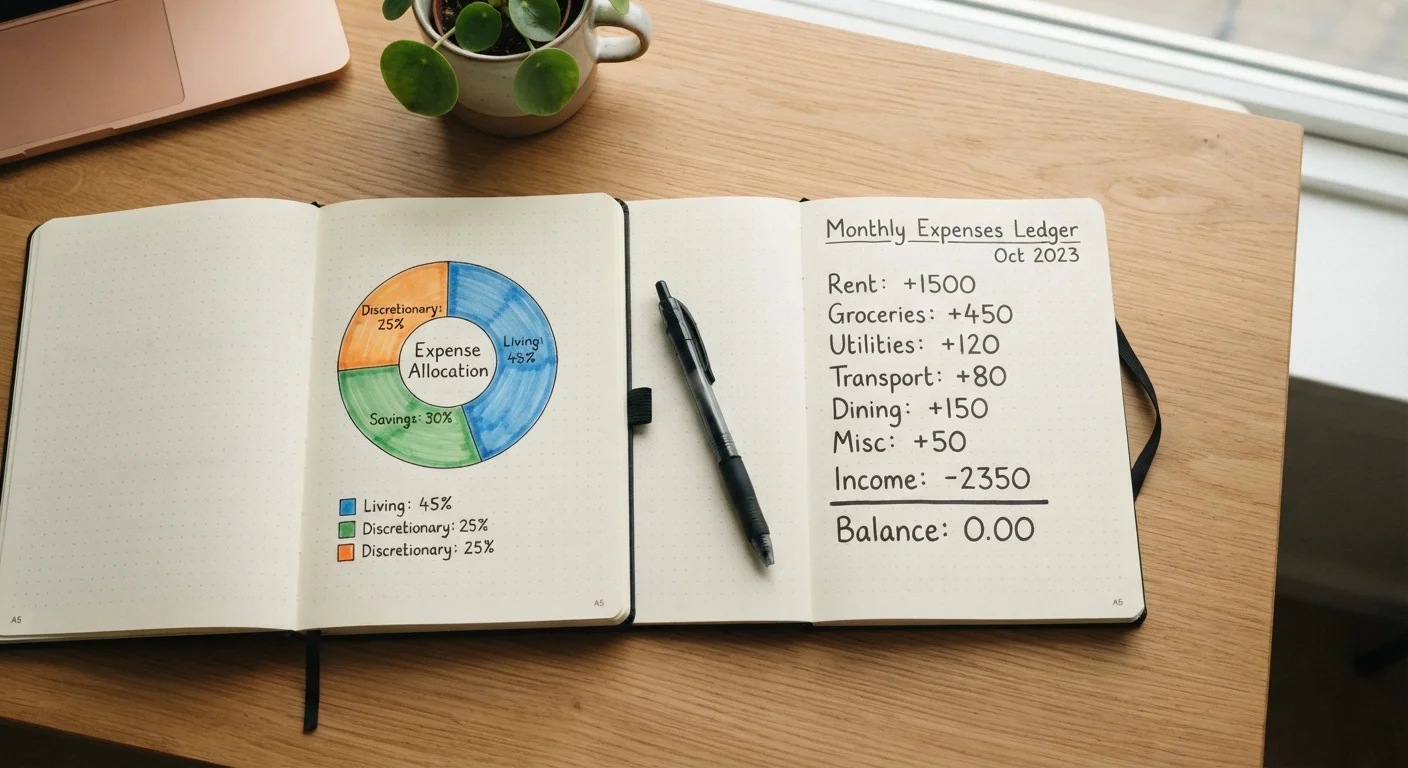
Zero-based budgeting starts from zero every month (or pay period). You list all expected income, then assign every dollar to a specific category - rent, groceries, gas, savings, entertainment - until the equation reads: Income minus Expenses equals Zero. Nothing is left unassigned.
This doesn't mean spending everything. Savings and investing are line items too - they just have to be explicitly planned. The discipline required is higher, but so is the visibility into where money actually flows. For a comparison with another category-focused approach, see envelope budgeting in a digital world.
Key Differences at a Glance
Both methods serve the same underlying purpose - making deliberate decisions about money - but they diverge significantly in structure, time investment, and flexibility. As a foundation, it helps to understand how fixed and variable expenses behave, since each framework handles them differently.
| Criterion | 50/30/20 Rule | Zero-Based Budgeting |
|---|---|---|
| Setup time | Low - set once, revisit occasionally | High - rebuilt each budget period |
| Category detail | 3 broad buckets | Every expense line-itemized |
| Best income type | Steady, predictable income | Variable or irregular income |
| Flexibility | High within each bucket | Requires deliberate category adjustments |
| Spending visibility | Moderate - broad categories only | High - every dollar accounted for |
| Learning curve | Low - easy to start | Moderate - requires planning discipline |
| Good for debt payoff | Adequate - 20% bucket covers it | Strong - debt gets its own line item |
One practical note: zero-based budgeting pairs naturally with a paycheck-by-paycheck approach, while the 50/30/20 rule typically works on a monthly cycle. If your pay schedule affects your decision, our article on budgeting by paycheck vs. budgeting by month walks through that trade-off.
Choosing the Method That Fits Your Life
Neither framework is objectively better. The right one is the one you'll actually use consistently. A few questions can help narrow it down:
No Method Works If You Don't Track
Whichever framework you choose, it only functions if you record actual spending - not just plan it. Reviewing real transactions against your budget, even once a week, is what turns a plan into a habit. Apps, spreadsheets, and even pen and paper all work; the tool matters far less than the consistency.
- How stable is your income? Salaried workers can apply percentages reliably. Freelancers and gig workers with variable income often find zero-based budgeting more useful because it forces a fresh plan each period based on actual dollars coming in.
- How much time will you commit? Zero-based budgeting typically takes 30-60 minutes to set up each month, plus periodic check-ins. The 50/30/20 method can be reviewed in minutes once established.
- What's your primary goal right now? If you're trying to build a savings habit or get a rough sense of spending, the 50/30/20 rule offers a gentle on-ramp. If you're aggressively building an emergency fund or repaying debt, zero-based budgeting's precision tends to accelerate progress.
You can also combine elements of both. Some people use the 50/30/20 rule as a target allocation, then use zero-based planning within each category to hit those targets. What matters most is having a system - any structured approach outperforms no approach. For a broader look at what budgeting is actually designed to do, see what a budget actually does.
~74%
U.S. adults living paycheck to paycheck
A 2023 LendingClub report found that roughly three-quarters of American consumers reported living paycheck to paycheck, underscoring how many households lack a structured budget.
1 in 3
Americans with no written budget
Multiple consumer surveys have consistently found that a significant share of U.S. adults do not follow any formal budgeting method, relying instead on informal mental accounting.
This article is for general informational purposes only and does not constitute personalized financial advice. Consider consulting a qualified financial professional regarding your specific situation.