

| Number of major credit bureaus (US) | 3 - Equifax, Experian, TransUnion (Consumer Financial Protection Bureau (CFPB)) |
| Typical credit score range | 300 to 850 (FICO scoring model) |
| How long most derogatory marks stay on your report | 7 years (Fair Credit Reporting Act (FCRA)) |
| How long a Chapter 7 bankruptcy stays on your report | Up to 10 years (Fair Credit Reporting Act (FCRA)) |
| Typical grace period on credit cards | 21-25 days after billing cycle closes (Credit CARD Act of 2009 (minimum 21 days required)) |
| Standard charge-off timeline | Approximately 180 days of nonpayment (Federal Financial Institutions Examination Council (FFIEC) guidelines) |
Why Credit Vocabulary Matters
Credit affects nearly every major financial decision most adults make - from renting an apartment to financing a car to applying for a mortgage. But the industry runs on terminology that isn't always explained clearly. Lenders, credit bureaus, and collection agencies use specific words that carry real legal and financial weight, and misunderstanding them can cost you money or lead you to make decisions based on incomplete information.
This glossary covers the terms you're most likely to encounter on credit reports, billing statements, and loan applications. It's organized thematically so related concepts sit near each other. For a broader look at everyday money language, see our Household Budget Glossary, and for savings and debt terminology, check out Savings and Debt Terms Every Adult Should Recognize.
This article is general financial information and education, not personalized financial or legal advice. For decisions specific to your situation, consult a qualified financial professional.
APR (Annual Percentage Rate)
The yearly cost of borrowing, expressed as a percentage, including the interest rate and most required fees. It's the standard figure used to compare the true cost of different credit offers.
Credit Score
A three-digit number calculated from the information in your credit report, used by lenders to assess the likelihood you'll repay a debt. Scores typically range from 300 to 850; higher scores generally indicate lower risk to lenders.
Credit Utilization Ratio
The percentage of your total available revolving credit that you're currently using. It's calculated by dividing your current balances by your total credit limits across revolving accounts.
Tradeline
Any individual credit account - such as a credit card, mortgage, or auto loan - listed on your credit report. Each tradeline includes account details, payment history, and current status.
Charge-Off
A creditor's accounting action when it considers a debt uncollectible after extended nonpayment, typically around 180 days. The debt remains legally owed and collectible despite the charge-off designation.
Hard Inquiry
A credit report access triggered by a new credit application. Hard inquiries are visible to other lenders and can temporarily lower your credit score by a small number of points.
Grace Period
The time between a billing cycle's close and the payment due date during which you can pay your full statement balance and avoid interest charges. Carrying a balance typically eliminates this benefit.
Derogatory Mark
A negative item on your credit report, such as a missed payment, collection account, charge-off, or bankruptcy. Most derogatory marks remain on your report for seven years.
Credit Limit
The maximum amount a lender permits you to borrow on a revolving account, such as a credit card or home equity line of credit. Exceeding the limit may result in fees or a declined transaction.
Minimum Payment
The smallest amount required each billing cycle to keep a credit account in good standing. Paying only the minimum while carrying a balance allows interest to accumulate on the remaining debt.
Balance Transfer
The process of moving an existing debt balance from one credit account to another, often to secure a lower interest rate. Transfer fees and promotional rate terms vary by lender.
Soft Inquiry
A credit report access that does not affect your credit score. Examples include pre-approval screenings by lenders and your own credit monitoring checks.
Terms You'll See on Credit Reports
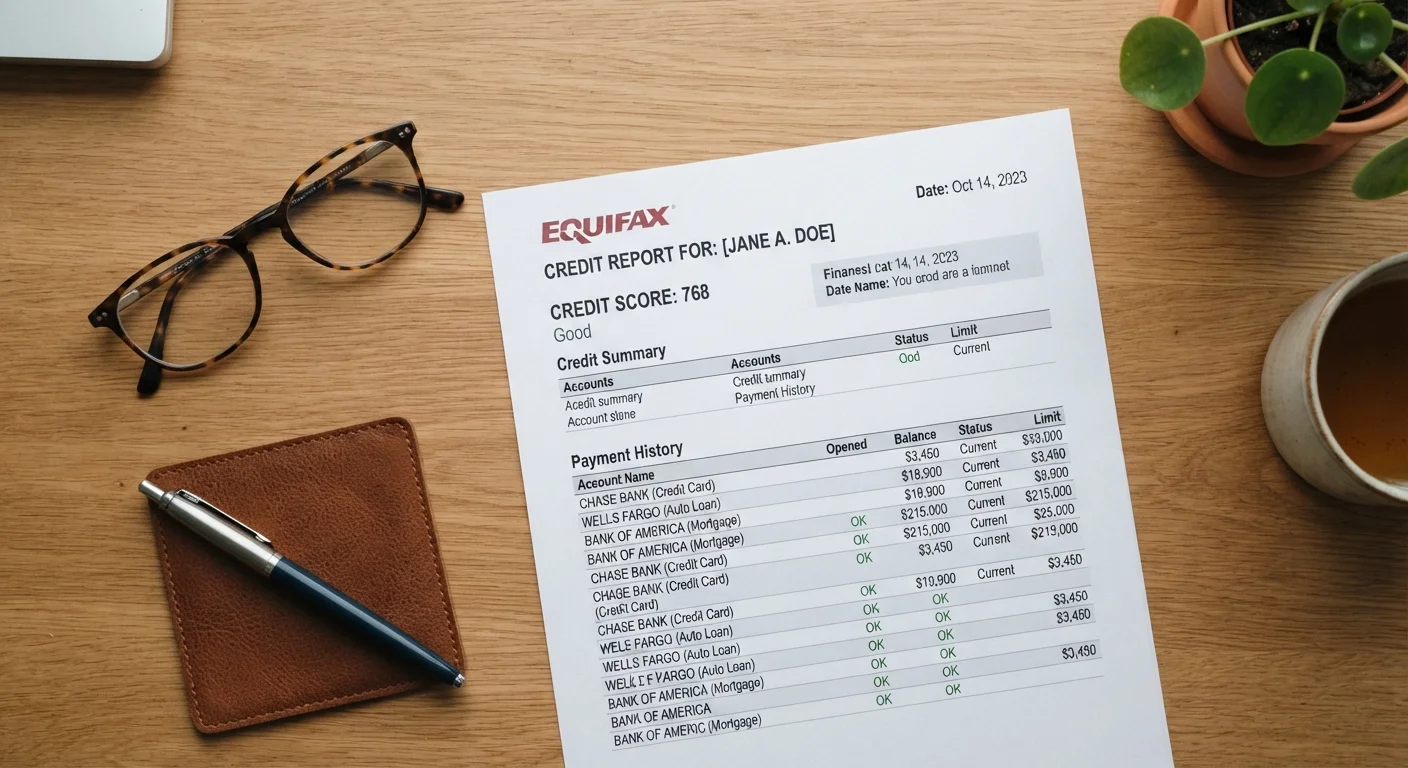
Your credit report is a detailed record maintained by the three major credit bureaus - Equifax, Experian, and TransUnion. Knowing what each entry means helps you spot errors and understand what lenders see when they pull your file.
| Number of major credit bureaus (US) | 3 - Equifax, Experian, TransUnion (Consumer Financial Protection Bureau (CFPB)) |
| Typical credit score range | 300 to 850 (FICO scoring model) |
| How long most derogatory marks stay on your report | 7 years (Fair Credit Reporting Act (FCRA)) |
| How long a Chapter 7 bankruptcy stays on your report | Up to 10 years (Fair Credit Reporting Act (FCRA)) |
| Typical grace period on credit cards | 21-25 days after billing cycle closes (Credit CARD Act of 2009 (minimum 21 days required)) |
| Standard charge-off timeline | Approximately 180 days of nonpayment (Federal Financial Institutions Examination Council (FFIEC) guidelines) |
- Tradeline
- Any account listed on your credit report - a credit card, auto loan, mortgage, or student loan. Each tradeline shows the account type, balance, payment history, and status.
- Account Status
- Describes whether an account is open, closed, in collections, or charged off. Status affects how lenders interpret your file.
- Inquiry
- A record that someone accessed your credit report. Hard inquiries occur when you apply for credit and can temporarily lower your score. Soft inquiries - from pre-approval checks or your own monitoring - do not affect your score.
- Derogatory Mark
- Any negative item, such as a late payment, collection, charge-off, or public record like a bankruptcy. Most derogatory marks remain on your report for seven years; bankruptcies can remain for up to ten.
- Charge-Off
- When a creditor writes an unpaid debt off its books as a loss - typically after 180 days of nonpayment. The debt doesn't disappear; it can still be collected, and the charge-off notation damages your credit standing.
Under the Fair Credit Reporting Act (FCRA), you have the right to dispute inaccurate information on your report. You can obtain free reports from the three major bureaus through the official government-authorized source, AnnualCreditReport.com. For a broader look at consumer protections, see our Consumer Rights hub.
Terms You'll See on Statements and Applications
Once you have a credit account, the billing and application language introduces another layer of vocabulary. These definitions cover the terms that directly affect how much borrowing costs you.
- APR (Annual Percentage Rate)
- The yearly cost of borrowing, expressed as a percentage. APR includes the interest rate and most required fees, making it a more complete cost comparison than the interest rate alone. Credit cards often carry multiple APRs - one for purchases, one for cash advances, and a higher penalty APR triggered by late payments.
- Grace Period
- The window - typically 21 to 25 days after your billing cycle closes - during which you can pay your statement balance in full without being charged interest. Carrying a balance from month to month usually eliminates the grace period.
- Credit Utilization Ratio
- The percentage of your available revolving credit that you're currently using. For example, a $2,000 balance on a $10,000 limit equals 20% utilization. Lower utilization is generally viewed more favorably in credit scoring models.
- Minimum Payment
- The smallest amount a lender requires you to pay by the due date to keep the account in good standing. Paying only the minimum while carrying a balance means interest accrues on the remainder, potentially extending repayment for years.
- Balance Transfer
- Moving a debt from one credit account to another, often to take advantage of a lower interest rate. Transfer fees and promotional rate expiration dates are important factors to review before proceeding.
Your Credit Reports Are Free to Access
Federal law entitles you to free credit reports from each of the three major bureaus through AnnualCreditReport.com, the only source authorized by the federal government for this purpose. Reviewing your reports regularly is a practical way to catch errors or unfamiliar accounts early. If you find inaccurate information, you have the right under the FCRA to dispute it directly with the bureau that reported it.