
Compound Interest: The Force That Works For You in Savings and Against You in Debt

Key Takeaways
Compound Interest
Compound interest is interest calculated not just on your original amount of money (called the principal) but also on any interest that has already accumulated. This means your balance grows - or your debt climbs - at an accelerating pace over time. The longer compound interest operates, the more powerful its effect becomes.
Compounding frequency matters: interest compounded daily produces a slightly higher effective annual rate than interest compounded monthly or annually at the same stated rate.
How Compound Interest Actually Works
Picture a snowball rolling downhill. It starts small, but as it rolls it picks up more snow - and the bigger it gets, the more it collects with each rotation. Compound interest works the same way. Each period, interest is added to your balance, and that enlarged balance becomes the new base for the next interest calculation.
With simple interest, you'd earn the same dollar amount every period. With compound interest, each period's calculation includes all the interest that came before it. Over months and years, that difference adds up to a meaningful gap.
For a grounded look at how this fits into the broader vocabulary of personal finance, see common savings and debt terms - a plain-language reference that covers the language you'll encounter across accounts and loans.
Daily
How often most credit cards compound interest
The Consumer Financial Protection Bureau notes that credit card interest is typically compounded daily, meaning balances grow faster than accounts that compound monthly.
Rule of 72
Shortcut for estimating money-doubling time
Dividing 72 by the annual interest rate gives an estimate of how many years it takes a sum to double - a well-known rule of thumb in personal finance education.
Minimum payments
Why debt payoff stalls
Financial educators consistently note that paying only the minimum on revolving debt can extend repayment timelines by years and dramatically increase total interest paid.
When Compounding Works in Your Favor: Savings
In a savings account, certificate of deposit, or investment account, compound interest means your money earns a return - and then that return itself starts earning a return. The effect is modest in the early years but becomes increasingly significant as time passes.
Consider two people who each set aside $5,000. One leaves it untouched for 10 years; the other waits five years before starting. Even if the interest rate is identical, the person who started earlier ends up with a noticeably larger balance, purely because compounding had more time to operate.
The key variables that determine how much compounding works for you:
- Principal: The starting amount. More principal means more interest earned each cycle.
- Rate: A higher annual interest rate accelerates growth.
- Time: The single most powerful lever. Longer time horizons allow compounding to produce larger jumps.
- Compounding frequency: Daily compounding produces slightly more than monthly at the same stated rate.
Start Small, But Start Now
The compounding benefit of time means that even modest contributions made early can outpace larger contributions made later. If you're weighing whether to begin saving before you feel financially ready, the math generally favors starting sooner - even at a smaller amount - over waiting for the 'right' moment.
When Compounding Works Against You: Debt
The same mechanics that grow savings can erode financial stability when applied to debt. Credit cards, for example, typically compound interest daily. If you carry a balance and only make the minimum payment, a large portion of that payment goes toward interest - meaning the principal shrinks slowly while new interest continues to accumulate.
This is not a minor inconvenience. A $3,000 credit card balance at a high interest rate, paid only minimally each month, can take years to clear and cost considerably more than the original amount borrowed. The compounding isn't dramatic in any single month, but it's persistent - and persistence is what makes it expensive.
Structural patterns that keep people trapped in this cycle are explored further in traps that make debt harder to escape. Understanding the mechanics is the first step toward recognizing why those traps are so effective.
APR vs. APY: A Key Distinction
When comparing accounts or loans, you'll often see both APR (Annual Percentage Rate) and APY (Annual Percentage Yield). APY reflects compounding, making it a more accurate measure of what you'll actually earn in a savings account. For debt, APR is the standard disclosure, though the effective cost can be higher when compounding is factored in. For a fuller breakdown of these and related terms, see savings and debt terms every adult should recognize.
Balancing the Two Sides
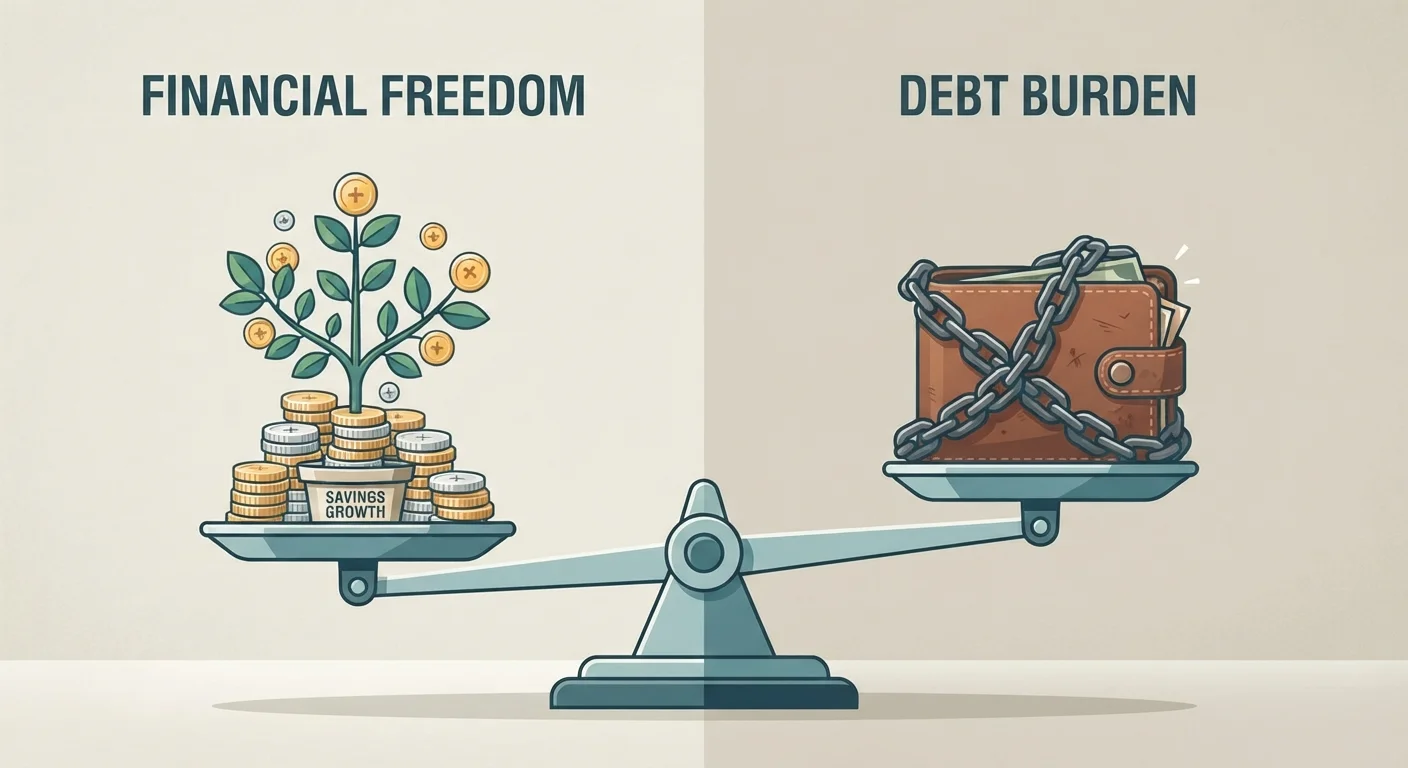
Once you understand that compound interest can simultaneously build your savings and inflate your debt, a natural question emerges: should you focus on one side first? There's no single universal answer, but the mathematics offer a useful frame.
If your debt carries a higher interest rate than your savings account pays, every dollar left in that debt is effectively costing you more than your savings are earning. That gap - between the rate you're paying on debt and the rate you're earning on savings - is a key factor many financial educators point to when discussing prioritization.
That said, this isn't purely a math exercise. Emergency funds, employer retirement contributions, and personal circumstances all shape what's practical. For a more detailed look at how people approach this balance in real life, paying off debt while saving at the same time walks through the logic. And if you're weighing a more aggressive approach in one direction, the trade-offs between aggressive saving and aggressive debt payoff covers the key variables.
This article is for general informational and educational purposes only and does not constitute personalized financial advice. Consult a qualified financial professional for guidance specific to your situation.