

Key Takeaways
Why These Concepts Work Together
Savings and debt are two sides of the same personal-finance coin. Money you owe costs you interest over time; money you save earns it. That inverse relationship means every dollar you allocate has a competing use, which is why understanding both subjects together - rather than in isolation - gives you a clearer picture of your financial position.
This guide covers the foundational mechanics: what an emergency fund is and why it matters, how different debt types behave, the math behind interest, proven payoff frameworks, and core savings principles. Once you have this map, you can explore more nuanced decisions, such as whether to pay off debt and save simultaneously or which goal to prioritize aggressively.
This article is for general educational purposes only and is not personalized financial, tax, or legal advice. Consult a qualified financial professional for guidance specific to your situation.
The Emergency Fund: Your Financial Floor
An emergency fund is a dedicated pool of liquid savings set aside exclusively for unplanned, necessary expenses - a job loss, urgent car repair, or medical bill. Its purpose is to absorb financial shocks without forcing you to borrow.
A widely cited guideline suggests keeping three to six months of essential living expenses in an accessible account, such as a savings or money-market account. The exact range depends on factors like income stability, number of dependents, and whether you have a single or dual income household. People with variable or self-employment income often aim toward the higher end of that range.
Start With a Starter Emergency Fund
Before aggressively paying down debt, consider building a small cash cushion of a few hundred to a thousand dollars. This buffer helps prevent a minor surprise - a flat tire, a copay - from going straight onto a credit card and undoing your payoff progress. Once you have a starter fund in place, you can direct more energy toward debt reduction.
Even a modest starter fund - sometimes called a starter emergency fund of roughly $500 to $1,000 - meaningfully reduces the probability that a minor setback turns into new high-interest debt. Building this buffer first is a common first step in many popular personal-finance frameworks.
Types of Debt and How Interest Works
Debt broadly divides into two categories:
- Secured debt is backed by collateral (a home, vehicle). If you default, the lender can seize the asset. Mortgages and auto loans are examples. Interest rates tend to be lower because the lender has a recovery path.
- Unsecured debt has no collateral. Credit cards and personal loans fall here. Without an asset backing the loan, lenders charge higher rates to compensate for the added risk.
Interest can be simple (calculated only on the principal) or compound (calculated on the principal plus previously accumulated interest). Most consumer debt compounds, often monthly or daily. This is why a credit-card balance left unpaid for years can grow substantially beyond the original charge.
The annual percentage rate (APR) is the standardized way lenders disclose borrowing costs, including certain fees. When comparing debt obligations, the APR is the most consistent figure to use.
~56%
Americans without enough savings for a $1,000 emergency
According to a Bankrate survey, roughly 56% of U.S. adults said they could not cover a $1,000 emergency expense from savings alone.
20%+
Typical credit card APR range in the U.S.
Federal Reserve data consistently shows average credit card interest rates above 20% APR, making high-rate card debt among the costliest consumer borrowing.
3-6 months
Recommended emergency fund coverage
Consumer financial education organizations, including the Consumer Financial Protection Bureau (CFPB), commonly cite three to six months of expenses as a target emergency fund size.
Understanding the fundamentals of credit products - including how lenders set rates and report to credit bureaus - can help you interpret loan terms more clearly.
Debt Payoff Strategies Explained
Two structured approaches dominate personal finance education:
- Avalanche method
- Direct any extra payment toward the debt with the highest interest rate first, while making minimum payments on all others. Once that balance reaches zero, redirect the freed-up funds to the next highest rate. Mathematically, this minimizes the total interest paid over time.
- Snowball method
- Pay off the smallest balance first, regardless of interest rate. The quick wins can build motivation and psychological momentum, which research in behavioral economics suggests matters for follow-through.
Neither method is universally superior. The avalanche approach wins on pure math; the snowball approach wins on human psychology. A hybrid - paying off one small balance for momentum, then switching to highest-rate priority - is also a legitimate approach some people find workable.
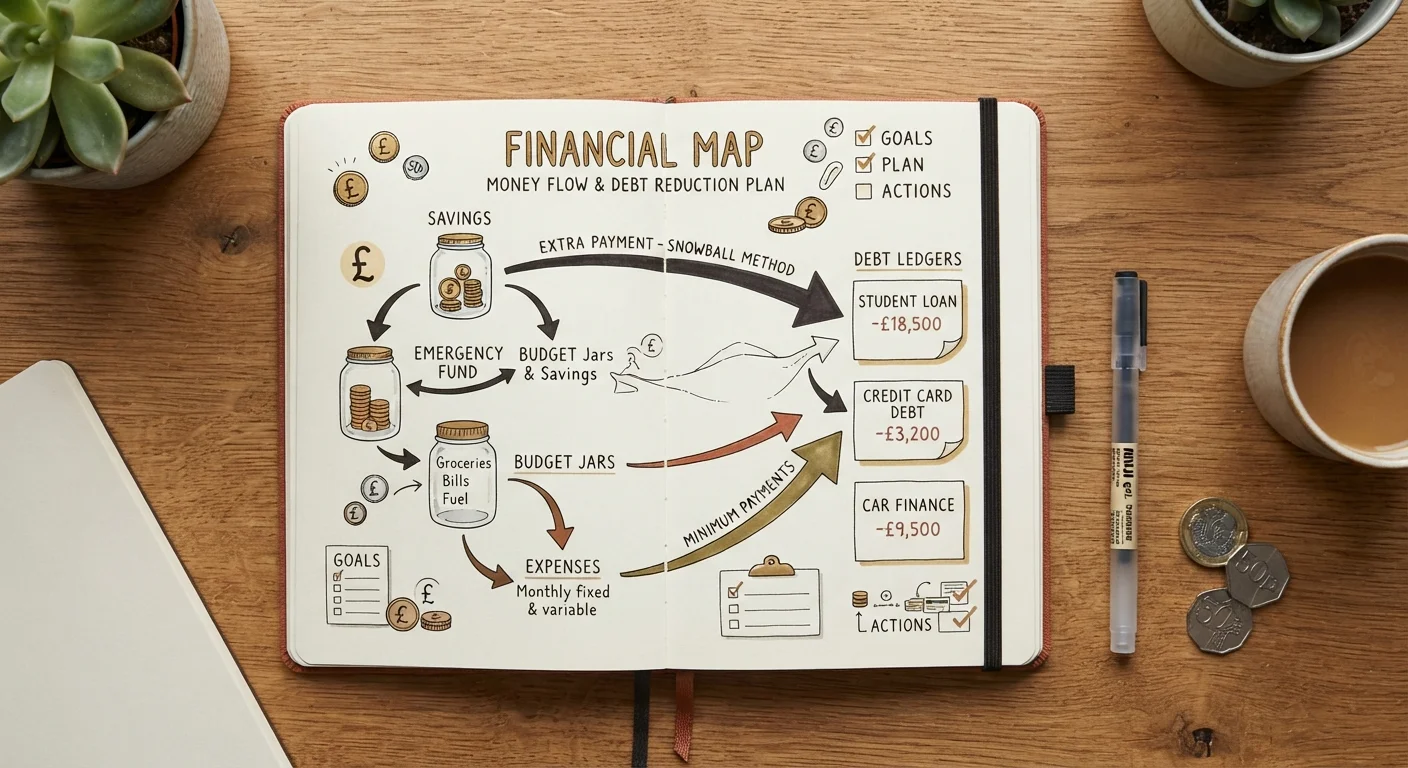
Before choosing avalanche or snowball, list every debt with its balance, rate, and minimum payment side by side. Seeing the full picture on one page often makes the right starting point obvious.
Many people discover they have one high-rate balance that dwarfs the others - or one tiny balance they could eliminate in a single month - simply by mapping their obligations visually.
Treat your emergency fund contribution like a fixed bill, not optional savings. Automate a transfer on payday so the decision is never re-made each month.
Behavioral research consistently shows that automatic saving - removing the active choice - leads to higher rates of consistent follow-through than intention-based saving.
Any payoff strategy works better when paired with a clear picture of your monthly cash flow. The core strategies in budgeting can help you identify how much extra you realistically have to put toward debt each month.
Core Savings Principles
Beyond emergency reserves, savings serve goals across different time horizons:
- Short-term goals (under two years): Generally kept in stable, liquid accounts. The priority is capital preservation, not growth.
- Medium-term goals (two to ten years): May tolerate some exposure to market fluctuation, depending on the individual's risk tolerance and timeline.
- Long-term goals (retirement, decade-plus horizons): Often held in tax-advantaged accounts. Compound growth over long periods is the primary engine.
Compound interest works in the saver's favor here. Money earning interest - and then earning interest on that interest - grows faster the longer it remains invested. This is the mirror image of how compound interest harms borrowers. The same mechanic that inflates a credit-card balance over years also amplifies savings over decades.
Pay yourself first is a phrase for automating savings contributions before discretionary spending. Automating transfers removes the reliance on willpower and reduces the temptation to spend money before it is saved.
Balancing Debt and Savings: The Key Variables
Most people face a genuine tension: every dollar put toward debt is a dollar not going into savings, and vice versa. Several factors shift the calculus:
- Interest rate differential: If a debt carries a higher rate than your savings account earns, paying down debt provides a guaranteed return equal to that rate. If your debt rate is low and savings or investment returns are higher, the math may favor saving.
- Employer match: If your employer matches retirement contributions up to a certain percentage, not contributing enough to capture that match is effectively leaving compensation on the table.
- Income stability: A volatile income makes a larger emergency fund more valuable and may justify a more conservative approach to debt payoff speed.
- Psychological factors: Some people find carrying debt stressful regardless of the math; others are comfortable prioritizing savings. Both reactions are valid inputs into a personal financial plan.
There is no single correct answer - these variables combine differently for every household. Consulting a licensed financial adviser can help you model trade-offs specific to your income, obligations, and goals.
This content is general financial education and does not constitute personalized financial advice. Always verify important financial decisions with a qualified professional.