

Key Takeaways
Why Minimum Payments Mislead So Many Cardholders
Minimum payments appear on every credit card statement, and they're usually small enough to feel manageable. That's by design. But the gap between what minimum payments appear to do and what they actually cost is one of the most consequential misunderstandings in personal finance.
These misconceptions aren't a sign of carelessness - they're a predictable result of how credit card terms are presented. Understanding the mechanics clearly puts you in a much better position. For a broader look at how financial myths can shape your habits, see our piece on budgeting myths worth examining.
Myth
Paying the minimum means I'm keeping up with my debt and making real progress.
Fact
Paying only the minimum typically covers mostly interest, leaving your principal balance nearly unchanged for months.
Credit card minimum payments are often calculated as a small percentage of the outstanding balance - commonly 1-2% - or a flat dollar floor, whichever is higher. At a high APR, a large portion of that payment goes straight to interest charges. The portion reducing your actual principal (the amount you borrowed) can be very small at first. As the balance slowly shrinks, so does the minimum payment, which means repayment can drag on for many years. Progress exists, but it's far slower than most people assume.
Myth
As long as I make minimum payments, I'm not being charged interest.
Fact
Interest accrues on any revolving balance that isn't paid in full by the statement due date, regardless of whether you make minimum payments on time.
The grace period on credit cards - the window during which you can pay your balance without incurring interest - applies only when you carry no balance from the previous month. Once you carry a balance, interest begins accruing on new purchases immediately in many cases, and it compounds on the remaining balance each billing cycle. Making the minimum payment on time avoids late fees and protects your credit report from a late-payment mark, but it does not stop the interest clock.
Myth
Minimum payments are set at an amount designed to help me pay off the balance in a reasonable time.
Fact
Minimum payment formulas are set by card issuers to keep accounts current - not to optimize how quickly you pay down debt.
There is no regulatory requirement that minimum payments be calculated in a way that results in timely payoff. Historically, some issuers set minimums as low as 2% of the balance, which at typical interest rates barely exceeds monthly interest charges. While the Credit CARD Act of 2009 introduced disclosure requirements and rules against certain fee practices, it did not mandate a specific minimum payment formula designed to benefit borrowers. The minimum is a floor, not a repayment plan.
Myth
My credit score will suffer if I pay more than the minimum.
Fact
Paying more than the minimum - or paying the full balance - generally helps your credit score by reducing your credit utilization ratio.
Credit utilization, which is the percentage of your available credit that you're currently using, is one of the most influential factors in most credit scoring models. Paying down balances reduces utilization, which typically has a positive effect on your score. There is no scoring penalty for paying ahead or paying in full. The only credit-score-related risk tied to minimum payments is paying less than the minimum, which results in a missed-payment mark.
Myth
If I can't pay more than the minimum right now, I might as well just pay the exact minimum each month.
Fact
Even modest amounts above the minimum can meaningfully reduce total interest paid and shorten your repayment timeline.
Because of how compound interest works, paying even $20 or $30 above the minimum each month can cut months or years off your repayment period. The additional payment reduces the principal, which reduces the base on which interest is calculated the following month, and the effect compounds over time. If budget constraints make large extra payments difficult, a consistent small increase above the minimum is still worth doing. There's no requirement to pay dramatically more - consistency matters.
How the Numbers Actually Work
The gap between perception and reality becomes clearest when you run the numbers. Consider a $3,000 balance at a 20% annual percentage rate (APR). If the minimum payment is set at 2% of the balance (or $25, whichever is greater), paying only the minimum each month can stretch repayment out to well over a decade - and result in paying more than double the original balance in total interest.
10+ years
Potential repayment timeline on a $3,000 balance
Paying only the minimum on a typical high-APR credit card balance can extend repayment well beyond a decade, based on standard minimum payment formulas at 20% APR.
2%
Common minimum payment as a percentage of balance
Many credit card issuers calculate the minimum as roughly 1-2% of the outstanding balance, or a flat dollar floor - whichever is greater.
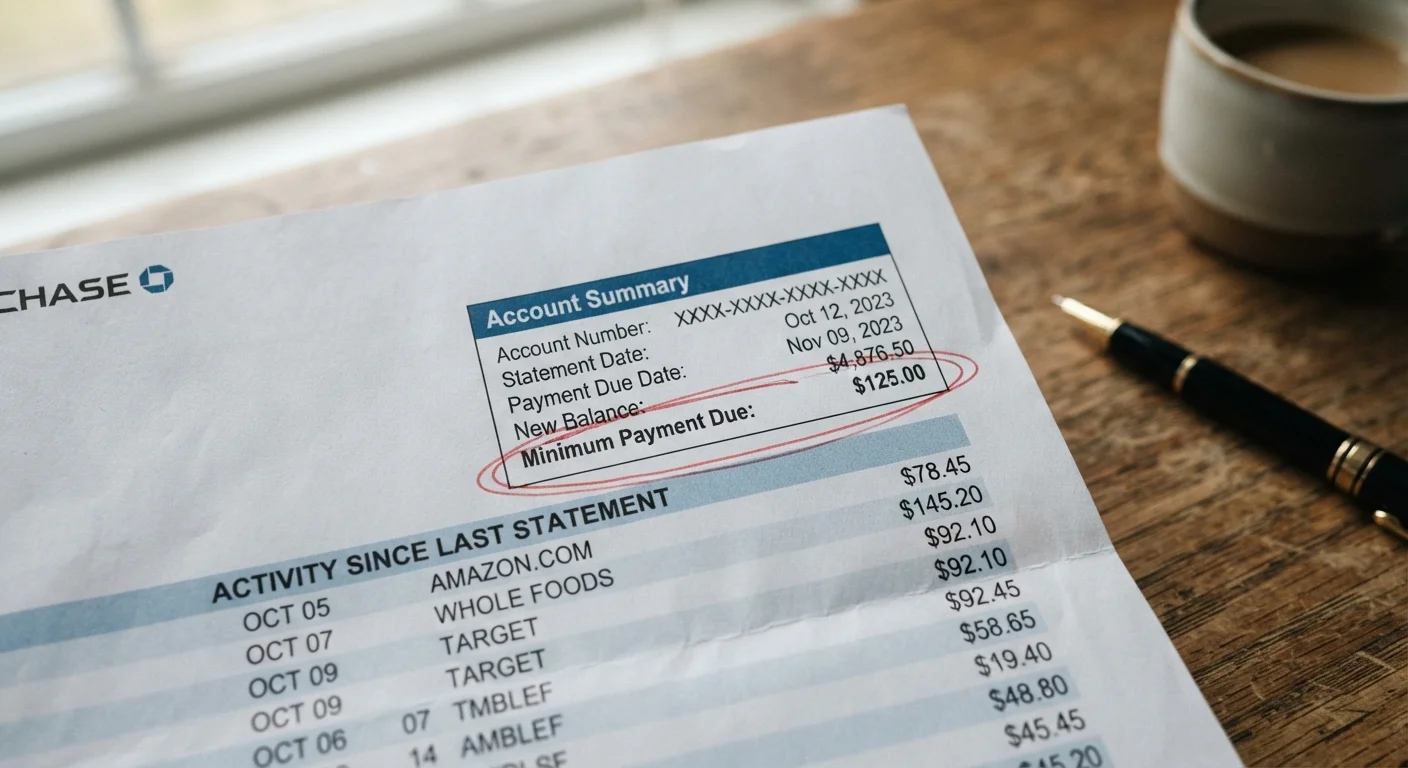
Credit card issuers are required by federal law (under the Credit CARD Act of 2009) to print a minimum payment warning on each statement. This disclosure shows how long repayment takes if only the minimum is paid, and what a three-year payoff payment would look like. Many cardholders overlook or misread this box - but it's one of the most useful numbers on the statement.
Understanding how credit products work is part of a larger picture. Our credit fundamentals hub covers how credit scores, reports, and credit products interact for everyday consumers. And if you've heard that carrying a small balance improves your credit score, that's worth fact-checking - see widely believed credit score myths.
The Minimum Payment Warning on Your Statement
Federal law requires credit card issuers to include a minimum payment warning on every statement. This disclosure tells you how long it will take to pay off your balance making only minimum payments, and what monthly payment would clear the balance in three years. Reviewing this box each month gives you a concrete reference point for deciding how much to pay. It's one of the clearest pieces of financial information on your statement - don't scroll past it.