

Key Takeaways
Option A
Express Warranty
The written (or spoken) promise you can point to.
Best for: Buyers who want clearly documented coverage terms they can reference and enforce if a product fails.
Option B
Implied Warranty
The unwritten baseline protection the law automatically provides.
Best for: Buyers who need a legal backstop even when no formal warranty documentation was provided at purchase.
If a seller made a specific written or verbal promise about a product's performance
Express Warranty
An express warranty gives you an explicit, documented basis for a claim. Written promises are easiest to enforce; verbal promises are harder to prove but still legally valid.
If you received no formal warranty documentation but the product failed to function as expected
Implied Warranty
The implied warranty of merchantability - automatically provided under the Uniform Commercial Code in most states - gives you a legal foundation even without paperwork.
If you bought a product for a very specific purpose the seller acknowledged
Implied Warranty
The implied warranty of fitness for a particular purpose may apply when a seller knew your specific use case and steered you toward a product that proved inadequate.
If you are comparing the strength of protection across warranty types before a major purchase
Express Warranty
A detailed express warranty with clear terms - duration, covered defects, and remedy - gives you the most predictable and enforceable coverage.
What Each Warranty Type Actually Means
A warranty is a legal assurance that a product meets certain standards or that a seller will remedy a defect within defined conditions. The distinction between express and implied is fundamentally about origin: one comes from a deliberate promise; the other is created automatically by law.
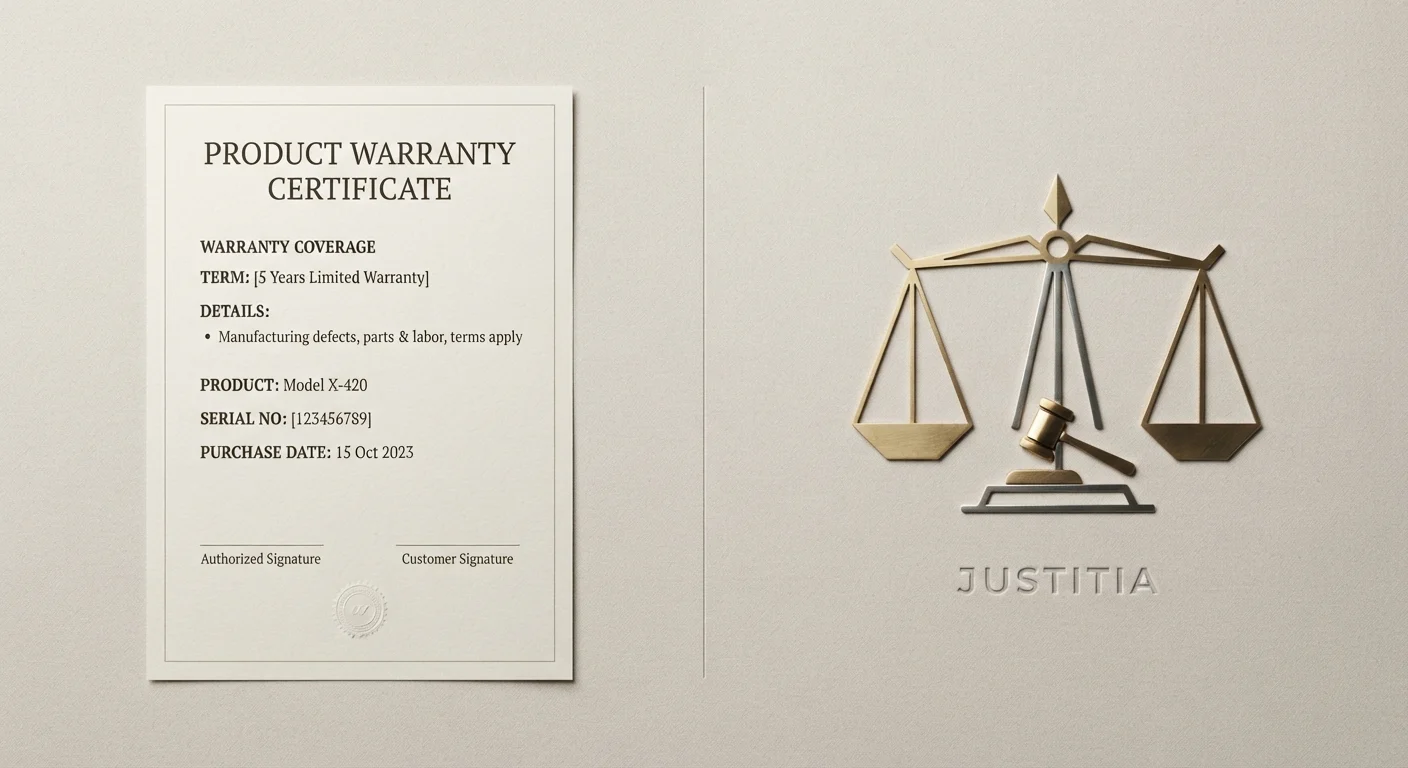
Express warranties are affirmative statements made by a seller or manufacturer about a product's quality, characteristics, or performance. Under the Uniform Commercial Code (UCC) - the model law adopted in some form by every US state - an express warranty is created any time a seller makes a factual claim or promise that becomes part of the basis of the bargain. That includes written warranty cards, packaging descriptions, product demonstrations, and even verbal assurances made during a sale. It does not include general opinion or sales puffery (e.g., "this is a great product").
Implied warranties exist without any affirmative statement. The two most significant are:
- Implied warranty of merchantability: A product must be fit for the ordinary purposes for which it is used. A blender must blend; a raincoat must resist water.
- Implied warranty of fitness for a particular purpose: When a seller knows a buyer has a specific, non-ordinary use in mind and recommends a product for that use, the product is implicitly warranted to fulfill it.
For a deeper look at the federal law governing written warranties, see Consumer Protections Under the Magnuson-Moss Warranty Act.
| Criterion | Express Warranty | Implied Warranty |
|---|---|---|
| How it's created | Explicit promise by seller or manufacturer | Automatically by operation of law |
| Written requirement | Not required; verbal claims qualify | No documentation needed |
| Common examples | Warranty card, packaging claims, ads | Product must work for ordinary use |
| Can be disclaimed | Terms can be limited if disclosed clearly | Yes, but with strict legal requirements |
| Federal law oversight | Magnuson-Moss Warranty Act applies | Magnuson-Moss limits disclaimer if express warranty exists |
| Burden of proof | Buyer must show promise was made | Buyer must show product failed ordinary use |
| Duration | Defined by the warranty's terms | Varies by state law; often tied to product's expected lifespan |
How Disclaimers and Limitations Change the Picture
Many buyers assume that once they make a purchase, all warranties apply without condition. That is not accurate - sellers have legal tools to limit or eliminate certain warranty protections, within bounds.
Disclaiming implied warranties is permitted in most states but must meet specific requirements. Under the UCC, a seller can disclaim the implied warranty of merchantability only if the disclaimer uses the word "merchantability" explicitly and, if the disclaimer is in writing, it must be conspicuous - meaning visible and clear, not buried in fine print. Phrases like "as-is" or "with all faults" can also effectively waive implied warranties if displayed conspicuously before a sale.
However, there are important limits. The Magnuson-Moss Warranty Act restricts a seller's ability to disclaim implied warranties on consumer products when a written express warranty has already been offered. In that case, implied warranties can be limited in duration but not eliminated entirely.
50
US states with UCC implied warranty protections
The Uniform Commercial Code, which establishes implied warranty rules, has been adopted in some form by all 50 US states, though details vary by jurisdiction.
"As-Is"
Common disclaimer language courts scrutinize
Courts have consistently required that "as-is" or similar disclaimer language be displayed conspicuously before purchase to be legally effective under the UCC.
Express warranty limitations - such as capping coverage to replacement parts only, or excluding labor costs - are generally enforceable if clearly stated. Courts have struck down limitations deemed unconscionable or buried so thoroughly that a reasonable buyer would not notice them.
If you have encountered warranty terms that seem designed to obscure your rights, Warranty Myths That Leave Shoppers Without Recourse addresses common misconceptions that can cost consumers their legitimate claims.
Putting Your Warranty Rights Into Practice
Understanding warranty theory matters little if you cannot act on it when a product fails. A few practical principles apply regardless of which type of warranty you are invoking.
Document everything from the start
Keep receipts, packaging, written warranty cards, and records of any verbal promises (note dates, names, and specifics). Express warranties are only as useful as your ability to demonstrate what was promised.
Read limitation clauses before you need them
Many warranty disputes hinge on duration limits or exclusions (e.g., normal wear-and-tear carve-outs). Knowing these terms before a product fails tells you whether you have a viable claim without wasting time.
Make your claim in writing
Whether invoking an express or implied warranty, submit your complaint in writing - email creates a timestamped record. State the defect, the remedy you expect, and a reasonable response deadline.
Know when to escalate
If a seller refuses a legitimate warranty claim, your options include filing a complaint with your state attorney general's consumer protection office, disputing through the Consumer Financial Protection Bureau if a credit card was used, or - for larger amounts - consulting a consumer protection attorney. Many states have "lemon laws" that provide additional remedies for qualifying products like motor vehicles.
If you are weighing additional coverage beyond a manufacturer's warranty, Extended Service Plans vs. Manufacturer Warranties explains where factory coverage ends and service contracts begin.
For a broader foundation, Understanding Consumer Rights as a Complete Beginner covers the full range of protections available to US shoppers.
State Law Variations Matter
Implied warranty rules are primarily governed by state law, and protections differ meaningfully across jurisdictions. Some states, such as California, provide stronger implied warranty protections that cannot be waived even in private sales. Always verify how your state's laws apply to your specific situation. A state attorney general's consumer protection office is a good starting point for free guidance.