

Key Takeaways
Our Verdict
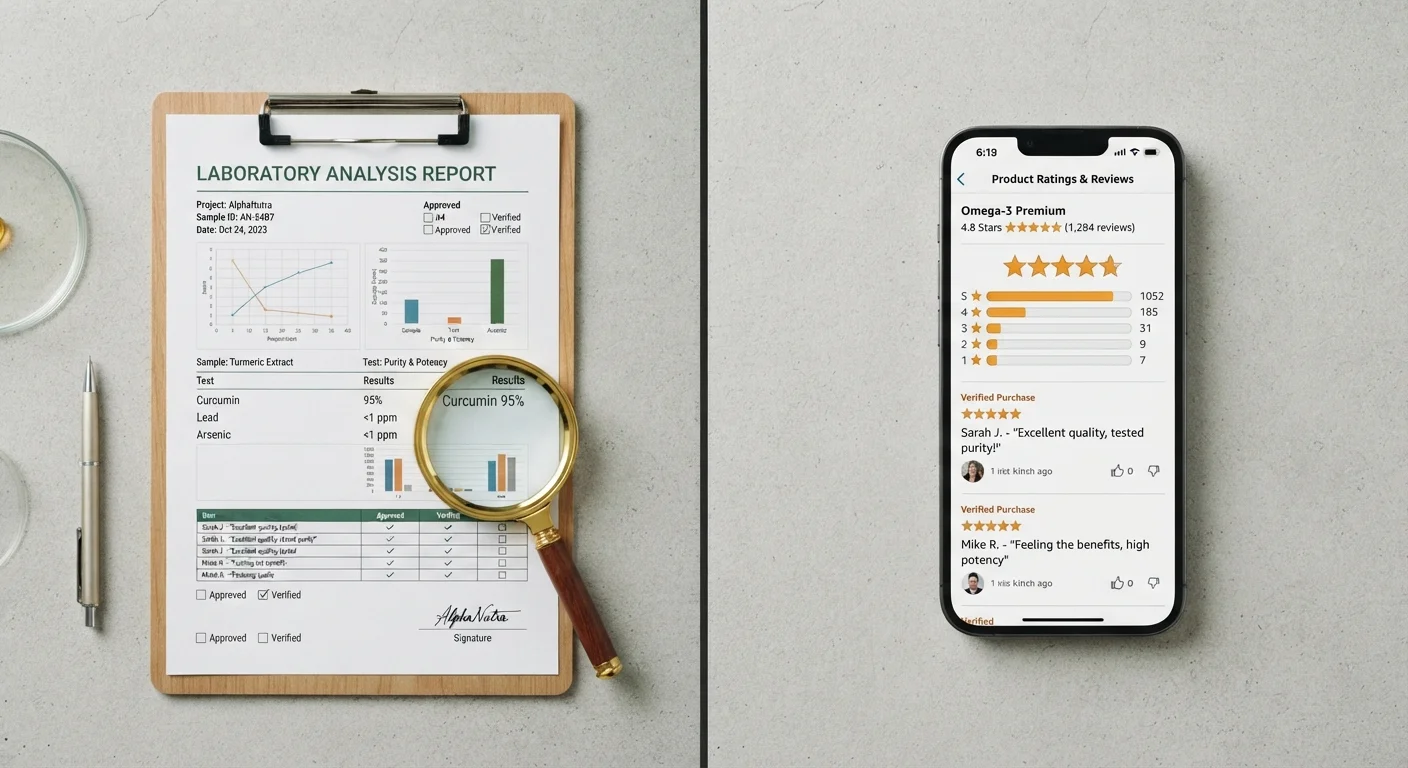
Expert testing and crowdsourced opinions are complementary tools, not competing ones. Lab results settle performance questions that require controlled measurement; user reviews surface the lived experience that no test bench can replicate. Defaulting to one source alone means accepting a blind spot that the other fills.
| Best for | Recommended |
|---|---|
| Evaluating safety, measured performance, or technical specifications | Expert Testing |
| Understanding long-term durability, comfort, and real ownership satisfaction | Crowdsourced Opinions |
| High-stakes purchases where both performance and daily usability matter | Both Sources Combined |
| Niche or specialized products with small user bases | Expert Testing |
Why the Two Sources Answer Different Questions
When you're researching a product, you're rarely asking just one question. You might want to know whether a vacuum's suction holds up over time, whether its filter actually captures fine particles, and whether it's annoying to empty at 7 a.m. Expert testing and crowdsourced opinions each answer a distinct slice of that inquiry - and conflating them causes real research errors.
Expert testing applies standardized, repeatable methodology to measure things like output, efficiency, and safety under controlled conditions. A lab can tell you a car seat meets federal impact standards or that a blender's motor reaches a specified RPM. These are facts that individual owners are poorly positioned to verify on their own.
Crowdsourced opinions, by contrast, aggregate what happens when thousands of real people use a product in the messy conditions of actual life. No lab can simulate three years of daily use, a household with pets, or a user who reads assembly instructions differently than intended. That gap is exactly where user reviews earn their value.
For a deeper look at what makes any review source trustworthy in the first place, see The Anatomy of a Trustworthy Product Review.
Where Expert Testing Has the Edge
Lean on expert testing when the quality you care about is objective, measurable, and consequential enough that getting it wrong carries real cost.
- Safety-rated categories: Car seats, helmets, smoke detectors, and electrical appliances all carry performance standards enforced by independent bodies. Expert testing - from organizations like NHTSA, UL, or ASTM-accredited labs - verifies compliance in ways no volume of Amazon reviews can match.
- Technical claims you can't verify personally: A mattress manufacturer might claim a specific firmness rating or a speaker brand might specify frequency response. These are measurable with the right equipment; a user on a forum cannot confirm them, but a calibrated reviewer can.
- Short-ownership products: If users rarely keep a product long enough to observe failure modes, reviews skew optimistically. Expert accelerated-wear testing can expose weaknesses that only surface after 18 months of use.
The caveat: expert testing is only as credible as the organization conducting it. Manufacturer-funded tests and truly independent ones are not equivalent. Manufacturer Claims vs. Independent Testing covers this distinction in detail.
| Expert Testing | Crowdsourced Opinions | |
|---|---|---|
| Best for | Objective, measurable performance | Subjective, real-world experience |
| Reliability on safety claims | High (when truly independent) | Low - users can't verify specs |
| Long-term durability signal | Limited unless accelerated testing used | Strong with large, time-filtered review pools |
| Use-case specificity | Generalist - standardized conditions | High - filter by reviewer context |
| Risk of bias | Manufacturer-funded tests skew positive | Fake or incentivized reviews distort scores |
| Best applied when | Stakes are high and specs are verifiable | Comfort, fit, or daily usability matters most |
Where Crowdsourced Opinions Tell You More
User reviews have a structural advantage in categories where subjective experience, long-term behavior, and edge-case performance matter most.
- Comfort and ergonomics: No lab test captures whether a running shoe causes hot spots after mile eight or whether a keyboard feels right after a four-hour session. These are inherently experiential and only emerge from aggregated user reports.
- Long-term reliability signals: A large review pool - especially one with time-filtered reviews showing a drop-off in satisfaction after six months - is a meaningful early warning system that controlled testing rarely provides.
- Fit for specific use cases: Reviews from users who share your context (apartment dweller, pet owner, frequent traveler) are more predictive of your experience than a generalist lab assessment. Knowing how to filter for those signals matters. The Upsides and Blind Spots of Relying on Online Communities explains how to extract genuine signal from forum noise.
Filter Reviews by Recency and Use Case
When reading user reviews, sort by most recent rather than most helpful - products change after initial launch, and older reviews may not reflect the current version. Also look for reviewers who describe a situation similar to yours: same household type, same intended use, same competing priorities. Aggregate sentiment from a mismatched audience is less predictive than a smaller set of directly relevant opinions.
One important filter: review volume and distribution matter as much as the average star rating. Reading Between the Lines: What Star Ratings Actually Tell You breaks down how to read the histogram, not just the headline number.
Building a Research Strategy That Uses Both
The practical approach is sequential and question-driven rather than picking a single source and committing to it.
- Start with the objective question: Does this product meet the technical or safety standard I need? Use expert testing to answer it. If it fails here, user reviews are irrelevant.
- Layer in the experiential question: Does it hold up in the conditions I'll actually use it in? Shift to crowdsourced opinions, filtered by reviewers whose circumstances resemble yours.
- Cross-check anomalies: If expert testing rates something highly but user reviews trend negative at scale, investigate why. The explanation - a design change after the lab test, a specific use-case mismatch - is usually findable and always informative.
For categories where you can't evaluate a product firsthand, combining both sources becomes especially important. Evaluating a Product You Can't Try Before Buying outlines additional strategies for closing that gap before you commit.
Neither source is a shortcut. Both require reading critically rather than scanning for a number. The upside is that used together - with awareness of their respective blind spots - they give you a far more complete picture than either delivers alone.