

Key Takeaways
Why Travel Money Needs Its Own Plan
International travel introduces financial variables that don't exist in daily life at home: fluctuating exchange rates, foreign transaction fees, cash dependency in certain destinations, and spending patterns that diverge sharply from your normal routine. A household budget covers recurring, predictable costs - travel finance is a temporary, compressed spending environment where decisions happen fast and mistakes are harder to reverse. See how these two planning contexts differ in our guide to long-term household budgeting.
The core problem most travelers encounter isn't overspending on big purchases - it's the accumulation of small, untracked costs: taxi fares paid in cash, a round of drinks converted at a poor rate, museum entry fees not factored into the daily estimate. These gaps add up quickly. A deliberate money management plan addresses them systematically before they become a problem.
Start Your Budget with Fixed Costs First
Lock in your non-negotiable expenses - flights, accommodation, and pre-paid tours - before estimating daily variable spending. This gives you an accurate baseline and clarifies how much budget flexibility you actually have. Attempting to estimate variable costs first often leads to underestimating fixed commitments.
Building a Pre-Trip Travel Budget
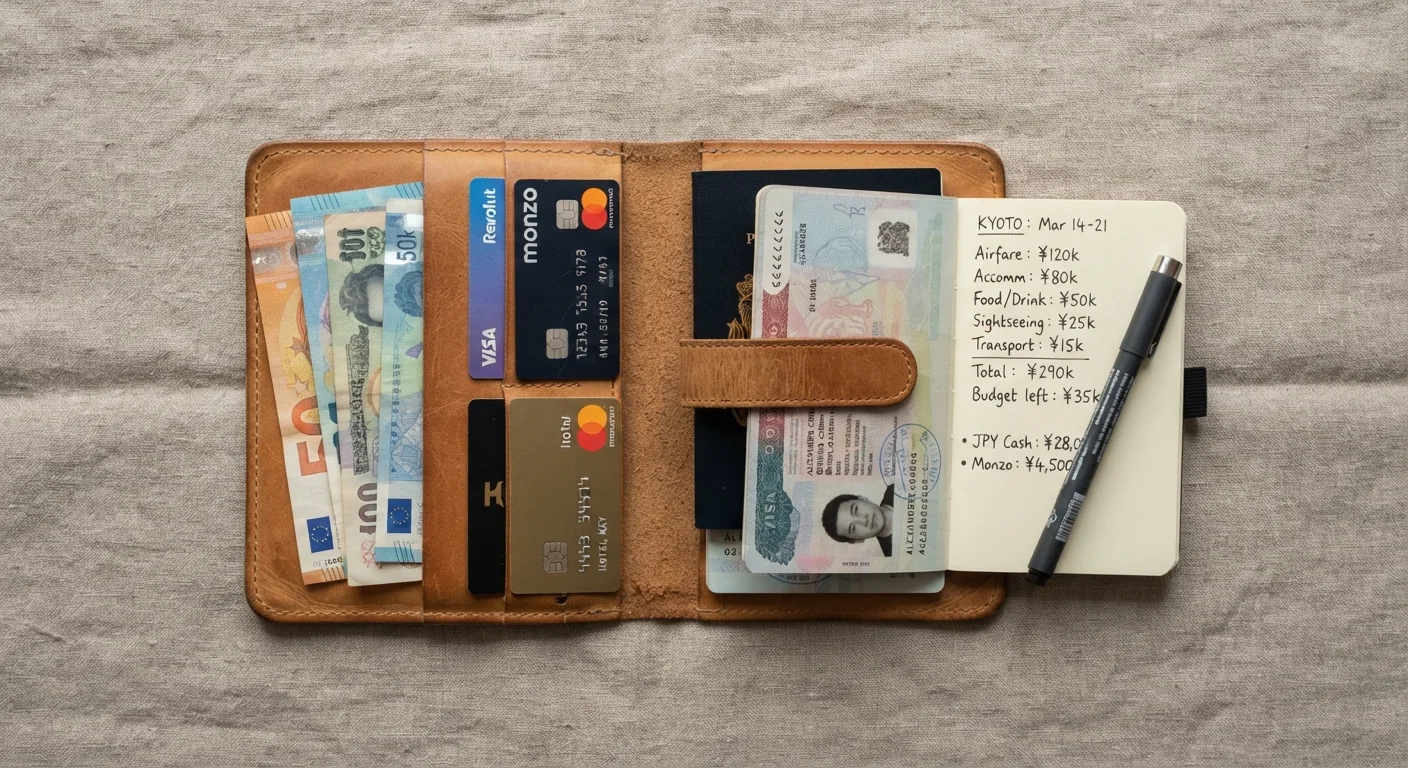
A realistic travel budget starts with research, not guesswork. Break projected spending into fixed costs (flights, accommodation, pre-booked tours) and variable daily costs (food, transport, activities, incidentals). Fixed costs are relatively easy to pin down; daily variable costs require destination-specific research.
Use publicly available resources - government tourism boards, traveler forums, and currency converter tools - to estimate realistic daily spending for your destination. Cost of living varies enormously: a comfortable daily budget in parts of Southeast Asia looks nothing like one in Scandinavia. Factor in your travel style honestly.
A useful formula: estimated daily spend × number of days + fixed costs + 10-15% contingency buffer. That buffer is not optional. It absorbs currency fluctuations, unplanned medical costs, missed connections, and other surprises. For guidance on building the broader trip structure around this budget, see the anatomy of a well-planned trip.
1-3%
Typical foreign transaction fee per card purchase
Standard credit and debit cards commonly charge 1-3% on each international transaction; fee-free cards exist but require advance research.
10-15%
Recommended contingency buffer above trip budget
Financial planners and travel advisors commonly suggest a 10-15% buffer to absorb currency swings, medical costs, and unplanned expenses.
Choosing How to Access and Spend Money Abroad
Most international travelers use a combination of payment methods: debit or credit cards for larger purchases and withdrawals, and local cash for smaller transactions, markets, and places that don't accept cards. The right mix depends on your destination, trip length, and risk tolerance.
Credit and debit cards with no foreign transaction fees are widely recommended for international use, but not all cards are equal. Foreign transaction fees typically range from 1-3% per transaction on standard cards. ATM withdrawal fees - both from your home bank and the foreign ATM operator - can add up over a multi-week trip. Review your card's fee schedule before departure.
Cash remains essential in many destinations, particularly outside major cities or in markets and transit systems. Withdraw cash from ATMs in-country rather than exchanging at airport kiosks, which typically offer less favorable rates. Avoid dynamic currency conversion (DCC) - where a merchant or ATM offers to charge you in your home currency rather than the local one - as this almost always results in a worse exchange rate.
For a thorough breakdown of strategies that minimize fees and confusion, see our article on spending money overseas.
Before departure, call your bank to confirm your daily ATM withdrawal limit for international transactions and request a temporary increase if needed - adjusting it abroad is far harder.
Daily withdrawal caps are set conservatively and can leave travelers short of cash at critical moments, especially in cash-heavy destinations with limited ATM access.
Always decline the 'pay in your home currency' option at foreign ATMs and card terminals - this is dynamic currency conversion, and the rate offered is almost always less favorable than your card's standard rate.
DCC is a merchant revenue tool, not a convenience feature. Studies and consumer finance sources consistently show that DCC rates include a significant markup over the interbank rate.
Tracking Spending While You Travel
The most common reason travel budgets collapse mid-trip is not a single large purchase - it's the failure to track small daily spending until the deficit becomes undeniable. Even a basic tracking habit prevents this. Options range from a pocket notebook updated each evening, to a shared spreadsheet, to a budgeting app with manual entry.
The method matters less than the consistency. Pick an approach you'll actually use under travel conditions - tired, possibly in a different time zone, and with limited phone battery. Many travelers find a brief nightly review sufficient: total the day's spend, compare to the daily budget, and note any category that ran over.
Common mid-trip budget traps include underestimating transport between cities, upgrading accommodation impulsively, and treating souvenir spending as outside the budget. Identifying these patterns early allows course correction. For more on tracking methods that hold up in practice, see approaches to tracking every dollar.
Managing Emergencies and Unexpected Costs
Financial emergencies abroad fall into a few predictable categories: medical expenses, theft or loss of funds, trip interruption costs, and document replacement fees. Each warrants a specific preparation step before you leave.
Travel insurance is general financial protection, not a guarantee of reimbursement - coverage varies significantly by policy. Read the policy document carefully before purchasing and understand what is and isn't covered, including pre-existing medical conditions, adventure activities, and cancellation triggers. This is general guidance only; consult the actual policy terms and a licensed insurance professional for decisions specific to your situation.
Carry a backup payment method - a second card from a different network stored separately from your primary wallet. Inform your bank of your travel dates to avoid fraud-triggered card blocks. Keep a small emergency cash reserve (in local currency or USD, depending on destination) separate from your main wallet. If you're carrying important financial documents, the same principles that apply to keeping your passport secure apply here - see our guide on keeping travel documents secure.
Post-Trip Financial Reconciliation
Returning home with an accurate picture of what you actually spent is more useful than it might seem. Reconciling your travel expenses - comparing actual spend to your pre-trip budget, category by category - reveals where your estimates were accurate and where they consistently missed.
Review all card statements once charges have settled (foreign transactions sometimes post with a delay). Convert all foreign currency amounts to USD at the approximate rate you paid, not today's rate, for an accurate picture. Note which categories ran over and why.
This reconciliation becomes the foundation for your next trip's budget. Travelers who skip it tend to repeat the same underestimates. Store your notes alongside your trip planning documents so the data is available next time. For a broader framework that incorporates financial planning into the full trip planning cycle, see the complete framework for planning any type of trip.
This article is for general informational purposes only and does not constitute personalized financial or legal advice. Fees, exchange rates, and insurance terms vary by provider and change over time - verify current terms directly with your bank, card issuer, and insurer before traveling.