

Key Takeaways
MSRP, Invoice Price, and Market Value
When buying a new car, you'll encounter at least three distinct prices: the MSRP (Manufacturer's Suggested Retail Price) printed on the window sticker, the dealer invoice price representing what the dealer paid the manufacturer, and the market value - what similar vehicles are actually selling for in your area. These numbers often diverge significantly, and understanding why matters when it comes time to negotiate.
Dealer invoice price does not represent the dealer's true cost; holdbacks, incentive programs, and manufacturer-to-dealer payments can reduce net cost below the invoice figure.
The Window Sticker: What MSRP Actually Represents
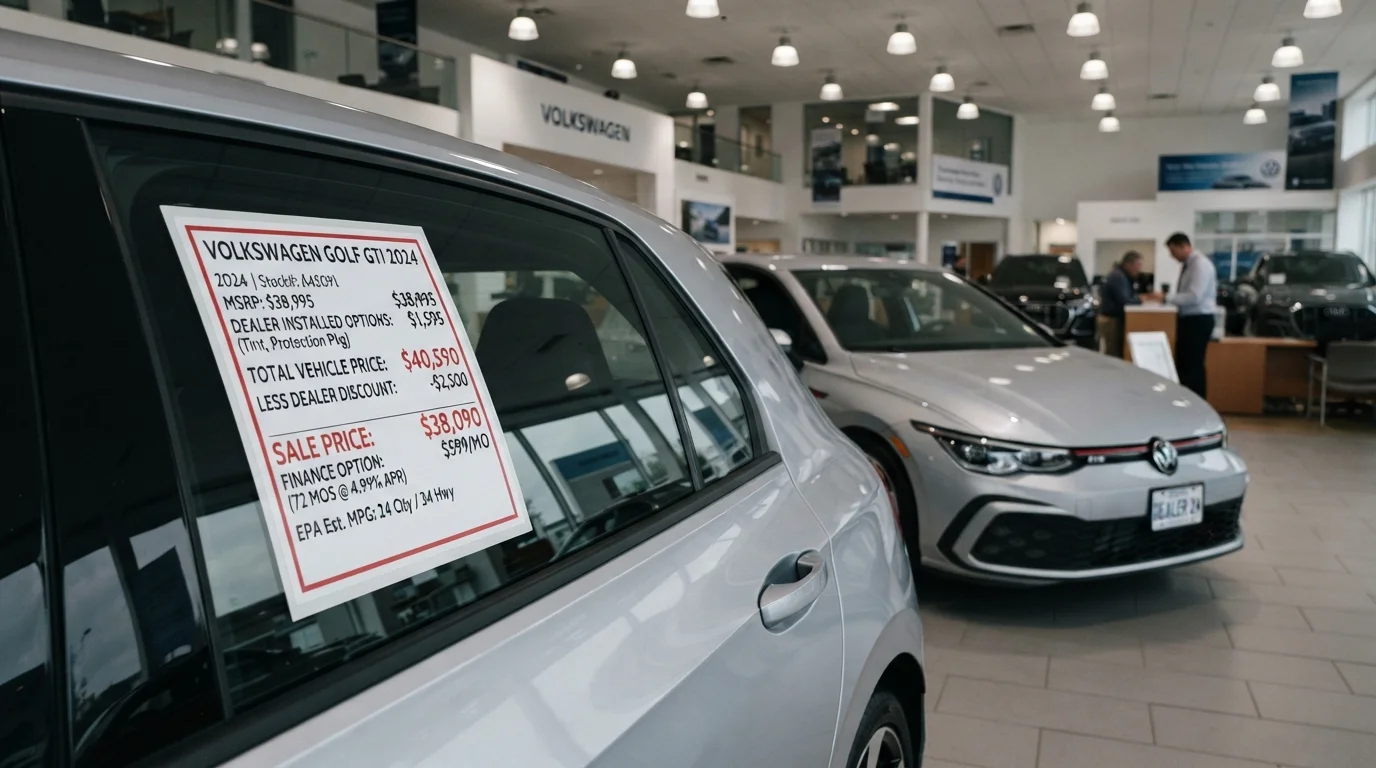
The Monroney sticker - the price label affixed to every new vehicle's window - is required by federal law and displays the Manufacturer's Suggested Retail Price (MSRP). The word "suggested" carries real weight: it is the manufacturer's recommended selling price, not a ceiling or a floor. Dealers are free to sell above or below it depending on market conditions and negotiation.
The MSRP shown covers the base vehicle, any factory-installed options and packages, and the destination charge. What it does not include are dealer-added accessories, documentation fees, taxes, and registration costs - all of which can meaningfully increase the final price. Treating MSRP as the total cost leads to sticker shock at the finance desk.
MSRP is most useful as a standardized comparison tool. It lets you compare two trim levels of the same model or evaluate whether a dealer's asking price is reasonable relative to the manufacturer's intended pricing. Just don't mistake it for the price you'll actually pay.
Check the Full Sticker, Not Just the Total
The Monroney sticker breaks out the base price, individual option packages, and the destination charge separately. Reviewing each line helps you identify options you may not want - and gives you a clearer view of where the MSRP figure comes from before you walk into any negotiation.
Dealer Invoice Price: A Reference Point, Not a Cost Floor
The dealer invoice price is what the dealership paid the manufacturer for the vehicle. For decades, consumers treated invoice as the magic number - a figure that revealed the dealer's true cost and anchored tough negotiations. That framing is incomplete.
Manufacturers routinely pay dealers additional compensation beyond the transaction. Holdbacks - typically one to three percent of MSRP - are returned to the dealer quarterly as a cash reserve. Manufacturer-to-dealer incentives, volume bonuses, and regional ad fund contributions further lower a dealer's effective cost below the invoice line. This is analogous to how retailers receive promotional allowances from suppliers, a dynamic explained well in the context of retail pricing and supplier margins.
Still, invoice price is a useful reference. Knowing it tells you whether a dealer's initial offer is anchored near cost or far above it. It establishes a realistic negotiating range, even if it does not represent the dealer's absolute floor.
1-3%
Typical dealer holdback as share of MSRP
Holdback percentages vary by manufacturer but commonly fall in this range, representing additional dealer compensation beyond the invoice transaction.
$48,000+
Average new vehicle transaction price in the US
Industry tracking data from automotive research organizations has placed average US new vehicle transaction prices above $48,000 in recent model years, reflecting a significant rise from historical norms.
~5-8%
Typical gap between invoice and MSRP
On many mainstream vehicles, the invoice price sits roughly 5-8% below MSRP, though this spread varies considerably by segment, brand, and model.
Market Value: What the Car Is Actually Selling For
Market value - sometimes called the average transaction price - is the figure grounded in reality. It reflects what buyers in a specific region are actually paying for a particular trim, not what a manufacturer suggests or what a dealer paid. This number fluctuates based on local inventory levels, consumer demand, fuel price trends, and economic conditions.
When supply tightens - as it did during the semiconductor shortage that affected production starting around 2021 - market values on many models shot above MSRP. When inventory builds, transaction prices often fall below MSRP. Tracking current market value for the exact vehicle you want is one of the most actionable pieces of research you can do before entering a dealership.
Several independent automotive research platforms compile real transaction data that reflects regional market conditions. Comparing that data with the dealer's asking price tells you immediately whether the offer is above or below what comparable buyers are paying nearby. This is the same logic behind checking recent price history before any major purchase - context always matters more than a single data point.
Putting All Three Numbers to Work
Used together, MSRP, invoice, and market value form a coherent picture of a vehicle's pricing landscape. Start with MSRP to understand manufacturer intent and to compare trims. Check invoice to gauge how much room likely exists between the dealer's cost and the asking price. Then anchor your research in current market value - the number closest to what you should actually expect to pay.
When evaluating a dealer's offer, look at what the asking price is relative to all three. A price near MSRP on a vehicle with average inventory may suggest room to negotiate. A price near or above MSRP on a vehicle with low regional stock may reflect genuine market dynamics, not dealer opportunism.
If you're bringing a trade-in to the table, keep that negotiation separate. Bundling a trade into a price discussion can obscure how individual numbers are moving. Separating the trade-in from the purchase negotiation is a widely recommended approach that gives you clearer visibility into both deals. And once you've agreed on a vehicle price, comparing coverage options is the next step - understanding what auto insurance quote numbers actually mean helps you evaluate that part of the total cost with equal clarity.