

Key Takeaways
Vehicle Electrical Starting System
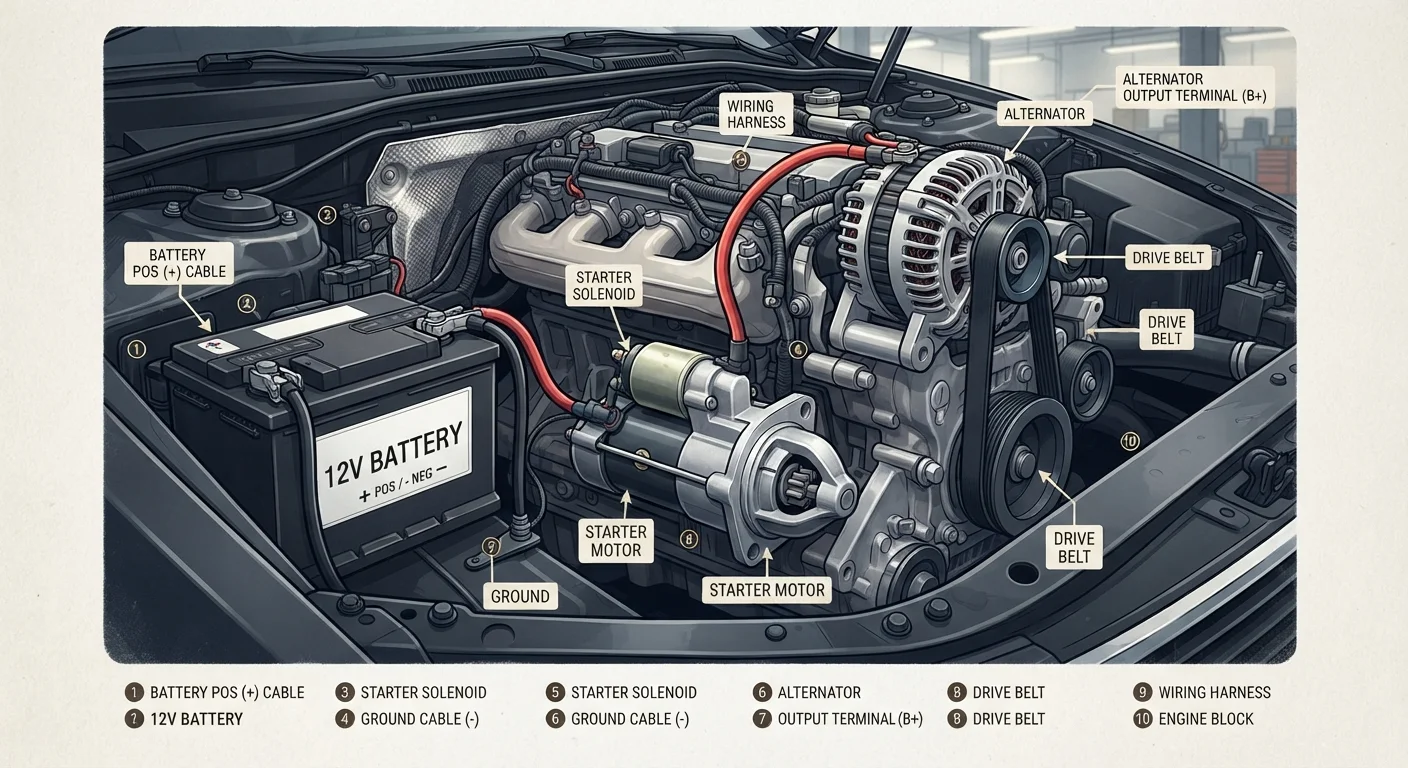
A car's starting system is made up of three interdependent components: the battery, the alternator, and the starter motor. The battery stores electrical energy to crank the engine. The starter motor converts that energy into mechanical force to turn the engine over. The alternator then recharges the battery while the engine runs and powers all electrical accessories.
Because these components work in sequence, a failure in any one of them can mimic the symptoms of a failure in another - making accurate diagnosis a matter of testing each component individually rather than assuming.
The Three-Component Chain and Why Diagnosis Is Tricky
When a car refuses to start, most drivers instinctively blame the battery. That instinct is reasonable - the battery is the most frequently replaced electrical component - but it leads to misdiagnosis often enough to warrant a closer look at how the full system works.
The battery, alternator, and starter function as a chain. The battery delivers the burst of current needed to activate the starter motor. The starter engages a gear against the engine's flywheel, physically turning the engine until combustion begins. Once running, the alternator - driven by a belt connected to the engine - generates electricity to recharge the battery and run every powered system in the car.
A break anywhere in that chain produces a no-start condition. Because the symptoms overlap, testing one component at a time is the only reliable path to the right answer.
Why Symptoms Can Overlap
A severely discharged battery can make the starter sound sluggish, mimicking a starter fault. A failing alternator can drain the battery until symptoms resemble a dead battery. This overlap is why mechanics test each component independently rather than relying on symptoms alone. Skip one test and you risk replacing the wrong part.
Reading the Symptoms: What Each Failure Sounds Like
Sound - or the absence of it - is a mechanic's first diagnostic tool.
- Rapid clicking when the key is turned typically points to a weak or dead battery. The starter solenoid is chattering because it isn't receiving enough current to engage fully.
- A single heavy click with nothing following can indicate a starter relay or solenoid fault, or a severely discharged battery.
- Complete silence with all dash lights on often points to the starter itself - the battery has power, but the signal isn't reaching or activating the motor.
- A grinding or whirring noise without the engine catching suggests the starter's drive gear is worn or not engaging the flywheel properly.
- The engine cranks slowly and weakly but doesn't start - this is classic low battery voltage, though a failing starter drawing excessive current can produce the same effect.
An alternator failure rarely prevents the car from starting initially. Instead, the battery drains gradually. Warning signs include a battery warning light on the dashboard, dimming headlights at idle, and accessories behaving erratically before the car eventually won't start at all.
3-5 years
Typical car battery lifespan
Battery manufacturers and automotive industry sources generally cite this range under normal driving and climate conditions.
~38%
Share of no-start calls attributed to battery failure
Roadside assistance data from AAA has historically identified battery-related issues as the leading single cause of service calls in the U.S.
13.5-14.5V
Healthy alternator output at idle
This voltage range is the standard benchmark used by mechanics and automotive engineers to confirm a charging system is functioning within specification.
How Mechanics Confirm the Diagnosis
Visual checks come first. Corroded battery terminals - white or blue-green buildup around the posts - can mimic a dead battery by blocking current flow. Cleaning terminals sometimes restores full function without any part replacement.
From there, the standard tests are:
- Resting voltage test: A multimeter placed across battery terminals should read approximately 12.6 volts on a fully charged battery. Below 12.0 volts indicates significant discharge or a failing cell.
- Load test: A battery load tester applies a controlled draw to the battery and measures how well it holds voltage under stress. This is more informative than resting voltage alone and is offered free at many auto parts stores.
- Charging system test: With the engine running, voltage at the battery terminals should rise to roughly 13.5-14.5 volts as the alternator charges the system. A reading below 13 volts at idle suggests the alternator is underperforming.
- Starter current draw test: A clamp-style ammeter measures how much current the starter pulls during cranking. Excessive draw indicates internal wear; too little can point to a wiring or connection issue.
When the evidence points to a starter or alternator replacement, it's worth consulting a qualified mechanic, particularly since accessing these components often requires removing other engine parts. See our guide on DIY vs. professional repairs for a clear breakdown of where that line typically sits.
Common Misconceptions That Lead to Unnecessary Replacements
One of the most frequent and costly mistakes is replacing a battery when the real problem is the alternator. If the alternator isn't charging, a brand-new battery will drain within days - and the driver ends up back at the parts store, confused and out of pocket.
Another misconception: a successful jump-start clears the battery of suspicion. It doesn't. A jump-start supplies external current to get the engine running. If the alternator is healthy, it will then recharge the battery normally. But if the battery has a failed internal cell, it may not hold that charge - and the alternator will struggle to compensate.
Starter problems are perhaps the most under-suspected of the three. Because starters can fail intermittently - working fine one day, refusing to engage the next - drivers sometimes attribute these episodes to a "temperamental" battery. A starter that fails only when the engine is hot, for instance, is a well-documented failure pattern tied to heat expansion in worn components.
This article is for general informational and educational purposes. For diagnosis and repair of vehicle electrical systems, consult a qualified mechanic. Improper electrical work can damage vehicle systems or create safety hazards.