

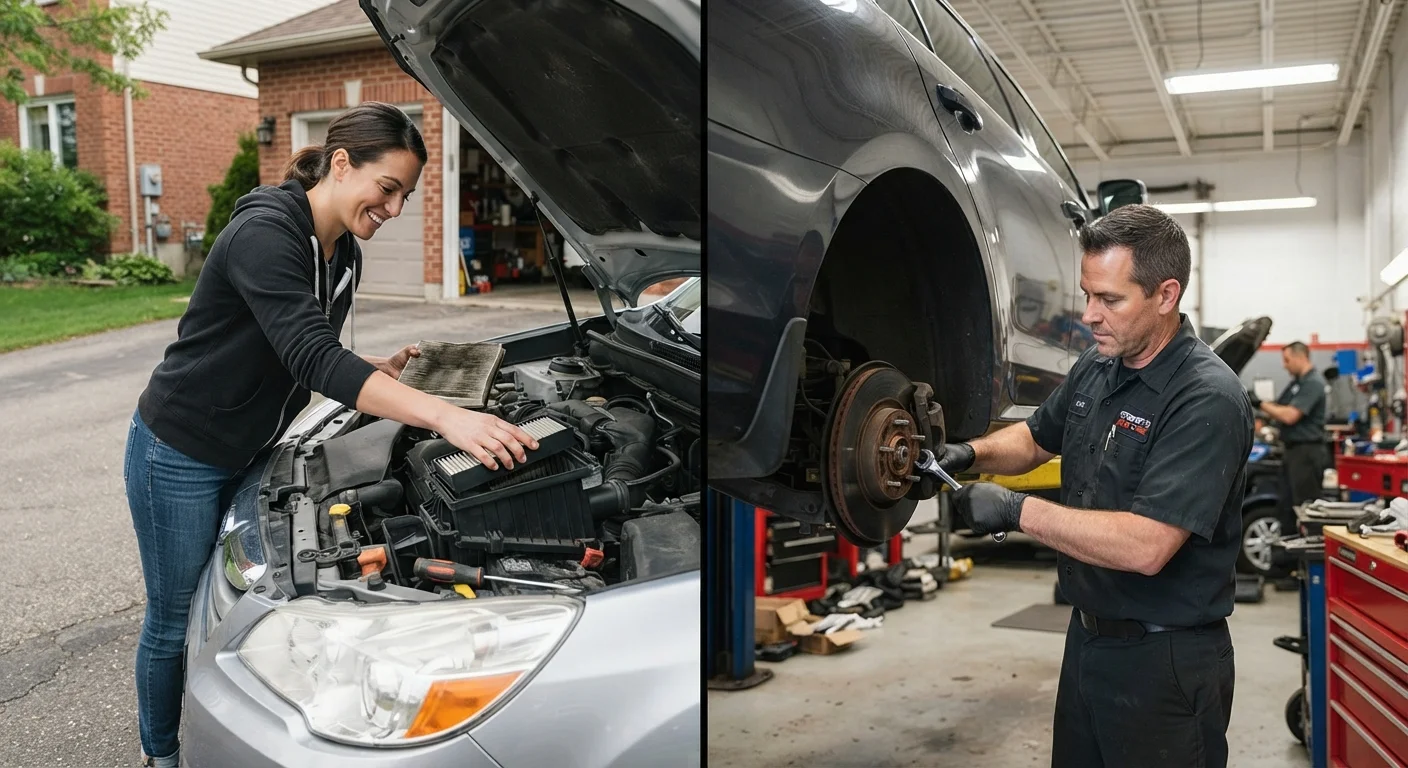
Key Takeaways
Our Verdict
DIY maintenance makes practical sense for low-risk, straightforward tasks where errors are easily corrected and tools are minimal. Professional service is the more prudent choice whenever a repair touches safety-critical systems, requires specialized equipment, or where a mistake could cause injury or compounding damage. Neither approach is universally superior - the right call depends on the specific job, your skill level, and what's at stake if something goes wrong.
| Best for | Recommended |
|---|---|
| Drivers comfortable with basic tools seeking to reduce routine maintenance costs | DIY |
| Safety-critical systems such as brakes, steering, and suspension | Professional Shop |
| Newer vehicles still under manufacturer warranty | Professional Shop |
| Quick, low-stakes tasks like replacing wiper blades or cabin air filters | DIY |
Why the DIY vs. Shop Question Matters
Labor costs account for a significant portion of most repair bills, so the appeal of handling maintenance yourself is understandable. But the decision isn't purely financial. Some tasks are genuinely straightforward - designed by engineers to be owner-serviceable. Others involve systems where an error creates a safety hazard, not just an inconvenience.
The goal here isn't to push you toward or away from the garage. It's to give you a clear, honest picture of where the dividing line sits, so you can make the call with confidence rather than guesswork. For a broader look at what your car needs across the year, see our seasonal car maintenance checklist.
Repairs That Are Generally Safe to DIY
These tasks share a common profile: they require minimal specialized tools, involve no safety-critical systems, and - crucially - a mistake is obvious and correctable before it causes harm.
- Engine air filter replacement: Accessible under the hood, typically secured by clips or screws. A wrong installation is immediately apparent.
- Cabin air filter replacement: Usually located behind the glove box. Most owner manuals walk through the steps in under a page.
- Wiper blade replacement: A straightforward snap-in process; blades and instructions come in the packaging.
- Battery terminal cleaning: Disconnecting and cleaning corroded terminals with a wire brush and baking soda solution is low-risk with proper gloves and eye protection.
- Tire inflation and rotation checks: Monitoring and topping off pressure is an easy habit. Note that rotating tires requires safely lifting the vehicle - if you don't own a quality floor jack and jack stands rated for your vehicle's weight, this task moves into professional territory.
- Headlight and taillight bulb replacement: On many vehicles this is owner-serviceable, though some modern designs require partial disassembly - check your manual first.
Always Start With Your Owner's Manual
Your owner's manual is the most authoritative source for your specific vehicle - not a generic online tutorial. It lists correct fluid specifications, filter part numbers, torque values, and flags which tasks require dealer service. If you've misplaced the physical copy, most manufacturers make digital versions available through their websites.
Even for DIY-friendly tasks, always cross-reference your owner's manual. Part numbers, torque specifications, and access procedures vary significantly between makes and models.
Repairs That Belong in a Professional Shop
The following repairs involve systems where failure doesn't just strand you - it can injure you or others on the road. They also frequently require diagnostic tools, calibration equipment, or torque specifications that aren't practical for a home garage.
- Brake system work: Replacing pads is sometimes listed as a DIY task in general guides, but the full system - calipers, rotors, brake lines, ABS components - demands precision. Improperly compressed caliper pistons, unevenly torqued lug nuts, or air introduced into brake lines are not minor errors.
- Steering and suspension components: Ball joints, tie rods, and struts affect how your vehicle handles at highway speed. Many of these parts require a press tool for installation and alignment afterward.
- Fuel system repairs: Working around fuel lines, injectors, or the fuel pump involves flammable vapors and pressurized systems. This is not a task for an improvised workspace.
- Transmission and differential service: Internal tolerances are extremely tight. Fluid changes are owner-serviceable on some vehicles, but internal repairs are not.
- Airbag and electrical systems: Airbag circuits can deploy unexpectedly. Modern vehicle electronics often require manufacturer-specific scan tools to reset codes and recalibrate sensors.
DIY Repairs Can Affect Your Warranty
If your vehicle is still under a manufacturer or extended warranty, DIY repairs on covered systems may void that coverage. Review your warranty documentation or contact the dealer before proceeding with any non-trivial work. Even fluid type mismatches have been documented as grounds for claim denial.
If your vehicle is still under a manufacturer or extended warranty, DIY repairs on covered systems may void that coverage. Review your warranty documentation or contact the dealer before proceeding with any non-trivial work.
When you do take your vehicle in, knowing how to read the estimate helps you ask better questions. Our guide on reading a mechanic's estimate breaks down common line items clearly.
How to Make the Right Call on a Specific Job
Before starting any repair, run through this practical checklist:
- Consult your owner's manual first. It specifies service intervals, fluid types, and often flags which tasks are owner-serviceable versus dealer-required.
- Look up the procedure before you start, not during. Knowing what's involved - tools, steps, potential complications - before you open the hood prevents you from committing to a job you can't complete safely.
- Honestly assess your tools and workspace. A proper floor jack, jack stands, torque wrench, and a clean, level surface are baseline requirements for anything beyond the simplest tasks. A rolling floor jack rated for 1.5 tons isn't adequate for a 4,500-lb SUV.
- Factor in the cost of mistakes. On a DIY-friendly task, an error typically means buying a second part. On a brake or suspension job, it can mean a much larger repair bill - or worse.
Whatever work gets done, recording it helps over time. Our piece on keeping a maintenance log explains why that habit pays off at resale and at the next service visit.
Side-by-Side: DIY vs. Professional Shop
The table below summarizes key differences across the factors that matter most to everyday drivers choosing between the two approaches.
| DIY | Professional Shop | |
|---|---|---|
| Upfront cost | Parts cost only; tools may add expense | Parts plus labor; can be significantly higher |
| Safety risk | Low on simple tasks; high on complex repairs | Managed by trained technicians with proper equipment |
| Warranty implications | May void coverage on some systems if done incorrectly | Typically preserves warranty when using approved parts |
| Diagnostic capability | Limited without scan tools or experience | Access to OEM-level diagnostics and data |
| Time investment | Higher - research, sourcing parts, and doing the work | Lower for the owner; shop handles scheduling and labor |
| Best suited for | Filters, bulbs, wipers, fluid top-offs | Brakes, suspension, fuel system, electrical work |