

Key Takeaways
Why Estimates Feel Confusing - and Why They Don't Have To
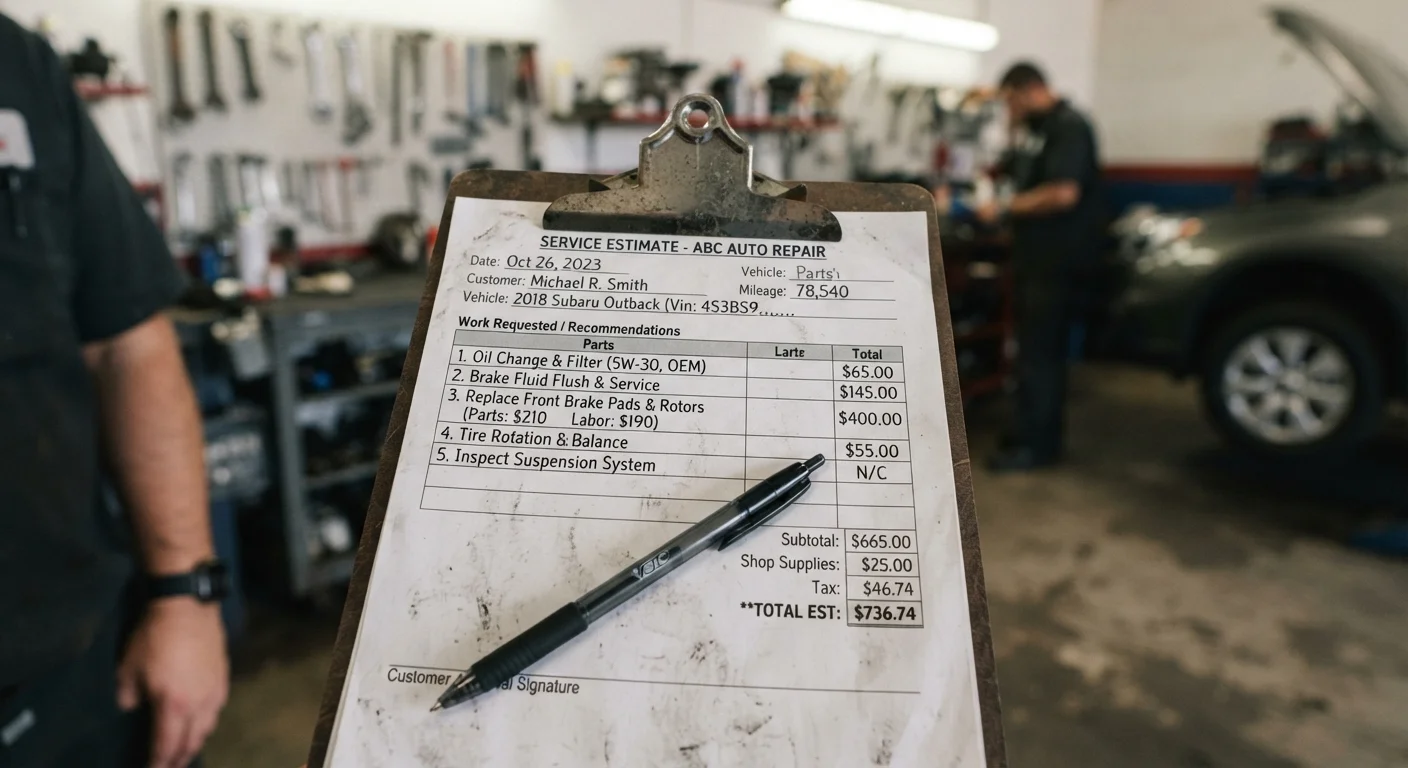
A mechanic's estimate is a formal document, and most are generated by shop management software that formats line items in ways optimized for technicians, not customers. Abbreviations, part numbers, and labor codes are all written for internal use. That gap between shop language and plain English is the primary source of confusion for most drivers.
The good news: once you understand the underlying structure, most estimates follow a predictable pattern. The same principles that apply to reading a vehicle window sticker - breaking a document into labeled segments and asking what each line means - apply here too.
What you will need
If the repair being quoted is something you're considering handling yourself, our explainer on what a modern tune-up covers can help you understand the scope of common maintenance jobs before you review estimates for them.
What to Look for Before You Sign
Authorize Work in Writing Only
Most US states require shops to get your written or verbal authorization before beginning any repair, and to provide a written estimate above a certain dollar threshold. Never allow work to start without confirming the total scope and cost in writing. Disputes are significantly harder to resolve if no written authorization exists.
Consumer protection laws around auto repair vary by state, but many US states require shops to provide a written estimate above a specific dollar threshold and to obtain your authorization before starting work. The Federal Trade Commission provides general guidance on auto repair rights, and your state's attorney general office may have specific consumer protection rules that apply in your area.
Before signing, confirm that the estimate lists a not-to-exceed total rather than an open-ended authorization. If the shop discovers additional problems during the repair, they are generally required to contact you before proceeding with unanticipated work - not just add it to the final bill.
Use the Old Parts as Proof
Ask the shop to save the removed parts so you can inspect them after the repair. Most reputable shops will comply. Seeing worn-out components firsthand confirms the work was done and can reassure you that the repair was genuinely necessary.
For more on evaluating service interactions at dealerships, see our guide on what to verify before a dealership visit, which covers documentation and authorization habits that apply to service departments as well.
Step-by-Step: Reading the Estimate
Identify the three main sections of the estimate
Nearly every shop estimate is organized into three billing categories: parts, labor, and shop fees (sometimes called miscellaneous or supplies). Parts are the physical components being installed. Labor is the technician's time, charged at the shop's hourly rate. Shop fees typically cover consumables like rags, fluids used during the job, and disposal of old materials.
Some estimates add a fourth line for sublet work - repairs the shop sends out to a specialist, such as transmission rebuilds or machine shop work. If you see this, ask which vendor will perform it.
Understand how labor hours are calculated
Shops use a flat-rate system to price labor. Published labor guides (such as those from ALLDATA or Chilton) assign a standard number of hours to each type of repair based on an average technician working on that vehicle. The shop multiplies those hours by its hourly labor rate to produce your labor charge.
This means you may be billed for 2.5 hours of labor even if the technician finishes in 1.8 hours - or takes 3. The flat-rate system is industry-standard and not inherently unfair, but understanding it helps you evaluate whether the quoted hours seem reasonable for the job described.
Clarify whether parts are OEM or aftermarket
OEM stands for Original Equipment Manufacturer - these parts come from or are equivalent to what the vehicle's manufacturer used. Aftermarket parts are made by third-party suppliers and vary considerably in quality and price. Neither category is automatically superior; the right choice depends on the component, your vehicle's age, and your budget.
Ask the service advisor which type is listed on your estimate, and whether substituting one for the other would change the price. This is a routine, reasonable question that any reputable shop should answer clearly.
Check for vague or bundled line items
Watch for line items described with generic language such as "miscellaneous parts," "shop supplies," or "inspection fee" without a dollar figure attached. These are not always illegitimate - shops do incur small consumable costs - but they should be listed with at least an approximate charge, not left open-ended.
If a line item reads "additional repairs as needed," ask the advisor to either remove it or define precisely what additional work might trigger it. Open-ended authorizations can lead to unexpected charges.
Compare the estimate against a second quote
Obtaining a second estimate is a completely normal part of the repair process. Bring or relay the same job description - including the specific fault codes if applicable - to another shop and compare the parts costs, labor hours, and hourly rate side by side rather than just the totals.
A large discrepancy in labor hours (not just hourly rate) may indicate that one shop is quoting a more thorough repair or a different approach. Ask each shop to walk you through what the labor time includes.
Confirm the warranty on parts and labor
Reputable shops generally offer a warranty on both the parts they install and the labor performed. Common warranties range from 12 months or 12,000 miles to 24 months or 24,000 miles, though this varies. Ask the service advisor to point out where the warranty terms appear on the estimate or invoice.
If a shop offers no warranty on their work, factor that into your decision. Warranty terms should be in writing - a verbal promise is difficult to enforce.
Tools That Help You Cross-Check
Written estimate from the shop
The primary document you will be reviewing and comparing line by line.
Labor time reference guide (e.g., ALLDATA or Chilton)
Allows you to cross-check standard flat-rate hours for a given repair against what the shop lists.
Parts pricing lookup (e.g., manufacturer or retailer websites)
Lets you verify whether the parts markup on your estimate is within a typical range.
You do not need technical expertise to do a basic cross-check. If the estimate lists a labor time that seems unusually high - say, 6 hours for a brake pad replacement - a quick search in a publicly accessible labor guide or a call to a second shop will tell you whether that figure is in a normal range. The goal is not to argue with the technician but to arrive at each conversation with enough context to ask an informed question.
This article is for general informational purposes only. Always consult a qualified, licensed mechanic for advice specific to your vehicle's condition.