

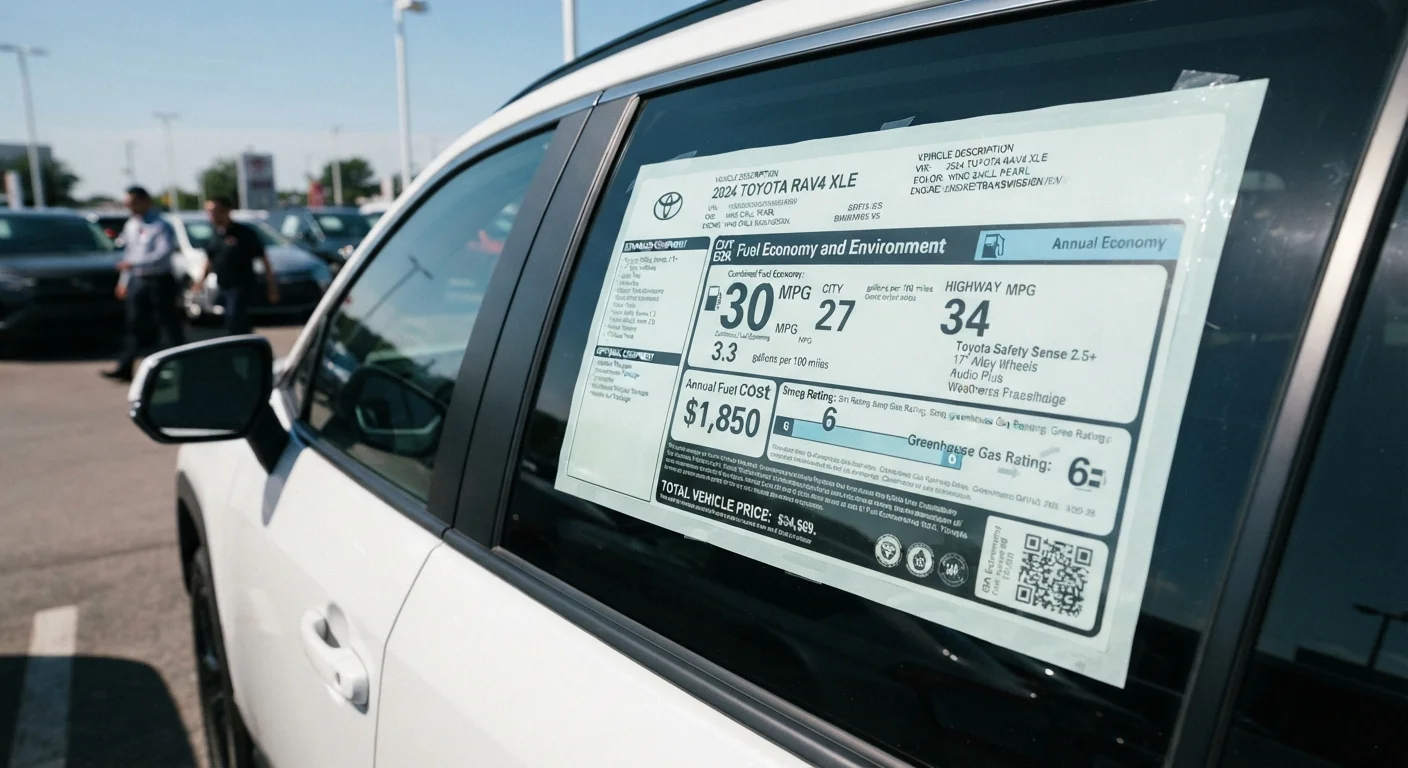
What the Monroney Label Is - and Why It Exists
The Monroney label - named after Senator Mike Monroney, who championed the 1958 Automobile Information Disclosure Act - is the federally mandated window sticker attached to every new passenger vehicle sold in the United States. Removing it before sale is a federal offense. Its purpose is straightforward: give buyers a standardized, manufacturer-provided snapshot of what a vehicle is, what it includes, and what it costs, before any negotiation begins.
Understanding each section prevents dealers from burying fees in jargon and helps you compare vehicles on equal footing. Think of it as a structured pricing document - every line has a defined meaning.
Line-by-Line Breakdown of Every Section
Vehicle Identification Block
At the top, you'll find the make, model, model year, trim level, and Vehicle Identification Number (VIN). The VIN is a 17-character code unique to that specific vehicle; it encodes the manufacturer, country of assembly, engine type, and production sequence. Cross-reference this number on the title and any vehicle history report.
Manufacturer's Suggested Retail Price (MSRP)
This is the base price for the trim level as configured, before options. It is a suggested price - dealers can sell above or below it. Do not treat MSRP as a fixed transaction price.
Standard Equipment
This section lists every feature included in the base trim at no extra charge - safety systems, infotainment, powertrain specs, seating, and convenience features. Reading it carefully prevents paying for an "upgrade" that is already standard.
Optional Equipment and Packages
Each optional item or bundle is listed with its individual price. Package names can obscure what's actually inside - look for the itemized contents, not just the package label. These add-ons are where the sticker price climbs fastest.
Destination and Delivery Charge
A federally regulated, fixed-per-model charge covering transport from the assembly plant to the dealership. It is non-negotiable and identical for every buyer of that model, regardless of dealership location. It is not a dealer markup.
Total MSRP
The sum of base MSRP, all optional equipment, and the destination charge. This is the figure most commonly advertised as the sticker price. It does not include taxes, registration, dealer documentation fees, or financing costs - those appear later in the sales contract.
MSRP
Manufacturer's Suggested Retail Price - the price the automaker recommends for the vehicle. It is a starting reference, not a legally fixed sale price.
VIN
Vehicle Identification Number - a unique 17-character alphanumeric code assigned to every motor vehicle. It encodes the manufacturer, specifications, and production details.
MPGe
Miles Per Gallon Equivalent - an EPA metric that converts the energy content of electricity (or other alternative fuels) into an MPG-comparable figure for electric and plug-in hybrid vehicles.
Destination Charge
A federally regulated, fixed fee covering transport of the vehicle from the assembly plant to the dealership. It is the same for every buyer of a given model and is not a dealer-controlled markup.
Addendum Sticker
A supplemental label placed by the dealership - not the manufacturer - listing dealer-installed accessories and their prices. Unlike the Monroney, these prices are set by the dealer.
NHTSA
National Highway Traffic Safety Administration - the federal agency that conducts crash tests and publishes star-based safety ratings for new vehicles sold in the U.S.
EPA Fuel Economy Section
Regulated by the U.S. Environmental Protection Agency, this section shows city, highway, and combined MPG (or MPGe for electrics and plug-in hybrids). The estimates reflect standardized lab test cycles; real-world results vary based on driving habits, load, climate, and road conditions. A five-year fuel cost estimate is also provided for direct comparison shopping. Electric vehicles display range in miles and energy consumption in kWh per 100 miles.
Safety Ratings
If the vehicle has been tested, federal crash test ratings from the National Highway Traffic Safety Administration (NHTSA) appear here on a one-to-five-star scale. Some stickers also reference Insurance Institute for Highway Safety (IIHS) ratings. Absence of a rating does not imply failure - the vehicle may not have been tested at time of printing.
Country-of-Origin and Parts Content
Federal law requires disclosure of where major components originate. This section lists the percentage of U.S. and Canadian parts content, the country of final assembly, and the source of the engine and transmission. This information matters for buyers prioritizing domestic manufacturing.
Using the Sticker as a Negotiation and Research Tool
The Monroney label is your baseline. Before stepping into a finance office, know your total MSRP and separate it from dealer-added accessories - items installed by the dealership, such as paint protection film or cargo mats, may appear on a supplemental sticker (sometimes called an "addendum") adjacent to the Monroney. These are dealer-priced additions, not factory items, and carry no federal pricing requirements.
Compare fuel economy figures across trims and competitors using the EPA's public fuel economy database (fueleconomy.gov), which publishes the same standardized data. If you're evaluating ownership costs beyond the purchase price, understanding repair and maintenance documentation is an equally useful skill once you've driven the vehicle off the lot.
Supplemental Stickers Are Not Federal Documents
Dealers sometimes place a second sticker - called an addendum - next to the official Monroney. It lists dealer-installed add-ons such as window tinting, floor mats, or paint sealant. Unlike the Monroney, these prices are set entirely by the dealer and are generally negotiable. Always identify which sticker is the federally required Monroney and which is the dealer's addendum before discussing price.
This article is for general informational purposes only and does not constitute financial, legal, or purchasing advice. Vehicle pricing, fees, and regulations vary. Consult applicable sources and verify details directly with the manufacturer or a qualified professional before making a purchase decision.