

Key Takeaways
Why Paper Clutter Is So Persistent
Paper accumulates because it arrives constantly, decisions about it are often deferred, and it lacks an obvious home in most households. Unlike a dish or a jacket, a piece of mail requires a judgment - keep it, act on it, or discard it - and when that judgment is skipped, the paper lands on the nearest flat surface and stays there.
The problem compounds quickly. A week of unopened mail becomes a month's worth, and a stack that once took ten minutes to sort now feels like a weekend project. This is a pattern familiar to most US households, and it tends to cluster in a few predictable spots: kitchen counters, entryway tables, home office desks, and - famously - junk drawers. If you're already working on those other zones, see how to organize the kitchen drawer for strategies that complement what you'll do here.
The solution isn't a fancy filing system or expensive organizers. It's a consistent decision-making habit applied at the moment paper enters your home. Everything in this guide builds toward that habit.
Make the Landing Zone Work Harder
Position your sorting station - a tray, basket, or wall-mounted organizer - directly at the entry point where mail arrives. The closer sorting happens to the door, the less paper migrates to other surfaces. A recycling bin within arm's reach of the mail drop removes the friction that lets junk mail pile up.
What You'll Need Before You Start
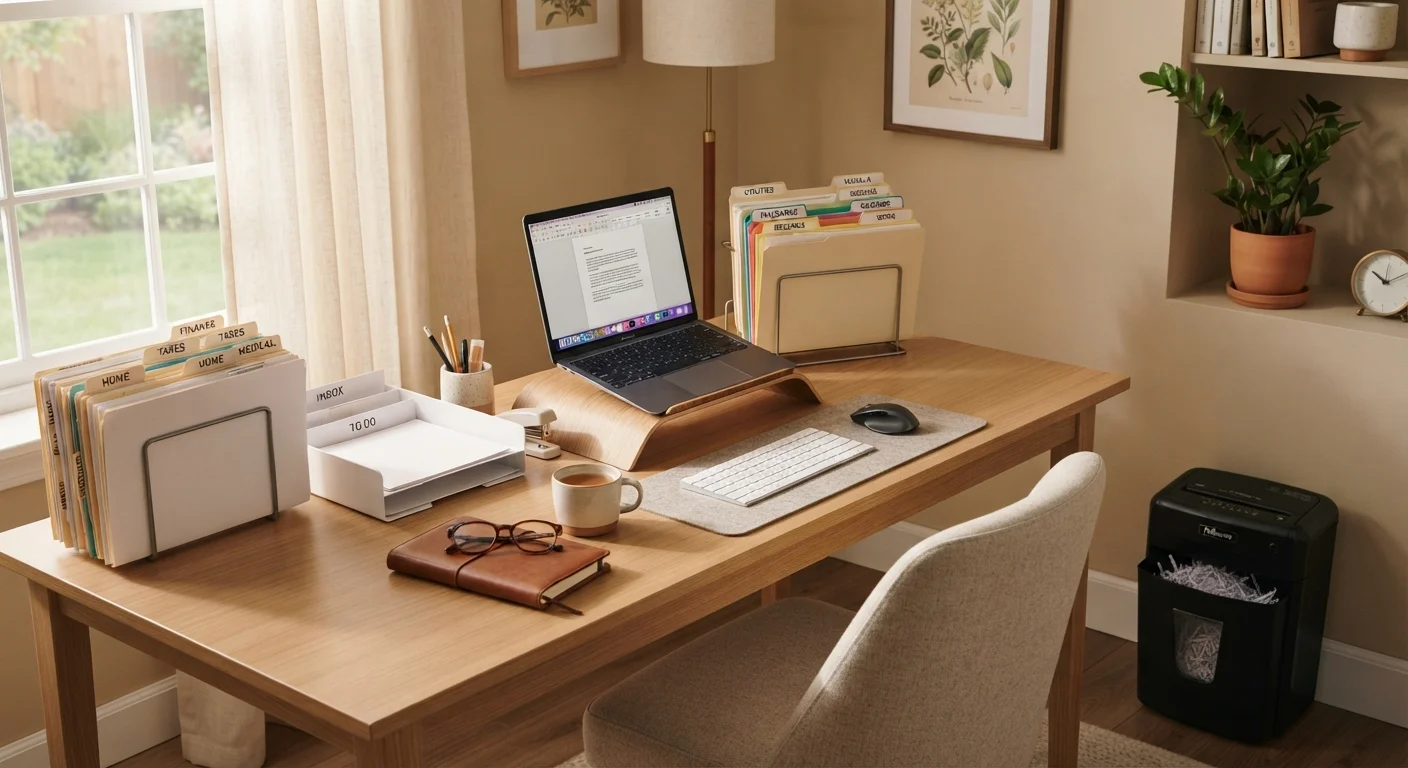
The good news: paper organization requires very little specialized equipment. Most of what you need is already available at any office supply or general merchandise store, and you may already have much of it at home.
Cross-cut shredder
Securely destroys documents containing personal or financial information before disposal.
File folders and labels
Organizes retained documents into clearly named categories for quick retrieval.
A filing cabinet or accordion folder
Provides a dedicated, enclosed home for active and archival paper files.
Letter tray or inbox bin
Serves as a temporary holding zone for incoming mail before it is sorted.
Recycling bin
Positioned at the mail entry point to immediately discard junk mail and envelopes.
Document scanner or scanning app
Creates digital backups of important documents to reduce physical storage needs.
What you will need
Shred Before You Recycle
Any document containing your name, address, account numbers, Social Security number, or financial information should be shredded - not simply recycled or thrown away. Identity theft frequently originates from discarded paper. A basic cross-cut shredder is a worthwhile household investment for this purpose.
If you're working through a larger home decluttering effort alongside this project, the approach covered in decluttering a whole house without burning out can help you pace the overall effort without exhausting yourself.
Step-by-Step: Building Your Paper Management System
Follow these steps in order. The first session will take the longest - typically 45 minutes to two hours depending on how much has accumulated - but subsequent maintenance will take only minutes per week.
Gather all paper into one place
Collect every loose piece of paper in your home - off countertops, desks, junk drawers, chairs, and any other surface paper tends to land on. Pile it all in one location. This single pile-audit reveals the true scope of the problem and prevents you from accidentally maintaining several hidden backlogs at once.
Sort into four immediate categories
Work through the pile and place each item into one of four buckets:
- Act: Requires a specific action - a bill to pay, a form to sign, an appointment to schedule.
- File: No action needed, but worth keeping - insurance documents, tax records, warranties.
- Read: Magazines, newsletters, or materials you genuinely intend to read. Be ruthless here.
- Recycle or shred: Everything else - junk mail, expired coupons, duplicate statements, outdated notices.
Most households find that 60-70% of accumulated paper falls into the last category.
Process the 'Act' pile immediately
Go through your Act pile while you have momentum. Pay the bill, schedule the appointment, sign the permission slip, or note the deadline in your calendar. The goal is to reduce this stack to zero. Anything that requires more than five minutes can go into a designated 'Pending' folder, but give it a due date so it doesn't become permanent clutter.
Set up a simple three-category filing system
Resist the urge to create dozens of highly specific folders - complexity is the enemy of maintenance. Instead, use three broad categories to start:
- Active Documents: Current insurance policies, lease or mortgage documents, vehicle titles, passports, Social Security cards.
- Financial Records: Tax returns and supporting documents, pay stubs, bank statements (if retaining paper copies), investment account records.
- Household Records: Appliance manuals and warranties, home repair receipts, medical records, utility account information.
Label folders clearly, file documents face-up and front-to-back in date order, and keep the most frequently accessed files at the front.
Reduce incoming volume by going paperless
The most effective long-term solution to paper clutter is reducing how much enters your home. Contact your bank, credit card issuers, utilities, and insurance providers to switch to electronic statements and notices. Most allow this through your online account settings. Unsubscribe from catalogs and unsolicited mail using available opt-out services - results take several weeks but meaningfully reduce volume over time.
Establish a weekly maintenance routine
A single organizing session means nothing without a habit to sustain it. Designate one day per week - many households find Sunday evening or Monday morning works well - for a 10-15 minute paper review. Open and sort all mail that arrived during the week, process any action items, and file what needs keeping. This prevents the accumulation that makes the problem feel overwhelming again.
For more on building sustainable organizing habits, see daily habits that reduce clutter over time.
Don't Discard Documents You May Still Need
Tax records, legal documents, insurance policies, and warranty paperwork should be retained for defined periods - often seven years for tax-related records, per general IRS guidance. When in doubt about retention requirements for specific documents, consult a tax professional or financial adviser rather than guessing.
Once your system is in place, it's worth revisiting common organization myths to make sure the habits you're building are the ones that actually hold up over time.