

Key Takeaways
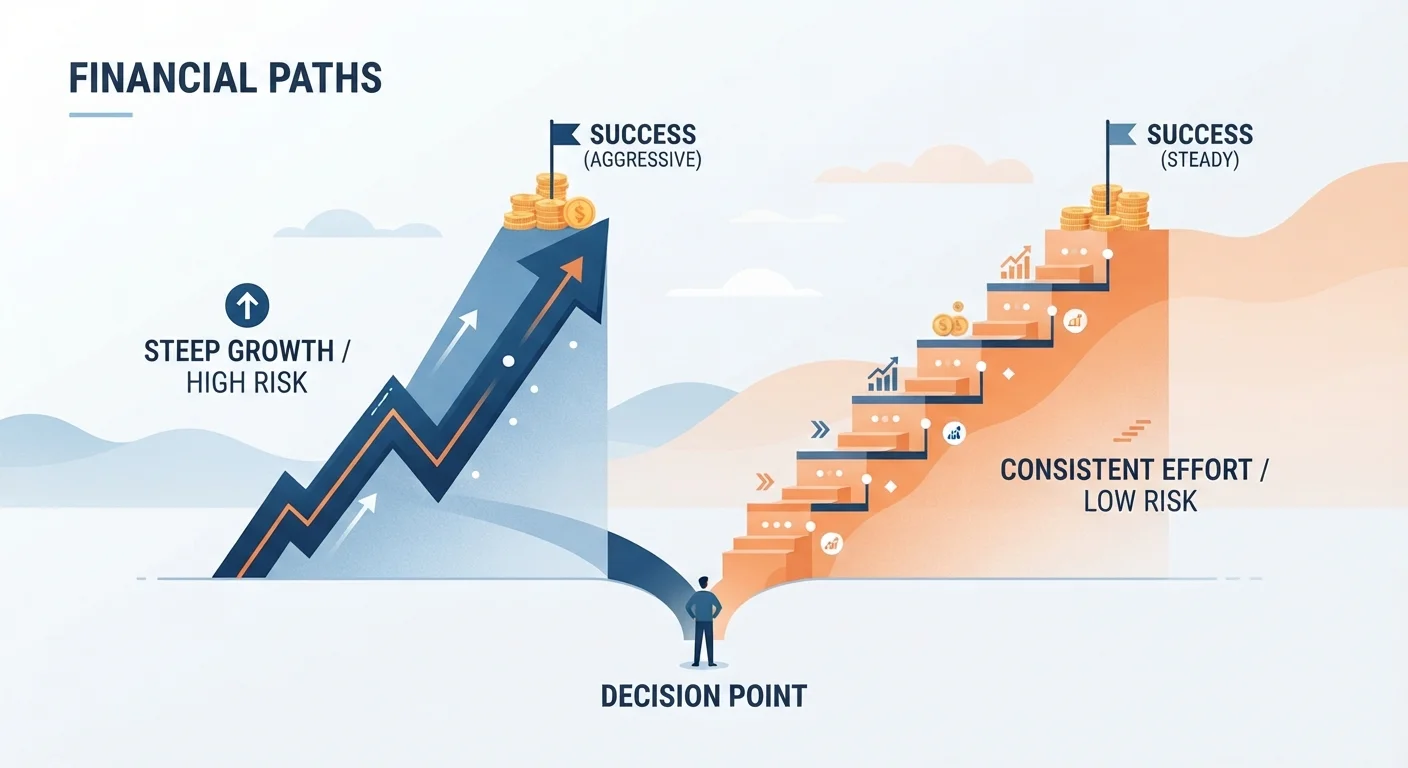
Option A
Debt Avalanche
The mathematically optimal approach for minimizing total interest paid.
Best for: People who are motivated by data, can stay patient without early wins, and want to pay the least possible over time.
Option B
Debt Snowball
The momentum-driven approach that delivers early psychological wins.
Best for: People who need visible progress to stay on track and find motivation in crossing debts off their list.
If you have high-interest debt like credit cards and can stay motivated without quick wins
Debt Avalanche
Targeting high-rate balances first reduces the total interest you pay, which can amount to hundreds or thousands of dollars saved over a multi-year payoff timeline.
If you've tried debt payoff before and lost momentum before finishing
Debt Snowball
Eliminating smaller balances quickly creates concrete proof of progress, which research in behavioral finance suggests helps sustain long-term commitment.
If your debts carry similar interest rates across the board
Debt Snowball
When rates are close, the mathematical difference between strategies shrinks - the snowball's motivational edge becomes the more meaningful variable.
If you have one or two very large balances with significantly higher rates than others
Debt Avalanche
A single high-rate account accruing interest rapidly can offset any psychological benefit from clearing smaller debts first.
If you're unsure which to choose and want to start now rather than wait
Debt Snowball
Starting is more important than optimizing. The snowball's early wins tend to reduce drop-off risk, and you can reassess your approach once you're in motion.
How Each Method Actually Works
Both strategies share the same mechanical foundation: you pay the minimum on every debt each month, then direct any extra money toward one targeted account. The difference is purely in how you pick that target.
With the debt avalanche, you rank your debts by interest rate - highest to lowest - and focus extra payments on the top of that list. Once the highest-rate debt is paid off, you roll everything you were paying on it into the next-highest-rate balance, and so on.
With the debt snowball, you rank by balance - smallest to largest - ignoring interest rates entirely. You attack the smallest balance with extra payments first. When it's gone, the full amount you were paying on it gets added to payments on the next-smallest debt. Each payoff "rolls" into the next, building size like a snowball.
Understanding how compound interest works in reverse - accelerating debt costs when left unpaid - helps clarify why order of payoff matters. See our explainer on compound interest for a deeper look at this dynamic.
Before committing to either method, it's worth running through some groundwork first. Our pre-payoff checklist covers the key steps to organize before you start.
The Math vs. The Mindset Trade-Off
On paper, the avalanche wins almost every time. By neutralizing the highest-rate debt first, you stop the most expensive interest from compounding. Over a multi-year payoff plan, this difference can be substantial - though the exact amount depends on your specific balances and rates.
The snowball, however, has a documented behavioral advantage. Research in consumer behavior and psychology consistently finds that people are more likely to continue a behavior when they receive regular, tangible feedback. Crossing a debt off entirely - even a small one - delivers that feedback in a way that shaving down a large balance slowly does not.
| Criterion | Debt Avalanche | Debt Snowball |
|---|---|---|
| Payoff order | Highest interest rate first | Smallest balance first |
| Total interest paid | Lower (in most scenarios) | Typically higher |
| Time to first payoff | Often longer | Often shorter |
| Motivational structure | Delayed gratification | Frequent early wins |
| Best debt mix | Widely varying interest rates | Similar rates or many small balances |
| Mathematical complexity | Requires rate comparison | Simple balance ranking |
Neither approach is irrational. Choosing the snowball over the avalanche isn't a financial mistake if the alternative is abandoning a plan after six months. A completed snowball plan outperforms an abandoned avalanche plan every time.
It's also worth noting that debt payoff doesn't have to mean pausing all saving. Our guide to paying off debt while saving simultaneously explores how some people balance both goals at once.
When Your Debt Mix Changes the Calculus
The gap between avalanche and snowball outcomes varies significantly depending on your specific debt situation.
A Note on Interest Rate Differences
The avalanche method's cost advantage grows in direct proportion to the spread between your highest and lowest interest rates. If your highest-rate debt is only a few percentage points above your others, the dollar difference between strategies may be smaller than you expect. Running the numbers on your specific balances - using a basic debt payoff calculator - can make this concrete before you commit to an approach.
If your debts carry very different interest rates - say, a 24% credit card and a 6% personal loan - the avalanche advantage is pronounced. The high-rate balance is actively expensive every month it sits unpaid. Clearing it quickly is financially meaningful.
If your rates are clustered close together, the math advantage shrinks. A 14% card and a 12% card aren't dramatically different. In that scenario, the snowball's motivational upside may outweigh the modest cost difference.
Similarly, if you have one very small balance and one very large high-rate balance, a hybrid approach sometimes makes sense: clear the tiny balance first (a one-time snowball win), then switch to avalanche order. This isn't a formal method, but it reflects how behavioral and mathematical factors can be blended pragmatically.
Watch for patterns that extend payoff timelines regardless of which method you choose. Our overview of common debt traps covers structural and behavioral pitfalls worth knowing about.
This article is for general informational and educational purposes only. It is not personalized financial advice. For guidance specific to your situation, consider consulting a licensed financial professional.