
Sale Events vs. Everyday Low Pricing: Two Retail Strategies Worth Understanding

Key Takeaways
Our Verdict
Sale-event retailers and everyday low pricing retailers each offer real value under the right circumstances. The key is recognizing which model a retailer uses, then aligning your timing and expectations accordingly. Shoppers who verify price history rather than trusting promotional framing consistently get more out of either model.
| Best for | Recommended |
|---|---|
| Those who need to buy immediately without waiting for promotions | Everyday Low Pricing retailers |
| Patient buyers willing to track prices and time purchases strategically | Sale-event retailers |
| Shoppers buying high-consideration items like appliances or electronics | Price-history verification regardless of model |
| Frequent, routine purchasers of everyday consumables | Everyday Low Pricing retailers |
What Each Pricing Strategy Actually Means
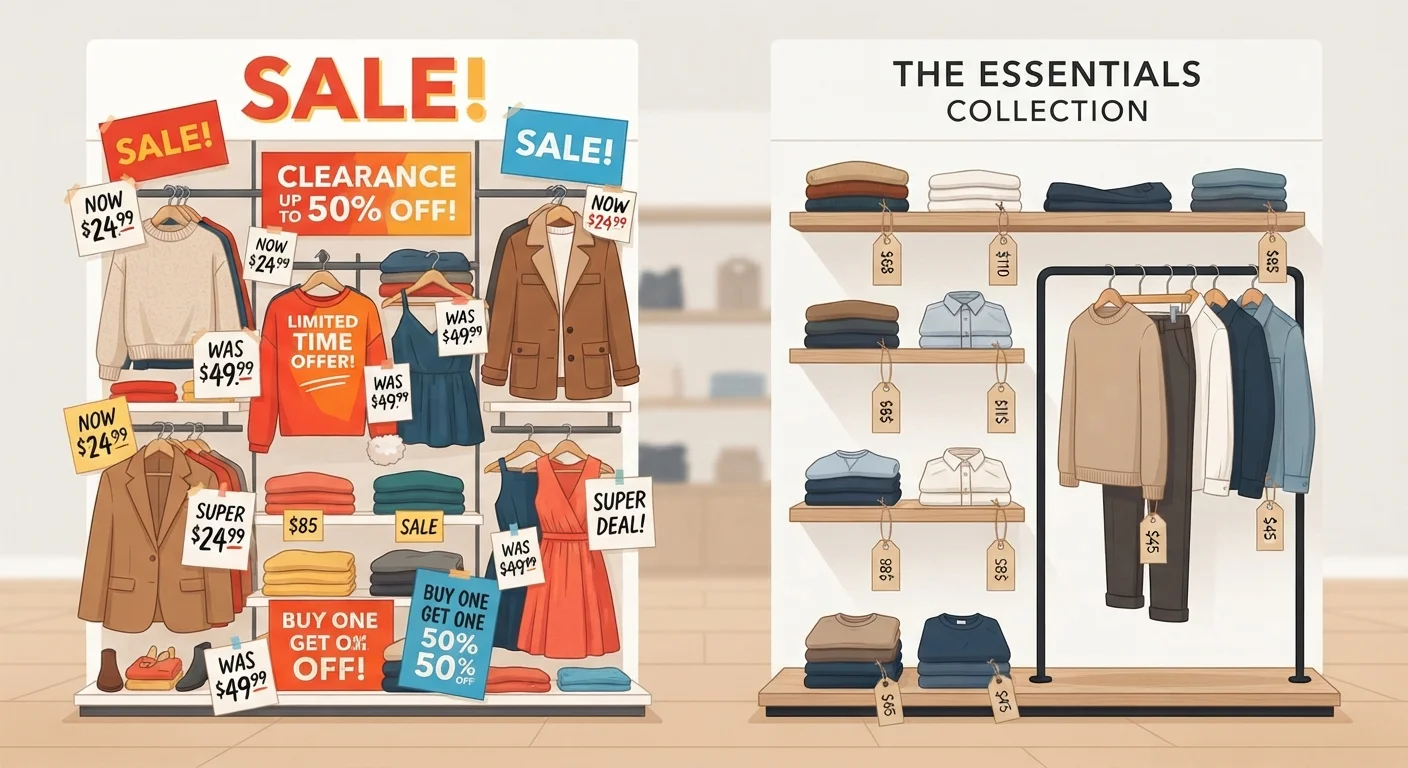
Retailers generally operate under one of two dominant pricing philosophies, even if they never advertise which camp they fall into.
Sale-event pricing (also called Hi-Lo pricing) involves setting regular prices relatively high, then periodically discounting heavily through promotions, seasonal events, and clearance cycles. The business model depends on a mix of full-price and sale-price purchases across a customer base. Shoppers who pay full price subsidize the deals others wait for.
Everyday low pricing (EDLP), by contrast, involves setting a consistently lower price year-round with few or no promotional markdowns. The value proposition is simplicity: no need to wait, no need to compare - the price today is approximately the same as next week.
These aren't just marketing labels. They reflect genuine differences in inventory management, supplier relationships, and how retailers plan their margins. Understanding which model a store uses tells you something real about how to shop there effectively.
The Appeal - and the Risk - of Sale Events
Sale events attract shoppers for obvious reasons: the potential for meaningful savings on products you already planned to buy. When a genuine markdown occurs - meaning a product's price actually drops from what it typically sold for - a sale event can be a legitimate opportunity.
The risk is that not every promotional discount reflects a real reduction. Retailers using Hi-Lo pricing sometimes inflate the "regular" price before marking it down, making a modest cut look dramatic. A "40% off" banner is only meaningful if the starting price was honest. Understanding how retailers structure discounts is essential before taking any promotional claim at face value.
There's also a behavioral cost to chasing sales: delayed purchases, impulse buys triggered by urgency messaging, and time spent monitoring promotions. Retailers use well-documented psychological tools - anchoring, artificial scarcity, countdown timers - to make sale prices feel more compelling than they may be.
Urgency Messaging Is a Design Choice
Countdown timers, "only X left" indicators, and "today only" banners are deliberate interface decisions - not neutral information. They're designed to compress your decision-making window. Before acting on any urgency signal, ask whether the same or similar product is available elsewhere, and whether price history supports the claim that this moment represents an unusual opportunity.
The Stability - and the Trade-offs - of Everyday Low Pricing
EDLP retailers compete on consistency rather than excitement. For many shoppers, particularly those buying recurring household goods or time-sensitive items, predictable pricing removes friction and reduces the cognitive load of comparison shopping.
The trade-off is that EDLP prices may not represent the absolute floor. During genuine clearance cycles or category-wide promotions at Hi-Lo retailers, some items do reach prices lower than what EDLP stores offer. The question is whether the time investment required to find and act on those moments is worth it relative to your purchase.
EDLP also tends to perform better for categories where demand is stable and products don't change rapidly - household staples, basic apparel, standard hardware. For categories with rapid product cycles, like consumer electronics, prices often fall over time regardless of retailer type, making patience its own strategy. Category-level pricing patterns can help clarify where waiting has historically paid off.
Use Price History as Your Reference Point
Before assuming an EDLP price is unbeatable or a sale price is a bargain, check what that specific product has sold for over the past 60 to 90 days across multiple retailers. Free browser-based price tracking tools can do this automatically for online purchases. A price that hasn't meaningfully changed regardless of promotional framing tells you what the item is actually worth in the current market.
How to Evaluate Savings Regardless of the Model
The comparison between these two strategies becomes actionable when you apply a consistent evaluation framework - one that doesn't rely on the retailer's own framing.
| Sale-Event (Hi-Lo) Pricing | Everyday Low Pricing (EDLP) | |
|---|---|---|
| Price consistency | Variable; high regular, low sale prices | Stable year-round with minimal fluctuation |
| Best strategy for shoppers | Wait for promotions; track price history | Buy when needed; no timing required |
| Risk of inflated "regular" price | Higher; baseline often set artificially high | Lower; price reflects ongoing market rate |
| Potential for deepest discounts | Higher during genuine clearance events | Limited; price is already compressed |
| Time and effort required | More; requires monitoring and timing | Less; straightforward purchase decision |
| Suits which purchase types | Planned, flexible-timeline purchases | Recurring, immediate-need purchases |
Track price history. Browser extensions and third-party price-tracking tools record a product's price over time. A promotional price that matches or exceeds a product's three-month average isn't a deal - it's the regular price with a banner attached. This is the single most effective check available to online shoppers.
Calculate total cost. A lower shelf price doesn't always mean lower total cost. Shipping, membership fees, limited return windows, and post-purchase support all affect actual value. EDLP retailers often compete on frictionless returns and transparent policies, which have real monetary value.
Several widely believed shopping assumptions don't hold up under scrutiny - including the idea that sale prices are always better than everyday prices. Treating either model with skepticism, and verifying claims independently, is the most reliable path to genuine savings.