

Key Takeaways
Retail Persuasion Psychology
Retail persuasion psychology refers to the use of well-documented cognitive principles - such as anchoring, urgency, and scarcity - to influence how shoppers perceive price and value. These tactics are not accidental; they are deliberately engineered features of sale messaging. Understanding them doesn't make you immune, but it does give you a framework for evaluating deals more objectively.
These principles draw on decades of behavioral economics research, including work on reference price theory (Winer, 1986) and the psychology of loss aversion as described in prospect theory.
Anchoring: How a Crossed-Out Number Shapes Your Judgment
Anchoring is one of the most thoroughly studied effects in behavioral economics. When you see a price tag showing $199 crossed out next to a sale price of $89, your brain doesn't evaluate $89 in isolation - it evaluates it relative to $199. That first number becomes the reference point, or anchor, against which the deal is measured.
The problem is that anchors can be set arbitrarily. A retailer who sets an inflated 'original' price before a promotional event hasn't necessarily discounted anything in a meaningful sense - they've simply established a favorable comparison point. Research in reference price theory has consistently shown that consumers perceive savings in relative, not absolute, terms, which makes the anchor more powerful than the actual price.
Reading a price tag like a researcher means questioning what that crossed-out number actually represents - whether the item was routinely sold at that price, or whether the anchor was set specifically to frame the promotion.
~30%
Price increase from inflated reference anchors
Research published in the Journal of Consumer Research found that artificially high reference prices can increase perceived savings and willingness to pay by roughly 30% compared to presenting the sale price alone.
2x
Weight consumers place on losses vs. equivalent gains
Prospect theory, developed by Kahneman and Tversky, established that people tend to experience losses as roughly twice as impactful as equivalent gains - the core mechanism that makes scarcity messaging effective.
Urgency: Engineering Time Pressure
Urgency messaging - countdown timers, 'today only' banners, flash sale labels - is designed to compress your decision window. The underlying mechanism is straightforward: when time feels short, people shift from deliberative reasoning to fast, intuition-driven decisions. That's exactly when comparative research gets skipped.
Countdown timers are particularly effective because they add a visual, real-time element to the pressure. But they aren't always honest signals. Some timers reset once they expire; others run perpetually on items that are always 'on sale.' The anatomy of a sale covers this distinction in more depth - distinguishing genuine markdowns from manufactured urgency.
A practical counter-move: treat any countdown as a cue to look up price history, not a reason to check out immediately. If the deal is real, independent data will confirm it quickly.
Check Price History Before Acting on a Timer
Several browser extensions track price history for major online retailers, showing whether today's 'sale' price is actually lower than the item's typical selling price. Running a quick check before checkout takes under a minute and is one of the most reliable ways to separate genuine discounts from promotional framing. If the sale price is the item's normal price, the countdown is largely decorative.
Scarcity: Why 'Only 3 Left' Feels Urgent
Scarcity cues activate loss aversion - the well-documented tendency to weight potential losses more heavily than equivalent gains. 'Only 3 left in stock' doesn't just inform you about inventory; it reframes inaction as a risk. Failing to buy starts to feel like losing something you already own.
Like urgency messaging, scarcity signals aren't always accurate. Low-stock labels on e-commerce platforms are sometimes generated dynamically by algorithms and may not reflect actual warehouse inventory. Items labeled scarce online are frequently available through other retailers at comparable or lower prices.
Loss leaders and doorbuster pricing sometimes use genuine scarcity - a truly limited quantity at a below-cost price - but that's distinct from the ambient 'low stock' messaging that applies to everyday products.
Putting It Together: A Framework for Clearer Evaluation
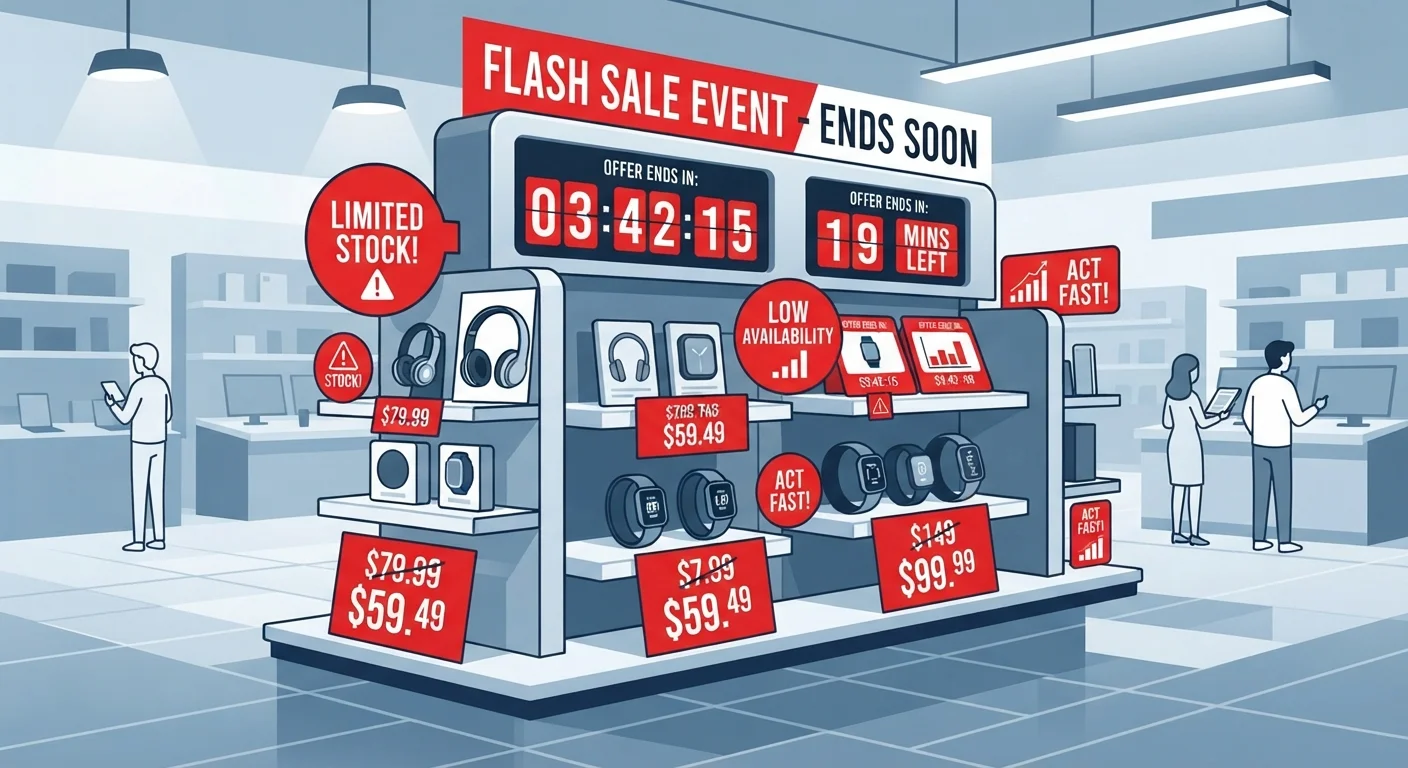
These three tactics - anchoring, urgency, and scarcity - often appear together, compounding their individual effects. A sale banner with a high crossed-out price, a ticking countdown, and a low-stock warning is a carefully assembled persuasion stack, not coincidence.
The antidote isn't skepticism for its own sake; it's replacing emotional cues with external data points. Price history tools, cross-retailer comparisons, and an understanding of how a particular retailer typically prices items are all more reliable inputs than the sale messaging itself. Sale events versus everyday low pricing is worth understanding here - some retailers manufacture frequent 'events' while others maintain steady prices, and knowing the pattern changes how you read their promotions.
It's also worth noting that these tactics are often legal, sometimes effective even when you know about them, and not confined to any single retail category. Shopping myths that cost people money addresses several related misconceptions that often persist alongside awareness of these tactics.