

Key Takeaways
Airport Currency Exchange
An airport currency exchange is a service that converts one country's currency into another, located within an airport terminal for traveler convenience. These operators - sometimes called bureaux de change - display buy and sell rates on large boards, but their true cost to the traveler typically exceeds what those numbers suggest. The gap between the interbank (wholesale) rate and the rate offered to customers is where the exchange earns its revenue.
The spread between the buy rate and sell rate, combined with any flat fees or commissions, determines the effective cost. Operators at airports command premium pricing partly due to high retail rents and captive customer demand.
What the Rate Board Is Actually Showing You
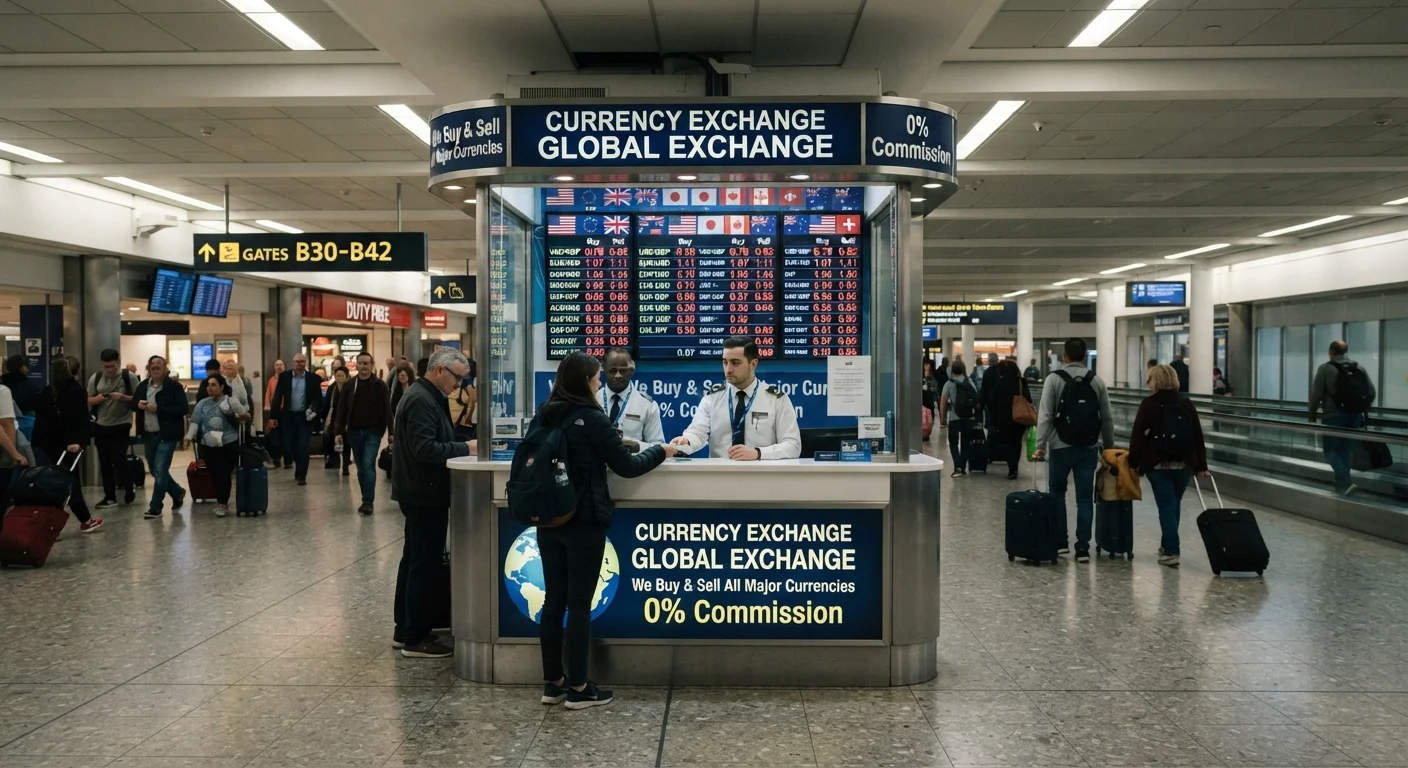
Walk up to any airport exchange counter and you'll see two columns of numbers: a buy rate and a sell rate. These aren't posted for your benefit - they describe the transaction from the operator's perspective. The buy rate is what they pay when purchasing foreign currency from you. The sell rate is what you pay when buying foreign currency from them.
The number travelers actually care about - the mid-market rate, also called the interbank rate - sits somewhere between those two figures and is rarely displayed. It represents the real-time global price of one currency against another. How exchange rates are set and why they fluctuate is a separate topic, but the key point here is that the rates on the board are already marked away from that benchmark before any flat fee is applied.
The spread between buy and sell rates can range from a few percentage points at competitive urban exchange offices to 10% or more at airport kiosks. That difference is the operator's built-in margin - and it applies to every dollar you convert.
5-15%
Typical spread range at airport currency exchanges
Industry observers and consumer finance publications have noted that airport exchange margins commonly fall in this range above the mid-market rate, compared to narrower spreads at bank branches or competitive online services.
~$1 billion
Annual US traveler spending on currency conversion fees
Estimates from travel finance researchers suggest US travelers collectively spend substantial sums on avoidable conversion costs each year, with airport exchanges representing a significant share.
Hidden Layers: Fees Beyond the Rate
Even when a rate looks tolerable on the board, additional costs may apply. Common structures include:
- Flat transaction fees: A fixed charge per exchange, regardless of amount. On a small transaction - say, $50 - a $5 flat fee represents a 10% surcharge before the spread is counted.
- 'No commission' framing: This phrase signals that no separate fee is charged, but it does not mean the transaction is cheap. The margin is embedded in the rate itself. Operators that advertise no commission frequently offer some of the widest spreads available.
- Rate-tiering by amount: Some operators display a favorable rate prominently but apply it only to transactions above a threshold most travelers won't reach. Smaller amounts receive worse rates, disclosed in smaller print or at the point of transaction.
Before handing over cash, ask the teller: "What is the exact amount of foreign currency I will receive for this amount?" That single question cuts through rate-board complexity entirely.
Ask for the Final Amount Before Committing
Instead of trying to decode rate boards, ask the teller directly: 'How many [foreign currency units] will I receive for [your amount]?' This gives you a single comparable number. You can then check that figure against the mid-market rate on your phone to assess the real cost - no currency math required.
Why Airport Exchanges Cost More - and When They're Unavoidable
Airport terminal rents rank among the highest in retail real estate. An exchange operator in a major US hub may pay substantial concession fees to the airport authority on top of base rent. That overhead is recovered through pricing. Travelers in transit also represent a captive audience with limited time and few alternatives - conditions that reduce competitive pressure on rates.
That said, airport exchanges serve a legitimate purpose. If you arrive at a destination late at night, need local currency immediately for a taxi or transit fare, or your debit card is declined abroad, a terminal exchange may be your only immediate option. In those situations, exchanging only the minimum needed - enough to cover your first few hours - limits the cost exposure while you locate a better option later.
For a broader view of how to structure your travel money approach, the travel money overview covers currency, cards, and cash strategies together.
Practical Steps Before You Reach the Terminal
Reducing dependence on airport exchanges starts before departure. Consider these general approaches - keeping in mind that the right mix depends on your destination, trip length, and your own financial accounts:
- Order currency from your bank in advance. Many US banks and credit unions can order foreign currency with a few days' notice, often at rates closer to interbank pricing than airport counters.
- Identify low-fee ATM options. Using a local ATM at your destination with a debit card that reimburses foreign ATM fees is a strategy many frequent travelers rely on. Check your bank's fee schedule before you travel.
- Understand your card's foreign transaction policy. Some cards charge a percentage on every foreign purchase; others don't. Knowing this in advance affects how much cash you'll actually want to carry. Our explainer on spending money overseas outlines common approaches.
- Arrive with a small buffer. Even $20-$40 in destination currency - obtained before departure - can cover ground transport from the airport without requiring a terminal exchange at all.
This article is for general informational purposes only and does not constitute financial advice. Exchange rates, fees, and available services vary by provider and location. Verify current terms directly with any exchange operator or financial institution before transacting.