

Key Takeaways
Exchange Rate
An exchange rate is the price of one country's currency expressed in terms of another. For example, if 1 US dollar equals 1.08 euros, that ratio is the exchange rate. It tells you how much foreign currency you receive for each unit of your home currency. These rates are not fixed by governments in most cases - they move constantly based on market forces.
Most major currencies operate under a floating exchange rate system, meaning their values are determined by supply and demand in global foreign exchange (forex) markets. Some governments maintain a pegged or managed rate, keeping their currency tied to another, typically the US dollar.
The Basics: Supply, Demand, and Currency Value
Think of a currency the way you would any commodity - its price rises when demand increases and falls when supply outpaces demand. Currencies are bought and sold on the global foreign exchange market, commonly called forex, which processes trillions of dollars in transactions each day. This market has no central location; it runs continuously across financial institutions worldwide.
When investors, corporations, and governments need a particular currency - to pay for imports, service debt, or invest in a country's assets - demand rises, typically pushing that currency's value up. When confidence in a country's economy weakens, sellers may offload that currency quickly, driving its value down.
For travelers, this matters because the rate you receive when exchanging money is a downstream reflection of these large-scale forces. See Travel Money Explained for a broader look at how these rates translate into practical choices abroad.
$7.5 trillion
Daily forex market trading volume
According to the Bank for International Settlements' 2022 Triennial Central Bank Survey, global foreign exchange market turnover averaged approximately $7.5 trillion per day.
180+
Currencies recognized globally
The United Nations recognizes over 180 currencies in circulation worldwide, though a handful of major currencies - USD, EUR, JPY, GBP - dominate international transactions.
1-10%+
Typical spread range travelers face
The margin applied above the mid-market rate varies widely by provider, from under 1% for competitive card products to over 10% at some physical exchange counters, according to consumer finance researchers.
The Economic Levers That Move Rates
Several measurable economic factors influence currency values over time:
- Interest rates: When a central bank raises interest rates, it attracts foreign capital seeking higher returns. Investors buy that country's currency to invest, increasing its value. The US Federal Reserve's rate decisions, for instance, regularly move global currency markets.
- Inflation: A country with lower, stable inflation typically sees its currency appreciate relative to higher-inflation counterparts. High inflation erodes purchasing power, which reduces the currency's attractiveness.
- Economic growth: Strong GDP growth signals a healthy economy, drawing foreign investment and strengthening the currency. Weak or contracting growth tends to have the opposite effect.
- Trade balance: Countries that export more than they import tend to see demand for their currency rise, since foreign buyers need it to purchase goods.
These factors interact constantly and don't always move in the same direction, which is why predicting rate movements is genuinely difficult - even for professionals.
Use the Mid-Market Rate as Your Benchmark
Before any currency exchange, look up the current mid-market rate through a financial data source. This gives you a neutral reference point. Any rate you're offered will include a provider margin - knowing the benchmark tells you exactly how large that margin is, so you can compare options with clear information.
Short-Term Swings: News, Sentiment, and Speculation
Beyond fundamental economics, exchange rates respond sharply to news and collective market psychology. An unexpected election result, a central bank announcement, or a geopolitical conflict can shift a currency's value within minutes. Speculative trading - where traders bet on where a rate is headed - amplifies these moves.
This volatility is why the rate you see quoted in morning headlines can differ meaningfully from the one available when you actually exchange money. Checking rates periodically in the weeks before a trip gives you a realistic baseline, even if you can't time the market.
Worth noting: currency movements work similarly to how dynamic pricing functions in retail - both reflect real-time supply and demand signals, just applied to different markets.
The Rate You Actually Get as a Traveler
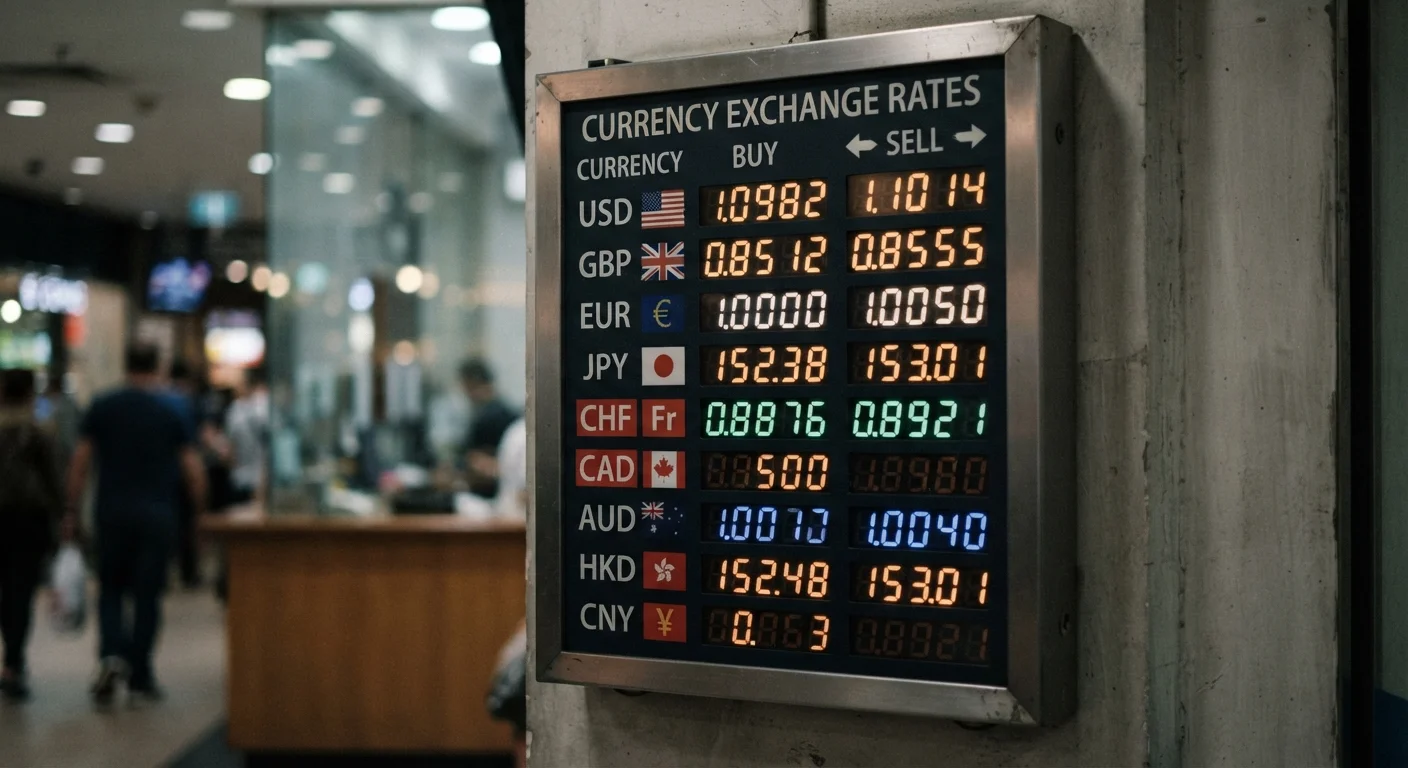
The exchange rate quoted in financial news - the interbank or mid-market rate - is a wholesale benchmark between large financial institutions. It is rarely the rate individual travelers receive. Banks, currency exchange counters, and card networks all apply a margin on top of this rate. That margin is how they earn revenue from the transaction.
This gap between the interbank rate and the rate offered to you is sometimes called the spread. It can range from less than 1% for some bank cards to 10% or more at some airport kiosks. Additionally, service fees and foreign transaction charges may apply separately. For a thorough breakdown of those costs, see Foreign Transaction Fees and Hidden Currency Costs.
Comparing the offered rate against the current mid-market rate - available through any financial data site - is the clearest way to gauge how much margin you are paying. No single exchange method eliminates the spread entirely, but knowing it exists helps you make more informed choices.