

Key Takeaways
Auto Insurance Coverage Types
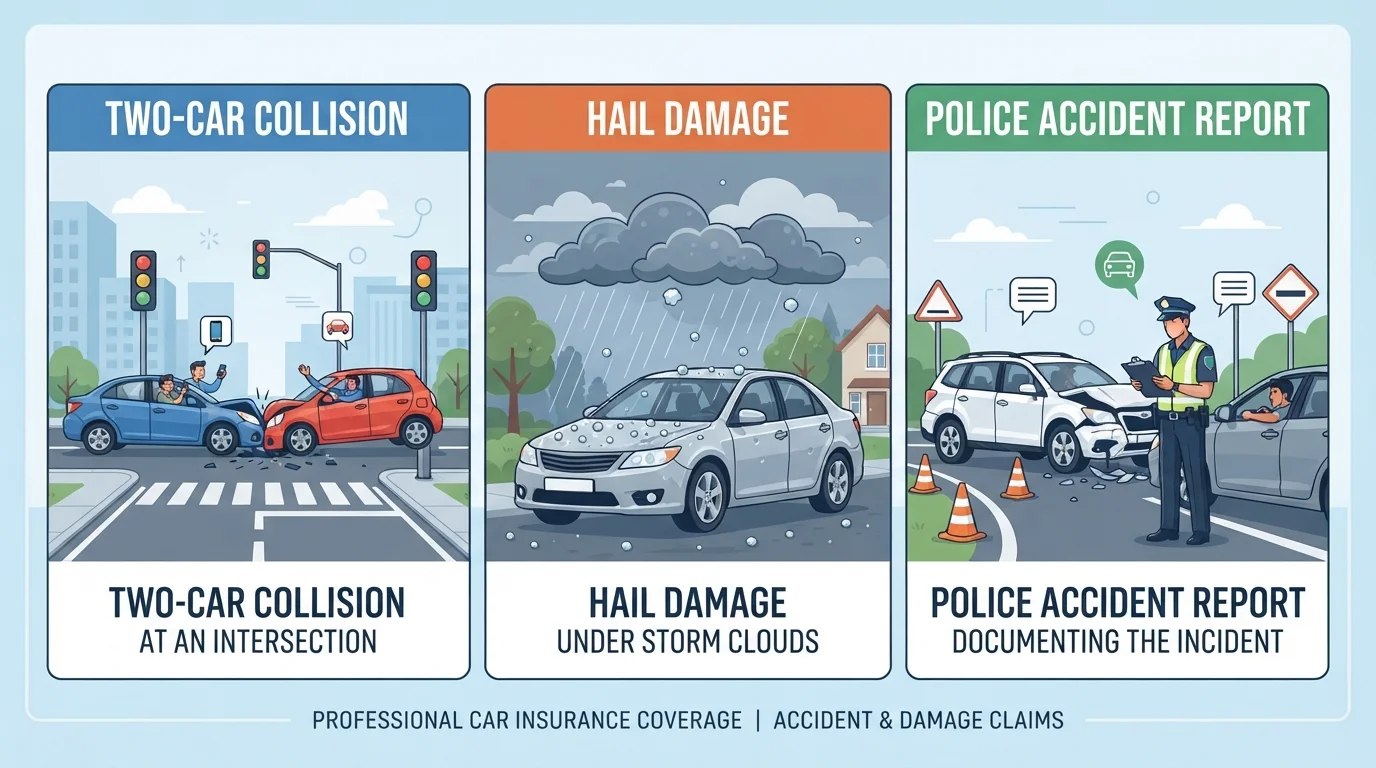
Auto insurance policies are built from distinct coverage types, each of which pays for a specific category of loss. Liability coverage pays for damage or injuries you cause to others. Collision coverage pays to repair or replace your own vehicle after a crash. Comprehensive coverage pays for damage to your vehicle from causes other than a collision, such as weather, theft, or fire.
Liability is expressed as split limits (e.g., 25/50/25) or a single combined single limit; collision and comprehensive each carry a separate deductible that reduces the insurer's payout.
Liability Coverage: Protecting Others From Your Mistakes
Liability coverage is the foundation of any auto insurance policy and the coverage type required by law in almost every US state. It pays for property damage and bodily injuries that you cause to other people - not for your own vehicle or your own injuries.
A standard liability policy has two components:
- Bodily injury liability (BI): Pays for medical expenses, lost wages, and legal costs if you injure another person in an at-fault accident.
- Property damage liability (PD): Pays to repair or replace the other driver's vehicle or other property you damage.
Liability limits are usually expressed as three numbers - for example, 100/300/100 - representing the per-person bodily injury limit, the per-accident bodily injury limit, and the property damage limit (all in thousands of dollars). If your damages exceed those limits, you are personally responsible for the difference.
For a broader look at how these pieces fit together, see our complete first-timer's walkthrough to car insurance.
Liability Covers Others - Not You
A point that surprises many first-time policyholders: liability coverage provides zero benefit to the policyholder's own vehicle or injuries. If you are at fault, you need collision coverage for your vehicle's damage and separate medical payments or personal injury protection (PIP) for your own injuries. Liability's entire purpose is to protect the other party from your at-fault losses.
Collision Coverage: Repairing Your Vehicle After a Crash
Collision coverage pays to repair or replace your own vehicle when it is damaged in a crash - whether you hit another car, back into a pole, or roll into a ditch. Fault does not affect eligibility; what matters is that the damage resulted from a collision.
When you file a collision claim, you pay your chosen deductible first. The insurer covers the remainder up to your vehicle's actual cash value (ACV) - its market value at the time of loss, accounting for depreciation. If repair costs exceed ACV, the insurer typically declares the vehicle a total loss and pays out ACV instead.
Collision coverage is optional if you own your vehicle outright, but most lenders and lessors require it on financed or leased vehicles. Weighing whether to carry it on a paid-off vehicle comes down to the car's current value versus the cost of the premium and deductible. Our guide on full coverage vs. minimum coverage walks through that decision in more detail.
Check Your Deductible Before Filing a Small Claim
For minor collision damage, compare your repair estimate to your deductible before filing. If the repair cost is close to or below your deductible, paying out of pocket may be more cost-effective than filing a claim, which could affect your premium at renewal. Learn more about how deductibles affect your overall costs in our guide on how deductibles work in auto insurance.
Comprehensive Coverage: Non-Collision Damage and Loss
Comprehensive coverage handles damage to your vehicle from events that are not collisions. Common covered perils include:
- Theft or attempted theft
- Hail, flooding, and other weather events
- Fire
- Falling objects (trees, debris)
- Animal strikes (a deer running into your path, for instance)
- Vandalism
Like collision, comprehensive pays up to ACV minus your deductible. The two coverages are closely related but distinct - for a side-by-side comparison of how each responds to specific claim scenarios, see our article on collision vs. comprehensive coverage.
One important limitation: comprehensive does not cover personal property inside your vehicle. A laptop stolen from your car is not a comprehensive claim - it would fall under homeowners or renters insurance.
How the Three Coverages Work Together - and Where Gaps Appear
A common misconception is that carrying all three coverages means you are fully protected. In practice, each type has defined limits, exclusions, and deductibles that can leave a driver exposed in certain scenarios.
~13%
US drivers estimated to be uninsured
The Insurance Research Council has estimated that roughly one in eight US drivers operates without any auto insurance, illustrating the real-world risk of relying solely on another driver's liability coverage.
Nearly all states
States with mandatory liability insurance
All US states except New Hampshire require drivers to carry some form of liability coverage or demonstrate financial responsibility, though minimum required limits vary significantly by state.
Varies by state
Minimum liability limits required
State-mandated minimum liability limits range from as low as 10/20/10 in some states to 25/50/25 or higher in others, meaning the floor of required protection differs considerably depending on where you live and drive.
For example, if you carry only state-minimum liability and are at fault in a serious accident, the other party's costs could far exceed your limits. If you skip collision, a single-car accident leaves your repairs entirely out of pocket. If you skip comprehensive in an area prone to hail or flooding, a weather event could total a vehicle with no recovery.
Understanding terminology - deductibles, actual cash value, exclusions - helps you read your policy accurately before a claim arises. Our auto insurance glossary decodes the most common policy language. And if you want to anticipate where policies commonly fall short, our article on coverage gaps that leave drivers exposed covers the scenarios most drivers discover too late.
This article provides general educational information about auto insurance coverage types and is not personalized insurance or financial advice. Coverage terms, limits, exclusions, and availability vary by insurer and state. Consult a licensed insurance agent or adviser and review your actual policy documents for guidance specific to your situation.