

Key Takeaways
Option A
Collision Coverage
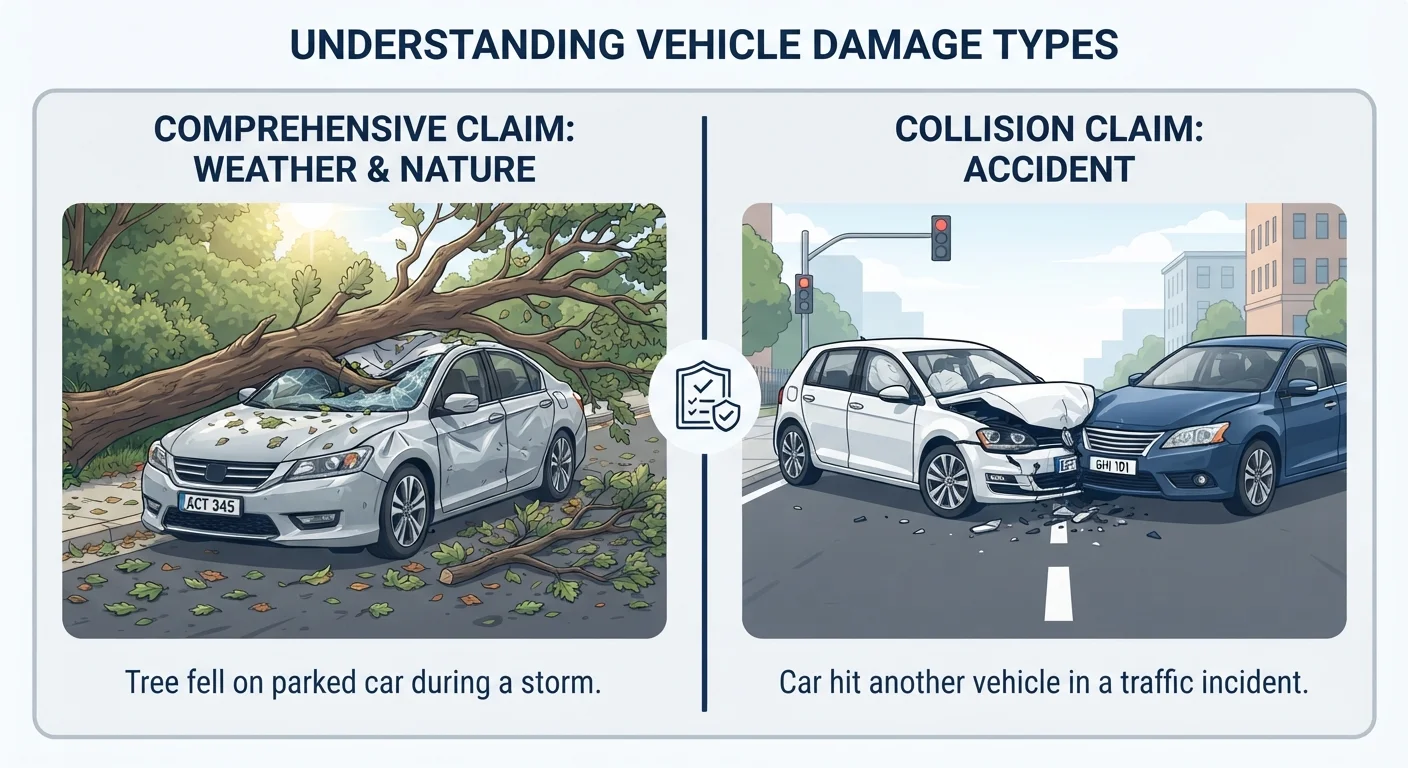
The coverage that responds when your car hits something.
Best for: Drivers who want protection when their vehicle is damaged in an accident involving another car, a guardrail, or any physical impact while driving.
Option B
Comprehensive Coverage
The coverage that responds when something happens to your car.
Best for: Drivers who want protection from events outside their control - theft, weather damage, falling objects, fire, or animal strikes.
If your car was damaged in a crash with another vehicle or object
Collision Coverage
Collision is designed precisely for impact-related vehicle damage, regardless of who was at fault in the accident.
If your car was stolen, struck by hail, or hit by an animal
Comprehensive Coverage
These events are non-collision losses, which fall squarely within the scope of comprehensive coverage.
If you have a financed or leased vehicle
Both Coverages
Most lenders and lease agreements require you to carry both collision and comprehensive to protect the asset until the loan or lease is satisfied.
If you drive an older, fully paid-off vehicle with low market value
Neither may be cost-effective
When the cost of both deductible and premium approaches or exceeds the vehicle's actual cash value, carrying either coverage may not be financially advantageous.
If you want the broadest protection against unexpected vehicle losses
Both Coverages
Collision and comprehensive together address most physical damage scenarios short of mechanical failure, closing a wide range of gaps in your policy.
What Each Coverage Is Actually Doing
The names are plain enough, but drivers frequently mix up which coverage applies to a specific loss. Understanding the underlying logic of each makes the distinction clearer.
Collision coverage activates when your vehicle sustains damage through physical impact - your car rear-ends another, you side-swipe a parked vehicle, you hit a pothole hard enough to damage the undercarriage, or your car rolls over. The defining feature is contact between your vehicle and something else (or the road). Fault is largely irrelevant to whether the coverage pays; it matters more for liability and subrogation purposes.
Comprehensive coverage covers physical damage that doesn't involve a collision. Think of it as the catch-all for events that happen to your vehicle rather than events your vehicle is involved in. Common comprehensive claims include theft, vandalism, hail, flooding, fire, falling branches, cracked windshields from road debris, and collisions with animals (deer strikes, for example, are universally treated as comprehensive claims, not collision).
For a broader look at how these two interact with liability protection, see our breakdown of all three core coverage types.
| Criterion | Collision Coverage | Comprehensive Coverage |
|---|---|---|
| Triggering event | Physical impact (crash, rollover, fixed object) | Non-collision loss (theft, weather, vandalism, animals) |
| Fault relevance | Pays regardless of fault | Fault not applicable |
| Deductible | Separate, chosen at policy setup | Separate, chosen at policy setup |
| Payout basis | ACV minus deductible | ACV minus deductible |
| Legally required | No (except by lenders/lessors) | No (except by lenders/lessors) |
| Deer strike covered? | No | Yes |
| Hail or flood damage? | No | Yes |
| Parking lot fender-bender? | Yes | No |
| Vehicle theft? | No | Yes |
Deductibles, Payouts, and the Actual Cash Value Rule
Both coverages work on a deductible basis. When you file a claim, you pay your chosen deductible first, and the insurer covers the remaining repair cost - up to the vehicle's ACV (actual cash value). ACV reflects your car's market value at the time of loss, not its replacement cost or what you paid for it.
If repair costs exceed the ACV, the insurer will typically declare the vehicle a total loss and pay out the ACV minus your deductible. This is where gap insurance becomes relevant - it covers the difference between the ACV payout and what you still owe on a loan or lease.
Deductibles for collision and comprehensive are set separately and independently. A common pairing might be a $500 collision deductible and a $250 comprehensive deductible, though ranges vary widely. Higher deductibles lower your premium; lower deductibles raise it. Neither coverage has a deductible waiver built in - you pay it each time you file a qualifying claim.
~$290
Average annual comprehensive premium (US)
According to the National Association of Insurance Commissioners (NAIC), the average annual expenditure for comprehensive coverage in the U.S. is approximately $290, though this varies widely by region and vehicle.
~$555
Average annual collision premium (US)
NAIC data indicates collision coverage typically costs nearly twice as much as comprehensive on average, reflecting the higher frequency of collision claims versus non-collision losses.
~$500-$1,000
Most common collision deductible range
Industry data consistently shows that $500 and $1,000 deductibles are the most frequently selected options for collision coverage among US policyholders.
Common Claim Scenarios and Which Coverage Responds
Ambiguity tends to arise in specific situations. Here are several real-world scenarios and the coverage that would apply under a standard U.S. auto policy:
- You back into a pole in a parking lot: Collision. Your vehicle made physical contact with a stationary object.
- A hailstorm dents your hood and roof: Comprehensive. Weather events are non-collision losses.
- A deer runs into your car on the highway: Comprehensive. Animal strikes are classified as non-collision events by virtually all U.S. insurers.
- Someone keys your car in a parking lot: Comprehensive. Vandalism falls under comprehensive, not collision.
- Your car is totaled in a multi-vehicle accident: Collision. The damage resulted from an impact between vehicles.
- A tree branch falls on your car during a storm: Comprehensive. Falling objects are covered under comprehensive.
- Your car rolls into a ditch after losing traction on ice: Collision. Contact with the ground or a fixed feature of the road environment qualifies as a collision.
If you're uncertain after an incident, contacting your insurer before assuming which coverage applies is advisable. The classification can affect your deductible amount and potentially your claims history. For guidance on navigating the claims process itself, see how to file a claim without complicating it.
When It Makes Sense to Carry One, Both, or Neither
Both coverages are optional under most state laws - unlike liability insurance, which is legally required in nearly every U.S. state. However, if you're financing or leasing your vehicle, your lender almost certainly requires both.
For drivers who own their vehicle outright, the decision depends primarily on the vehicle's current market value relative to the combined annual cost of premiums and the deductible you'd pay in a claim. A general rule of thumb: if your annual premium for a coverage type exceeds 10% of the vehicle's value, the math may favor dropping that coverage. That said, individual risk tolerance, parking environment, and local weather patterns (higher hail or flood risk, for example) all influence whether comprehensive remains worthwhile even on an older car.
Dropping collision on a high-mileage older vehicle while keeping comprehensive is a fairly common approach - it retains protection against theft and weather damage (risks that don't correlate with vehicle age) while eliminating the costlier coverage on a car that may not be worth repairing after a serious collision.
For a full picture of how these choices affect overall policy cost, review the trade-offs between full and minimum coverage. And to understand what gaps might still exist even with both coverages in place, see which coverage gaps most commonly surprise drivers after an accident.
This article provides general information about auto insurance coverage types and is not a substitute for personalized advice from a licensed insurance professional. Coverage terms, definitions, and exclusions vary by policy and insurer. Always review your actual policy documents and consult a licensed agent for guidance specific to your situation.