

Key Takeaways
When to Replace vs. Repair
Deciding between repair and replacement is the first real decision homeowners face, and it's worth thinking through carefully. A system that's 8-12 years old with a single failed component - a capacitor, a contactor, a blower motor - is generally a strong repair candidate. A system pushing 15-20 years that requires a compressor replacement or refrigerant recharge is a different story.
A commonly applied benchmark is the "5,000 rule": multiply the system's age by the estimated repair cost. If the result exceeds $5,000, replacement usually makes more financial sense over the medium term. That said, this is a heuristic, not a guarantee - your specific system, climate, and energy costs all factor in.
Other signals that favor replacement include: persistent humidity problems indoors even when the system runs, unusually high utility bills compared to similar homes, frequent cycling on and off, or an R-22 refrigerant system (phased out federally and now costly to service). See our DIY myths guide for a broader look at assumptions that can lead homeowners toward costly mistakes during home projects.
R-22 Systems: A Costly Refrigerant Problem
If your existing system uses R-22 (Freon), be aware that this refrigerant was phased out under the Clean Air Act and is no longer produced or imported in the US. Remaining supplies are limited and expensive. A refrigerant leak in an R-22 system can make repair costs prohibitive - often tipping the decision firmly toward replacement.
Understanding System Types and Fuel Sources
HVAC is an umbrella term covering heating, ventilation, and air conditioning. Replacement doesn't always mean swapping like-for-like - this is often a good moment to evaluate whether your current system type still makes sense for your home and region.
- Split systems - the most common US configuration, with an outdoor condenser and an indoor air handler connected by refrigerant lines. They can be paired with a gas furnace (for heating) or a heat pump (for both heating and cooling).
- Heat pumps - increasingly popular nationwide, heat pumps move heat rather than generate it, making them highly efficient in moderate climates. Cold-climate heat pumps (rated for operation below 0°F) have expanded their viability in northern US regions.
- Packaged units - self-contained systems common in the South and Southwest, where all components sit in a single outdoor cabinet.
- Mini-split / ductless systems - ideal for homes without existing ductwork or for room additions. They offer zoning flexibility but at a higher per-zone cost.
Fuel source decisions - natural gas, propane, electric, or dual-fuel (heat pump with gas backup) - depend on local utility rates, infrastructure at your home, and climate. A qualified HVAC contractor should help you model operating costs across options before committing.
How Sizing Works - and Why It Matters
System sizing is measured in tons of cooling capacity (1 ton = 12,000 BTUs per hour). A common mistake - even among some contractors - is sizing by square footage alone. The correct method is a Manual J load calculation, a standardized protocol that accounts for square footage, ceiling height, insulation levels, window area and orientation, local climate data, and occupancy.
An oversized system short-cycles: it reaches the thermostat setpoint quickly, then shuts off before completing a full dehumidification cycle. The result is a home that feels clammy and humid even when it's at the right temperature. An undersized system runs constantly and never quite catches up on the hottest or coldest days.
Always request a written copy of the Manual J load calculation - not just the result, but the inputs used. This lets you verify that your home's actual insulation, window area, and climate data were entered correctly.
Load calculations based on inaccurate inputs produce inaccurate sizing recommendations, and oversized systems are one of the most persistent sources of comfort complaints after HVAC replacement.
Before your contractor arrives, note which rooms in your home feel consistently too hot, too cold, or too humid. Share this information upfront - it can flag duct distribution problems that sizing alone won't solve.
Comfort problems that originate from duct layout or room-level airflow imbalance won't be resolved by a new system; they need to be diagnosed and addressed as part of the replacement project.
Before accepting a quote, ask whether the contractor performed a Manual J calculation or is estimating by rule of thumb. If your attic insulation is underperforming, addressing it before HVAC replacement can actually reduce the size - and cost - of the system you need.
Efficiency Ratings Explained
Efficiency ratings tell you how much conditioning output you get per unit of energy consumed. As of 2023, the US Department of Energy transitioned to updated rating standards:
- SEER2 (Seasonal Energy Efficiency Ratio 2) - measures cooling efficiency. Minimum federal standards vary by region: 13.4 SEER2 in the North, 14.3 SEER2 in the South and Southwest. Higher is more efficient; mid-range units typically land around 16-18 SEER2.
- HSPF2 (Heating Seasonal Performance Factor 2) - applies to heat pumps in heating mode. Higher numbers indicate greater efficiency.
- AFUE (Annual Fuel Utilization Efficiency) - applies to furnaces. An 80% AFUE furnace converts 80% of fuel to heat; a 96% AFUE unit converts 96%.
Higher-efficiency equipment costs more upfront but reduces monthly operating costs. The payback period depends heavily on local utility rates and how many hours per year the system runs - a home in Phoenix with long cooling seasons will see faster payback on a high-SEER2 unit than one in Minneapolis.
20-30%
Efficiency lost through leaky ductwork
The U.S. Department of Energy estimates that duct leakage in a typical home can account for 20-30% of conditioned air loss.
15-20 years
Typical HVAC system lifespan
Most industry guidance places the serviceable lifespan of a central air conditioning system between 15 and 20 years with regular maintenance.
14.3 SEER2
Federal minimum (South/Southwest)
As of January 2023, the U.S. Department of Energy updated minimum efficiency standards, with the South and Southwest region requiring at least 14.3 SEER2.
What Installation Actually Involves
A proper HVAC replacement is a multi-step process that extends well beyond swapping equipment. Here's what a reputable installation should include:
- Load calculation - confirming correct sizing before equipment is ordered.
- Duct inspection - existing ductwork should be evaluated for leaks, obstructions, and sizing. Leaky ducts can reduce system efficiency by 20-30%, meaning a new high-efficiency unit underperforms on day one if duct issues aren't addressed.
- Equipment removal and disposal - old refrigerant must be recovered by a certified technician under EPA Section 608 regulations; it cannot legally be vented.
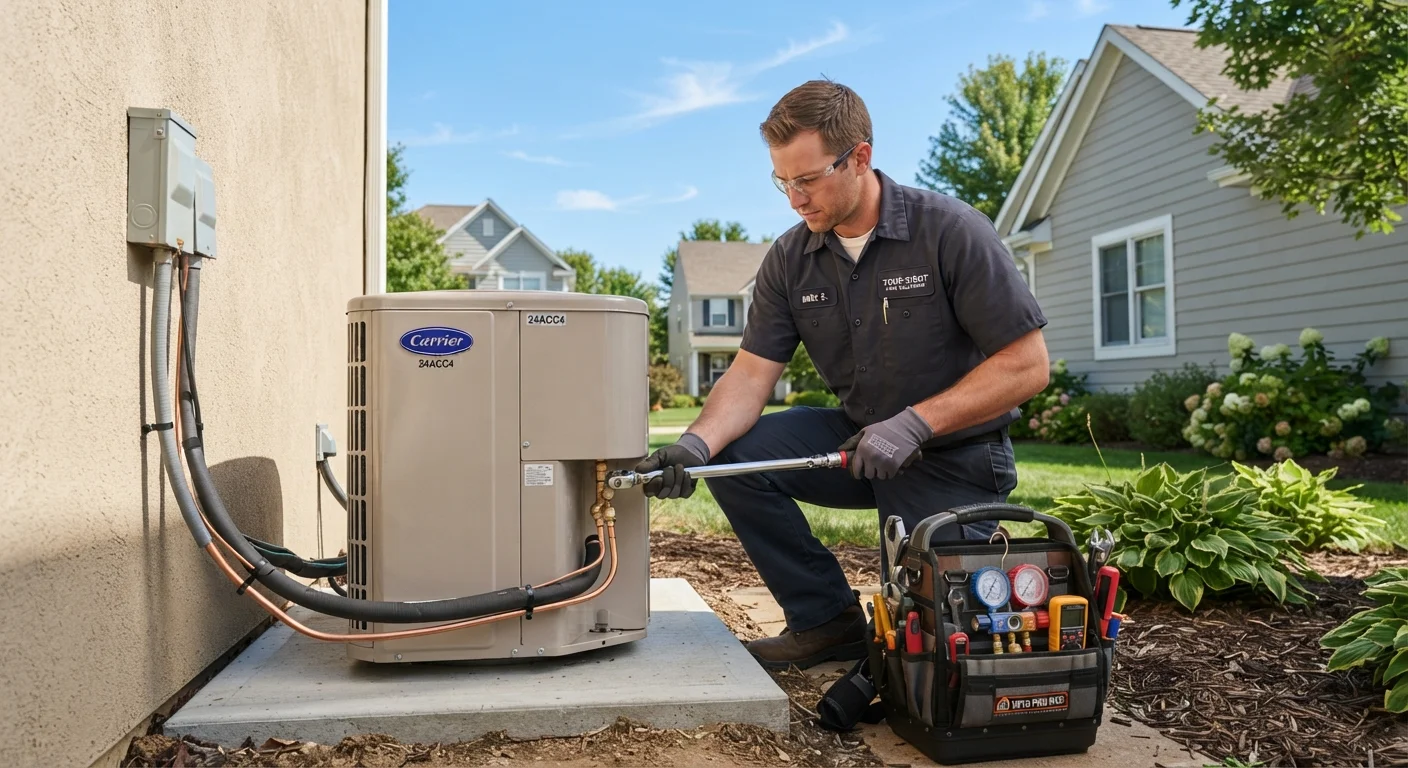
- New equipment installation - includes setting the outdoor unit on a level pad, connecting refrigerant lines, installing or replacing the air handler, and integrating with the thermostat.
- Electrical work - most systems require dedicated circuits; upgrades to your electrical panel may be necessary, particularly for heat pumps.
- Permitting and inspection - virtually all jurisdictions require a permit for HVAC replacement. Work performed without a permit can create issues with homeowner's insurance and future home sales.
- Commissioning and testing - verifying refrigerant charge, airflow, and thermostat operation before the contractor leaves.
Never accept a quote that treats installation as a simple swap. Skipped steps - particularly duct evaluation and proper commissioning - are among the most common sources of post-installation performance complaints.
Reading and Comparing Contractor Quotes
Comparing HVAC quotes is harder than it looks because contractors don't all itemize the same way. A quote that looks cheaper may simply be less detailed - hiding costs that emerge later as change orders. Our guide on reading contractor estimates covers this in depth, but for HVAC specifically, watch for these line items:
- Is the Manual J calculation included or listed as an add-on?
- Does the quote specify equipment model numbers (so you can compare equivalent units)?
- Are duct repairs, modifications, or testing included, or excluded?
- What is the warranty - separately for equipment and labor?
- Does it include permit fees and inspection scheduling?
- Is refrigerant recovery and disposal explicitly covered?
Get at least three quotes and ask each contractor the same set of questions. Evaluate the scope of work, not just the bottom line. A thorough quote from a licensed contractor that includes all necessary steps will typically serve you better than a low bid that leaves critical work undefined.
This article is for general informational purposes only. HVAC installation involves licensed trades, local code requirements, and safety considerations that vary by jurisdiction. Always verify permit requirements with your local building department and hire appropriately licensed professionals for any installation work.