

Key Takeaways
Our Verdict
Neither flat nor pitched roofs are universally superior - the right choice depends on your climate, home structure, budget horizon, and how you plan to use rooftop space. Flat roofs suit dry climates and specific architectural styles but demand diligent maintenance. Pitched roofs perform better across most US weather conditions and tend to carry lower long-term upkeep costs over decades of ownership.
| Best for | Recommended |
|---|---|
| Homeowners in dry, arid US climates (Southwest, desert regions) | Flat Roof |
| Those in wet, snowy, or high-rainfall US regions | Pitched Roof |
| Homeowners prioritizing rooftop utility space or solar panel installation | Flat Roof |
| Those focused on long-term durability with minimal maintenance cycles | Pitched Roof |
How Each Roof Type Works
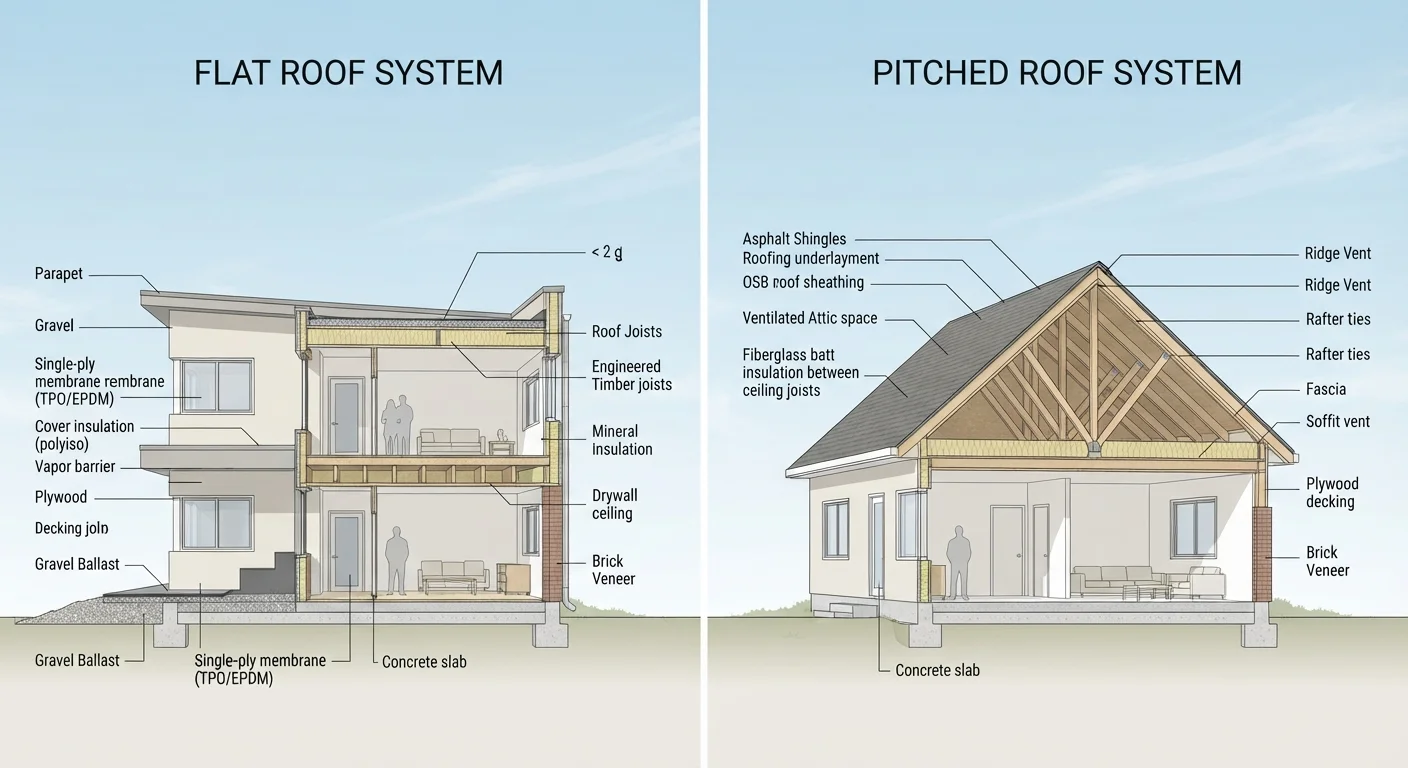
A flat roof isn't truly flat - it has a slight slope (typically 1/4 to 1/2 inch per foot) designed to direct water toward drains or scuppers. Common materials include modified bitumen, TPO (thermoplastic polyolefin), EPDM rubber, and built-up roofing membranes. These systems are most common on commercial buildings but appear frequently on modern residential architecture, mid-century designs, and additions.
A pitched roof has a steeper slope - measured as "rise over run" - that sheds precipitation by gravity. Pitches above 4:12 (four inches of rise for every twelve inches of horizontal run) are considered standard residential. Asphalt shingles dominate US pitched roofs, though metal, wood shake, clay tile, and slate are also used depending on region and budget.
Understanding the structural difference matters because the choice affects not just materials and aesthetics, but drainage performance, attic ventilation, and the scope of future repairs.
Drainage, Moisture, and Weather Performance
Drainage is where the two roof types diverge most sharply. Pitched roofs move water off the surface quickly - a meaningful advantage across most of the continental US, where annual rainfall and seasonal snow are common. Because gravity does the work, blockages at gutters are localized problems rather than systemic ones.
Flat roofs rely entirely on functional drains and intact membrane seals. When drains clog or membranes crack, water pools - a condition called ponding water - which accelerates material degradation and increases leak risk. In snowy climates, accumulated snow weight can stress the structure if load limits aren't monitored.
Flat Roofs Require Vigilant Maintenance in Wet Climates
In US regions with heavy precipitation or significant snow loads (Northeast, Midwest, Pacific Northwest), flat roofs demand more rigorous seasonal maintenance. Homeowners who skip annual inspections are more likely to encounter interior water damage. Before assuming a flat roof is manageable in your area, consult a licensed roofing contractor familiar with local weather patterns and building codes.
In US regions with heavy precipitation or significant snow loads (Northeast, Midwest, Pacific Northwest), flat roofs demand more rigorous seasonal maintenance. Homeowners who skip annual inspections are more likely to encounter interior water damage. Before assuming a flat roof is manageable in your area, consult a licensed roofing contractor familiar with local weather patterns and building codes.
Lifespan and Maintenance Demands
| Flat Roof | Pitched Roof | |
|---|---|---|
| Typical lifespan | 15-25 years | 20-70 years (material dependent) |
| Drainage method | Interior drains and scuppers | Gravity slope to gutters |
| Snow and rain performance | Requires active maintenance | Sheds precipitation passively |
| Installation cost | Lower upfront | Higher upfront |
| Maintenance frequency | Every 1-2 years inspection | Every 3-5 years typical |
| Rooftop utility potential | High (HVAC, solar, green roof) | Limited by pitch and access |
| Climate suitability | Best in dry/arid regions | Suitable across most US climates |
Flat roof membranes typically last 15-25 years depending on material and maintenance frequency. EPDM and TPO systems at the higher end of that range require professional inspection every one to two years to catch seam failures, blistering, or punctures early. Repairs are generally accessible - the entire surface is reachable without scaffolding - but they must happen promptly to prevent cascading damage.
Pitched roofs with asphalt shingles commonly last 20-30 years; metal and tile roofing can last 40-70 years with proper care. Maintenance intervals tend to be less intensive - gutter cleaning, periodic shingle checks after major storms, and ridge vent inspection are typical tasks. However, steep-pitch roofs require fall protection and scaffolding for any significant work, which raises contractor labor costs.
As a general principle, the common DIY assumptions about roofing - like applying sealant as a long-term waterproofing fix - can be especially costly on either roof type. Roofing work above a single story is a domain where professional assessment consistently pays off.
Installation Cost and Long-Term Ownership
15-25 yrs
Typical flat roof membrane lifespan
Industry roofing guidelines indicate most flat membrane systems require replacement within this range under average maintenance conditions.
30-50%
More surface area on steep-pitched roofs
A steeply pitched roof covers significantly more surface area than the footprint below it, directly affecting material and labor costs.
Flat roofs are generally less expensive to install per square foot because the surface area is smaller, material handling is simpler, and labor is faster on a walkable plane. However, the shorter replacement cycle means total cost of ownership over 30-40 years may exceed that of a well-maintained pitched roof - particularly if multiple re-roofing cycles are required.
Pitched roofs carry higher upfront installation costs, especially at steeper pitches where safety equipment and labor time increase. Premium materials like metal or tile add significantly to initial expense. Over decades, though, longer material lifespans and lower average maintenance frequency can make pitched roofs more economical in most US climates.
Local permit requirements also factor in. Most jurisdictions require permits for full roof replacements regardless of type, and some municipalities have code requirements about minimum pitch or approved materials in specific neighborhoods or flood zones. Always verify local building department requirements before any roofing project begins - this isn't optional, and skipping it can create issues when selling the home. Similar due diligence applies to other major structural decisions, such as the trade-offs explored in finishing a basement.
Making the Right Choice for Your Home
If you're replacing an existing roof, your structural framing largely determines which type is viable - converting a flat roof to pitched (or vice versa) is a major structural undertaking requiring engineering review and significant permits. Most homeowners are choosing materials and systems within an existing roof type, not switching between them.
Key factors to weigh:
- Climate zone: High precipitation and snow favor pitched roofs; arid regions tolerate flat roofs more reliably.
- Architecture: Some home styles - flat-roofed mid-century modern, commercial-style additions - are built around flat roofs structurally and aesthetically.
- Rooftop use: Flat roofs can accommodate HVAC equipment, green roofs, or solar arrays more easily, though structural capacity must be evaluated.
- Budget horizon: Consider total cost over 20-30 years, not just today's installation quote.
Whichever type you have or are planning, engage a licensed roofing contractor for any work beyond basic gutter cleaning. Structural and waterproofing decisions on a roof have direct consequences for everything below it - including insulation, interior ceilings, and in some cases, foundational moisture patterns.