

Key Takeaways
Our Verdict
Both FICO and VantageScore give lenders a snapshot of credit risk using the same scale, but their internal boundaries and weighting differ enough to matter in practice. Neither model is universally 'better' - what matters is understanding where your score falls within whichever model a particular lender uses. Focus on the fundamentals: payment history, balances, and account age. Those behaviors move the needle across every model.
| Best for | Recommended |
|---|---|
| Consumers monitoring general credit health | VantageScore (widely available free through banks and apps) |
| Applicants preparing for a mortgage or auto loan | FICO (most mortgage and auto lenders specify a FICO version) |
| Those with a thin or short credit history | VantageScore (can score files with as little as one month of history) |
| Anyone seeking a precise lender-facing number | FICO (purchase your report directly from myFICO for lender-used versions) |
The Two Dominant Models and Why Both Matter
Most credit scores consumers encounter in the United States are generated by one of two companies: Fair Isaac Corporation (FICO) or VantageScore Solutions. While both models translate your credit file into a three-digit number on a 300-850 scale, they were built with different methodologies and use different range boundaries - which means the same underlying credit file can produce slightly different numbers and tier classifications depending on which model runs the calculation.
FICO has been in use since 1989 and remains the model most frequently cited by mortgage lenders, auto lenders, and credit card issuers. VantageScore, developed collaboratively by the three major credit bureaus (Equifax, Experian, and TransUnion), launched in 2006 and is now the score most commonly provided free through banking apps and personal finance platforms. Knowing which model produced the number on your screen is the first step toward interpreting it correctly.
As our breakdown of what a credit score actually measures explains, both models draw on the same underlying credit file data - but they weight the factors differently, which is why the same person can legitimately hold different scores across models.
How the Range Tiers Compare Side by Side
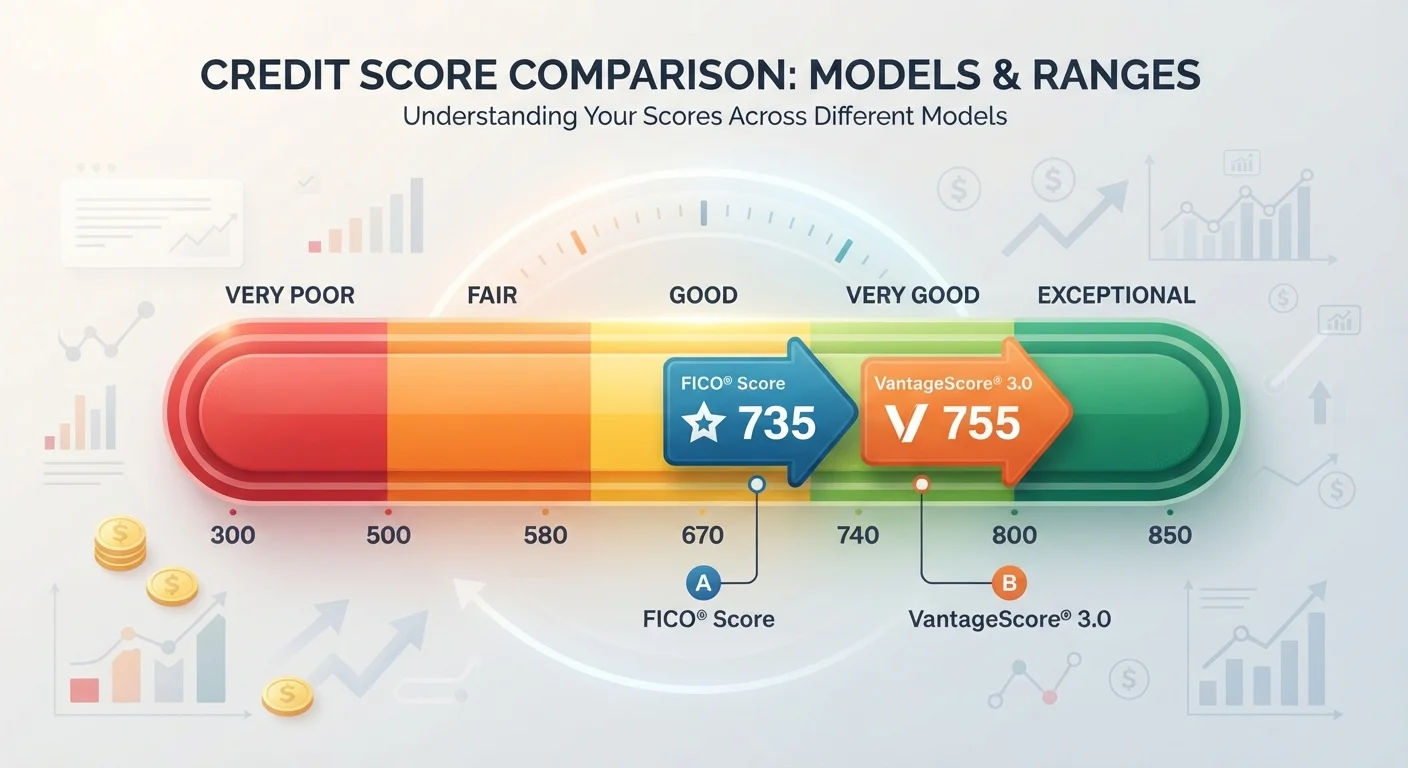
Both FICO and VantageScore use 300-850, but they slice that range into tiers with different names and cutoff points. Here is how they map against each other:
| Score Range | FICO Tier Label | VantageScore Tier Label | |
|---|---|---|---|
| 800-850 | 800-850 | Exceptional | Excellent |
| 740-799 | 740-799 | Very Good | Excellent (725-850) |
| 670-739 | 670-739 | Good | Good (661-724) |
| 580-669 | 580-669 | Fair | Fair (601-660) |
| 300-579 | 300-579 | Poor | Very Poor (300-600) |
One practical consequence: a score of 670 sits in FICO's "Good" band, but VantageScore classifies it as "Good" as well - the labels happen to align there. However, a score of 740 is "Very Good" under FICO and crosses into "Excellent" under VantageScore. These distinctions matter when a lender's internal pricing tiers are built around one model's cutoffs rather than the other's.
It is also worth noting that FICO publishes more than 60 industry-specific score versions. FICO Auto Score and FICO Bankcard Score, for example, use a 250-900 range - wider than the standard scale - so a score of 820 on an auto-specific version does not translate directly to 820 on the standard FICO 8 model consumers most often see.
What Each Tier Means in a Lending Context
Credit score ranges exist primarily to help lenders segment applicants by perceived risk. In general terms, the tiers carry the following practical implications - though specific lender policies vary and this is general educational information, not a guarantee of any particular outcome:
- Exceptional / Excellent (800-850): Applicants in this range typically qualify for the most favorable terms lenders offer. That said, lenders consider many other factors alongside the score.
- Very Good / Good (740-799 under FICO; 725-799 under VantageScore): Strong positioning. Most prime lending products are generally accessible, though not always at the lowest advertised rate.
- Good / Good (670-739 under FICO; 661-724 under VantageScore): Near-prime territory. Approval is common, but terms may be less favorable than for higher tiers.
- Fair / Fair (580-669 under FICO; 601-660 under VantageScore): Subprime range. Some lenders will still extend credit, but rates are typically higher and options narrower.
- Poor / Very Poor (300-579 under FICO; 300-600 under VantageScore): Approval for standard credit products is difficult. Secured products or credit-builder accounts are common starting points for rebuilding.
Check Which Score Your Lender Actually Uses
Before a major application, ask the lender which scoring model and version they pull. Many mortgage lenders still use older FICO versions (such as FICO 2, 4, or 5) rather than the more widely publicized FICO 8 or 10. Knowing the specific version lets you pull the same score and interpret your standing accurately before submitting an application.
Because lenders set their own internal cutoffs, two lenders using the same model may still draw the line for approval or pricing at different score thresholds. A score that qualifies you at one institution may not at another.
Why Your Score Differs Across Sources - and What to Do About It
Seeing a different number on your bank's app versus your credit card portal is not a sign that something is wrong. The variation usually comes from three sources: different scoring models, different bureau data (each bureau maintains its own file and they don't always contain identical information), and different score versions within the same model family.
The most reliable way to understand your credit standing is to focus less on the precise number and more on the tier it places you in across both major models - and on the behaviors that drive improvement in both simultaneously. Payment history and amounts owed are the two heaviest-weighted factors in FICO scoring; VantageScore similarly prioritizes payment history and credit utilization. Credit utilization - the ratio of your revolving balances to your credit limits is particularly influential and can shift a score meaningfully within a billing cycle.
Similarly, the mix between revolving accounts (such as credit cards) and installment accounts (such as auto loans or mortgages) plays a role in both models. Understanding how revolving and installment accounts are treated differently can help you manage your profile more deliberately.
If you are preparing for a major loan application, ask the lender directly which FICO version or score model they use. That allows you to pull the same version and interpret your standing on an apples-to-apples basis before you apply.
This article is for general informational and educational purposes only and does not constitute personalized financial or credit advice. For guidance specific to your situation, consider consulting a licensed financial counselor or advisor.