

Key Takeaways
Our Verdict
Neither revolving nor installment credit is inherently better for your profile - scoring models reward a healthy mix of both. The key variables are how responsibly each account is managed: keeping revolving balances low relative to limits and making on-time payments on all accounts are the two most impactful behaviors regardless of account type.
| Best for | Recommended |
|---|---|
| Those focused on managing credit utilization | Revolving credit (managed carefully) |
| Those building a longer payment history with predictable payments | Installment credit |
| Those starting with little or no credit history | Both types used together |
| Those aiming for the highest possible scores over time | A balanced mix of both |
What Makes These Two Credit Types Different
Every account on your credit report falls into one of two broad categories: revolving credit or installment credit. Understanding the mechanical difference between them is the foundation for understanding how each shapes your credit profile.
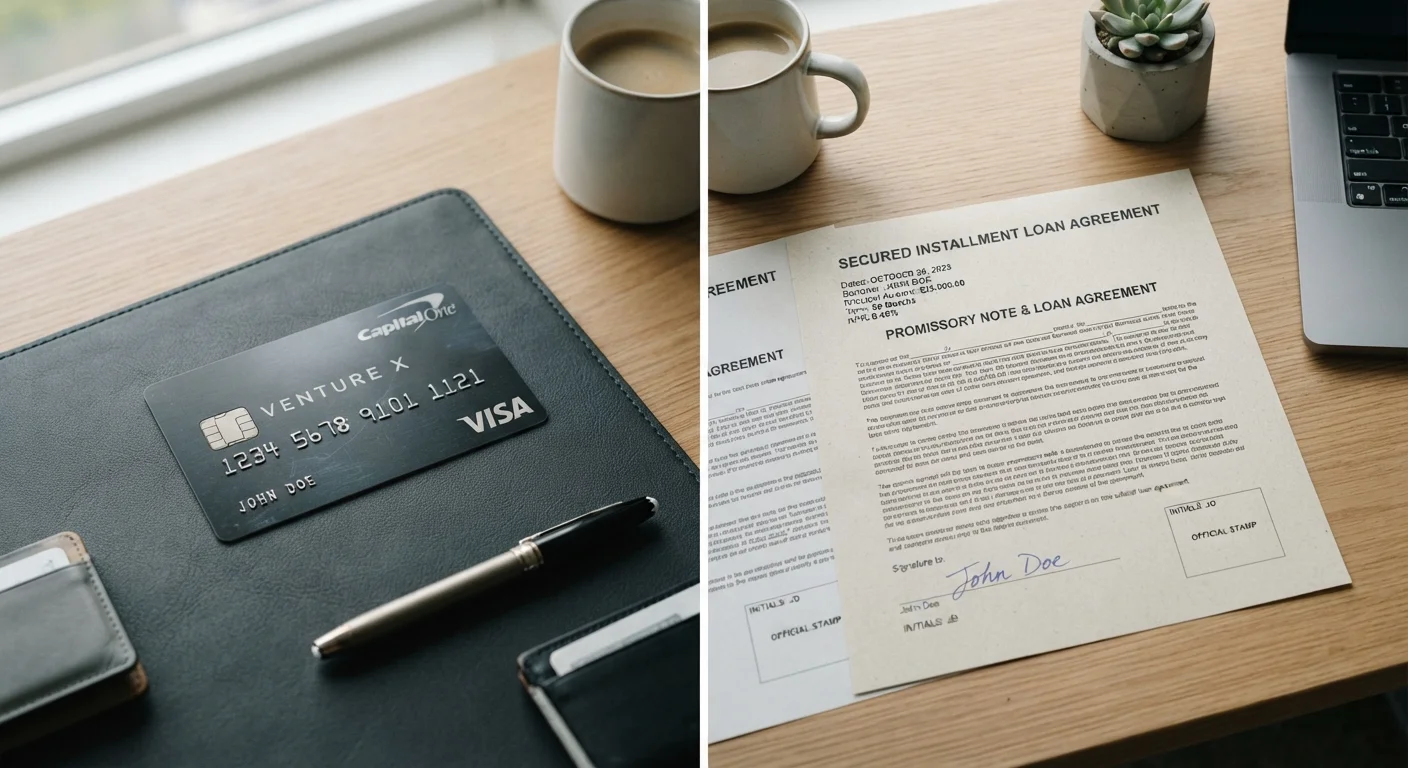
Revolving credit gives you a set credit limit that you can borrow against repeatedly. Credit cards are the most common example. Each month you can carry a balance, pay it down - fully or partially - and borrow again. Your balance fluctuates, and so does the interest you owe if you don't pay in full.
Installment credit works differently. A lender advances you a fixed sum - a mortgage, an auto loan, a student loan, a personal loan - and you repay it in equal monthly installments over a defined term. The balance moves in one direction only: down. Once it's paid off, the account is closed.
| Revolving Credit | Installment Credit | |
|---|---|---|
| Balance structure | Flexible; rises and falls with use | Fixed; decreases with each payment |
| Credit limit | Set limit; reusable as you pay down | No revolving limit; loan amount fixed at origination |
| Payment amount | Variable; minimum due each cycle | Fixed payment, same amount monthly |
| Utilization impact | Directly affects utilization ratio | Generally not factored into utilization |
| Common examples | Credit cards, HELOCs | Mortgages, auto loans, student loans, personal loans |
| Scoring model treatment | Affects amounts owed heavily | Affects amounts owed but via balance-to-original-loan ratio |
This structural difference is what drives each type's distinct effect on your credit score. Scoring models, including widely used FICO and VantageScore models, treat revolving and installment accounts differently in several key categories.
How Each Type Affects Credit Utilization
Credit utilization - the ratio of your revolving balances to your revolving credit limits - is one of the most sensitive inputs in most scoring models. It falls under the "amounts owed" category, which accounts for a significant share of a base FICO Score.
~30%
Score weight: amounts owed (FICO)
According to FICO's published scoring criteria, 'amounts owed' - which includes utilization on revolving accounts - makes up roughly 30% of a base FICO Score.
35%
Score weight: payment history (FICO)
Payment history is the single largest factor in base FICO Scores, applying equally to both revolving and installment accounts.
Crucially, utilization applies almost exclusively to revolving accounts. If you carry a $2,000 balance on a credit card with a $5,000 limit, your utilization on that card is 40%. Scoring models track this at both the individual account level and across all revolving accounts combined.
Installment loans don't factor into your revolving utilization ratio in the same way. Paying down a mortgage from $200,000 to $190,000 doesn't reduce your utilization ratio. Installment accounts do affect a related metric - the ratio of your current balance to the original loan amount - but this has a comparatively smaller impact on most scores than revolving utilization does.
Keep Revolving Balances Proportionally Low
Scoring models calculate your credit utilization ratio by dividing your revolving balances by your total revolving limits. Carrying a high balance relative to your limit - even if you pay on time - can suppress your score. A commonly cited guideline is to keep individual and overall utilization below 30%, though lower tends to score better. See how utilization affects score swings for a deeper breakdown.
Payment History: Where Both Types Are Equal
Here's where revolving and installment credit converge: on-time payments matter equally for both. Payment history is the single largest scoring factor in base FICO models, representing roughly 35% of your score. A 30-day late payment on a credit card is treated with similar severity as a 30-day late payment on an auto loan.
This means that managing installment credit responsibly - setting up autopay for a fixed monthly amount - can quietly build a strong payment history over years. Similarly, even a single missed payment on a revolving account can cause a meaningful score drop. See what actually happens when a negative item appears on your report for details on how late payments age and eventually fall off.
Because installment payments are fixed and predictable, some borrowers find them easier to manage consistently than revolving accounts, where the minimum payment changes monthly and the temptation to carry a larger balance exists.
Credit Mix and Why Having Both Can Help
Scoring models reward variety in your account types - a factor called credit mix. While it typically makes up only about 10% of a base FICO Score, having both revolving and installment accounts on your report generally scores better than having only one type.
This doesn't mean you should take on debt you don't need just to diversify. But it does explain why someone with only credit cards and no installment history might see a modest score improvement when they open a credit-builder loan, and vice versa. Secured cards and credit-builder loans are specifically designed for people building from a thin file, and they can help establish both account types at lower financial risk.
It's also worth noting that the number of accounts you open matters. Each new application typically generates a hard inquiry on your report. Hard inquiries and soft inquiries affect your score differently - understanding which is which helps you apply strategically.
What Closing Accounts Does to Your Profile
Closing a revolving account - say, a credit card you no longer use - removes that account's credit limit from your total available revolving credit. If you carry balances on other cards, your overall utilization ratio rises immediately, which can lower your score.
Closing an installment account that's already paid off has a different effect. It doesn't change your utilization ratio (installment accounts aren't part of that calculation), but it can eventually reduce your average account age as the closed account ages off your report, typically after 10 years for positive accounts.
Neither action is universally harmful or harmless - the impact depends on the rest of your credit profile. If you're considering closing accounts, understanding how your score is currently constructed is a useful first step. Credit score ranges across scoring models can help you contextualize where you stand before making changes.
This article is for general informational and educational purposes only and does not constitute personalized financial or credit advice. For guidance specific to your situation, consider consulting a qualified financial professional.