

Key Takeaways
Credit Score
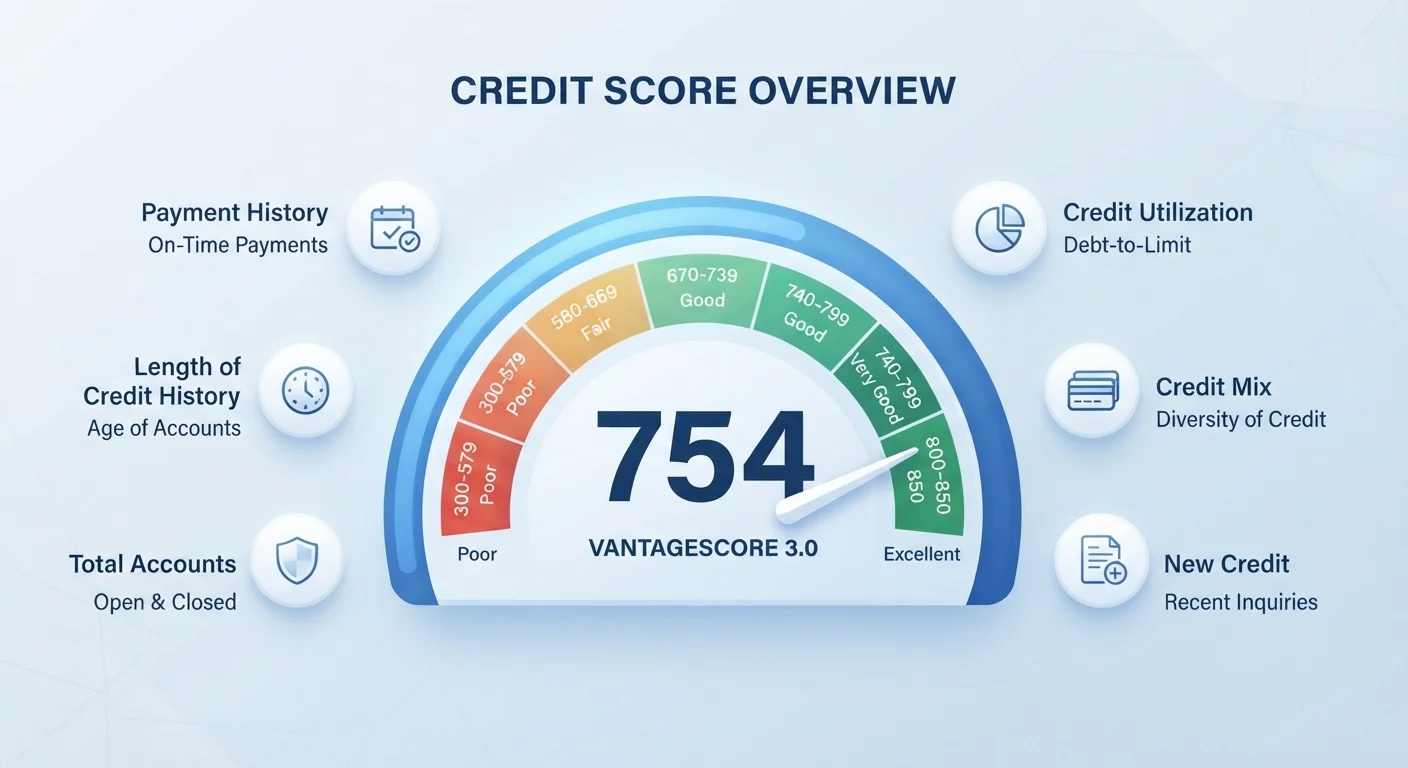
A credit score is a three-digit number - typically ranging from 300 to 850 - that summarizes how reliably a person has managed borrowed money over time. It is calculated by a scoring model using data pulled from your credit report. Lenders use it as a quick gauge of how likely you are to repay future debts on time.
The two dominant scoring models in the US are FICO® Score (used in the vast majority of lending decisions) and VantageScore, which use similar but not identical algorithms and weighting structures.
What a Credit Score Actually Measures
A credit score is not a measure of wealth, financial savvy, or character. It measures one thing: how you have managed credit obligations in the past, as a proxy for how you are likely to handle them in the future. The score is entirely backward-looking, derived from data in your credit report - the account histories, balances, and public records that creditors have submitted to the major credit bureaus.
It's worth being clear that a credit score and a credit report are two separate things. The report is the raw data; the score is a number a model produces by processing that data. If you haven't already, understanding the distinction is a useful starting point - our article on how your credit report and credit score differ covers this in detail.
200M+
US consumers with FICO scores on file
FICO estimates that more than 200 million Americans have scoreable credit files, based on data submitted to the major credit bureaus.
~90%
Top US lenders using FICO scores
FICO has reported that the vast majority of top US lenders rely on FICO scores as part of their credit decisioning process.
35%
Weight of payment history in FICO scoring
According to FICO's publicly published factor weighting, payment history is the single largest contributor to a FICO Score.
The Five Factors That Feed the Formula
Most major scoring models weigh a similar set of factors, though the exact percentages differ by model and version. Under the widely referenced FICO framework, the five categories are:
- Payment history (~35%): Whether you've paid accounts on time. Late payments, collections, and defaults carry significant negative weight.
- Amounts owed (~30%): How much of your available revolving credit you're using - commonly called your credit utilization ratio. Lower utilization generally helps your score. Our deeper article on how credit utilization drives score changes explains the mechanics in full.
- Length of credit history (~15%): How long your accounts have been open, including the age of your oldest account and the average age across all accounts.
- Credit mix (~10%): Whether you have experience managing different types of credit - revolving accounts like credit cards and installment loans like auto or student loans.
- New credit (~10%): Recent applications for credit, reflected as hard inquiries, and how many new accounts you've opened recently.
For a more detailed breakdown of each factor, see the five factors behind every FICO score.
Focus on the Biggest Levers First
Payment history and credit utilization together account for roughly 65% of a standard FICO score. If you're trying to improve your score, consistently paying on time and keeping revolving balances low relative to your limits will generally have more impact than any other single action. Small adjustments to less-weighted factors, like closing old accounts, can sometimes do more harm than good.
Why the Same Person Can Have Multiple Scores
Many people are surprised to discover that they don't have a single credit score - they have many, potentially dozens. Here's why:
- Multiple scoring models: FICO has released many versions of its model (FICO 8, FICO 9, FICO 10, and others), and different lenders adopt different versions. VantageScore, developed jointly by the three major bureaus, runs its own separate model.
- Three credit bureaus: Equifax, Experian, and TransUnion each maintain their own credit file for you. If a creditor doesn't report to all three - or if a detail was reported differently - your scores based on each bureau's data can diverge.
- Timing: Scores are recalculated on demand. If your balance was just reported high, your score might dip; once the balance updates, it can recover.
None of this means your scores are random or meaningless. They tend to move together over time, and the same habits that help one score generally help the others. If you want to understand how to read the raw data driving all of them, our guide to reading a credit report for the first time is a practical next step.
What Credit Scores Don't Measure
Understanding what stays outside the score is just as important as knowing what goes in. Standard credit scoring models do not consider:
- Your income or employment status
- Your savings, investments, or net worth
- Your age, race, gender, religion, or national origin (prohibited by law)
- Whether you've been through bankruptcy - though related account records may appear in your credit file
Lenders often look beyond the score itself when making final decisions. Your debt-to-income ratio - total monthly debt payments divided by gross monthly income - is one metric lenders frequently assess separately, even though it doesn't factor into your credit score.
This article is for general informational and educational purposes only and does not constitute personalized financial or credit advice. For guidance specific to your situation, consider consulting a licensed financial professional.