

Key Takeaways
Option A
Credit Report
The full history - a detailed record of your borrowing behavior.
Best for: Checking accuracy, spotting errors, and understanding what's driving your overall credit profile.
Option B
Credit Score
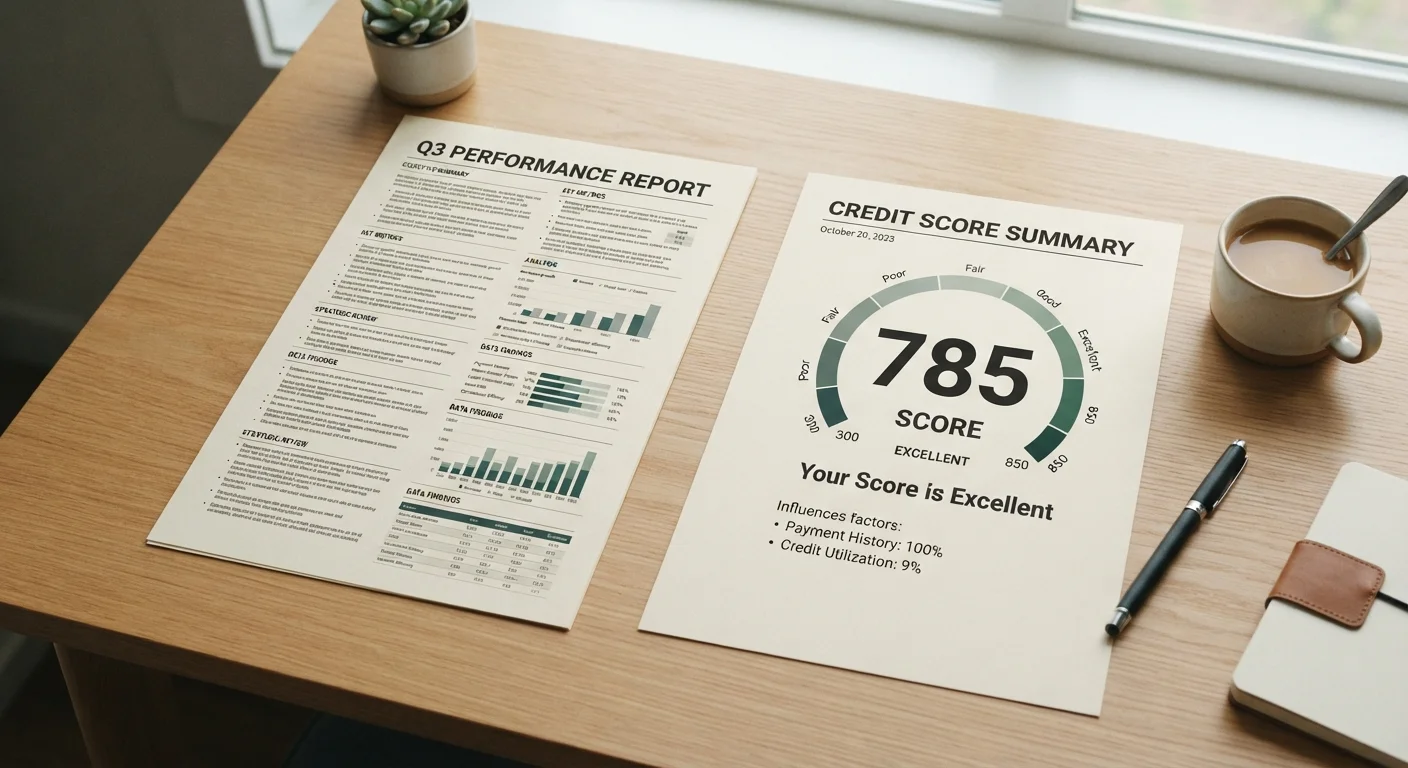
The summary number - a snapshot of your creditworthiness at a moment in time.
Best for: Quickly gauging where you stand and predicting how lenders are likely to evaluate your application.
If you want to understand what's in your credit file
Credit Report
The report contains the actual account data, payment history, and public records that shape your credit standing. Reviewing it helps you catch errors and understand your full history.
If you're preparing to apply for a loan or credit card
Credit Score
Lenders typically pull a score first to decide whether to proceed. Knowing your score range helps you set realistic expectations before you apply.
If you've been denied credit or received unfavorable terms
Credit Report
Federal law entitles you to a free report after an adverse action. The report reveals the specific factors - late payments, high balances, or errors - that may have contributed.
What Each Document Actually Is
A credit report is a detailed file compiled by a credit bureau - Equifax, Experian, or TransUnion - that records your history with borrowed money. It lists open and closed accounts, payment history, credit limits, outstanding balances, public records such as bankruptcies, and credit inquiries. Think of it as a financial biography, not a judgment.
A credit score, by contrast, is a three-digit number produced by a scoring model - most commonly FICO or VantageScore - that reads the data in your credit report and converts it into a single numerical summary. The score itself does not live inside your report; it's generated separately, on demand, each time a lender or consumer requests it.
The relationship between the two is one-directional: your report feeds the score. If your report contains inaccurate negative information, that error can drag your score down even though you did nothing wrong. That's one reason the Consumer Financial Protection Bureau (CFPB) encourages consumers to review their reports regularly. For a section-by-section walkthrough of what a report contains, see Reading a Credit Report for the First Time.
Who Creates Each One - and Why It Matters
The three major credit bureaus collect data from lenders, creditors, and public records and compile separate reports for each consumer. Because lenders are not required to report to all three bureaus, your Equifax report may differ from your TransUnion report - sometimes meaningfully.
Scoring companies then apply their proprietary models to bureau data. FICO has multiple scoring versions (FICO 8, FICO 9, FICO 10, and industry-specific variants), and VantageScore has its own versions as well. A mortgage lender may use a different FICO version than an auto lender, which is one reason the same person can have different scores depending on when and how they're checked.
| Criterion | Credit Report | Credit Score |
|---|---|---|
| What it is | Detailed history of your credit accounts | Single number summarizing creditworthiness |
| Who produces it | Equifax, Experian, TransUnion | FICO, VantageScore, others |
| How many versions exist | 3 separate bureau reports | Dozens of model versions |
| Free access | By law via AnnualCreditReport.com | Often via card issuers or banks |
| Affected by errors | Errors appear directly in the report | Score drops if report contains errors |
| Used by lenders to | Verify account details and history | Make quick eligibility decisions |
Neither document is "better" - they serve different functions. Lenders typically look at both: the score to make a quick eligibility decision, and the report to verify the details that support that score.
Accessing Your Report vs. Checking Your Score
Federal law - specifically the Fair Credit Reporting Act (FCRA) - gives you the right to one free credit report from each bureau every 12 months through AnnualCreditReport.com, the only site officially authorized for this purpose. Some periods have offered more frequent free access; check that site directly for current availability. Requesting your own report is a soft inquiry and has no effect on your score.
Free score access varies more widely. Many credit card issuers, banks, and credit unions now display a score in your online account dashboard, though these may use different models than what a lender would pull. Understanding the difference between hard and soft inquiries helps clarify when checking your score is safe versus when a lender's pull could affect your file.
Your Score Can Change Without You Doing Anything
Because scores are calculated on demand from current report data, your score can shift from month to month as balances change, accounts age, or old negative items fall off. A score you saw 90 days ago may no longer reflect your file today. This is normal - it's a feature of how dynamic scoring models work, not a sign something is wrong.
For context on interpreting any score you receive, Credit Score Ranges Across Scoring Models explains how to read the numbers regardless of which model produced them.
This article is for general informational purposes only and does not constitute personalized financial or legal advice. For guidance specific to your situation, consult a qualified financial professional.