

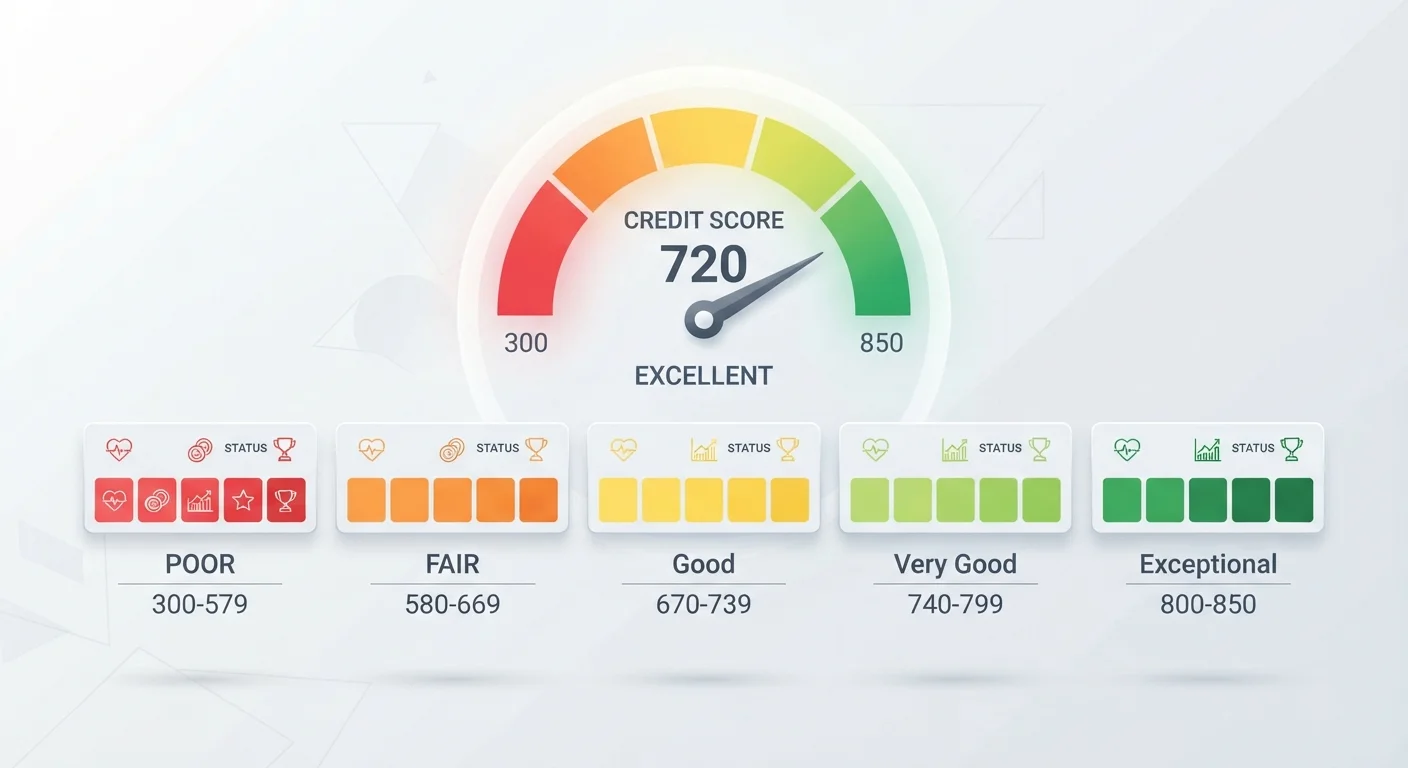
How FICO Builds a Score From Five Inputs
A FICO score is a three-digit number, typically ranging from 300 to 850, that lenders use to estimate how likely you are to repay a debt. What most people don't realize is that the score isn't a mystery - it's a formula built from five specific categories of credit behavior, each carrying a defined weight.
Understanding these weights helps you focus your energy where it actually matters. The factors are not equal, and improving some of them takes more time than others. Here's what each one measures and why it's included.
Breaking Down Each of the Five Factors
1. Payment History (35%)
This is the single largest factor in your FICO score. It tracks whether you've paid your accounts on time - credit cards, mortgages, auto loans, student loans, and certain bills. Even one payment that's 30 or more days late can meaningfully lower a score, and the effect compounds the longer the delinquency runs. To learn more about how specific negative entries play out, see what actually happens when a negative item appears on your report.
2. Amounts Owed (30%)
This factor is largely driven by your credit utilization ratio - how much of your available revolving credit you're currently using. High balances relative to your credit limits signal financial strain to lenders, even if you pay on time every month. A lower utilization ratio generally works in your favor. Credit utilization: The Silent Driver of Score Swings covers this in depth, including how billing cycles affect what gets reported.
3. Length of Credit History (15%)
FICO looks at the age of your oldest account, your newest account, and the average age of all accounts. A longer track record generally helps because it gives lenders more data to assess your behavior. Closing older accounts can shorten your average history and may reduce your score - something worth knowing before tidying up accounts you rarely use.
4. Credit Mix (10%)
Lenders like to see that you can manage different types of credit responsibly. This category rewards having a healthy mix of revolving accounts (credit cards, lines of credit) alongside installment accounts (mortgages, auto loans, personal loans). That said, you shouldn't open accounts you don't need just to diversify your mix - the benefit is modest and the costs can outweigh it.
5. New Credit (10%)
Each time you apply for new credit, the lender typically runs a hard inquiry on your report. Multiple hard inquiries in a short window can signal that you're taking on new debt quickly, which slightly lowers your score. FICO does treat rate-shopping for mortgages, auto loans, and student loans as a single inquiry if done within a short period, so comparison shopping for large loans carries less penalty than many people assume.
Credit Utilization Ratio
The percentage of your available revolving credit that you're currently using. It's calculated by dividing your total revolving balances by your total revolving credit limits.
Hard Inquiry
A credit check initiated when you apply for new credit. Hard inquiries appear on your credit report and can temporarily lower your FICO score by a small amount.
Revolving Credit
A type of credit with a reusable limit, such as a credit card or line of credit, where you can borrow, repay, and borrow again up to the limit.
Installment Account
A loan with a fixed number of scheduled payments over a set term, such as a mortgage, auto loan, or student loan.
Delinquency
A failure to make a required payment by the due date. Accounts are typically reported as delinquent after 30 days past due, with increasing severity at 60 and 90 days.
What This Means in Practice
The five-factor breakdown reveals a clear priority order. Paying on time and keeping balances low account for 65% of your score combined - those two behaviors carry more weight than everything else put together. History length, credit mix, and new credit matter, but they are secondary levers.
Improvement is possible in every category, but the timelines differ. Recovering from a missed payment takes months to years. Reducing a high utilization ratio, on the other hand, can reflect in your score as soon as the lower balance gets reported to the credit bureaus. Be cautious of habits that erode scores gradually - some behaviors undermine a good score slowly and without obvious warning signs.
If you want to put your score number in context, credit score ranges across scoring models explains what different score tiers typically mean to lenders and how FICO and VantageScore ranges compare.
This article is for general informational purposes only and does not constitute personalized financial or legal advice. For guidance specific to your situation, consult a qualified financial professional.