

Key Takeaways
Why Unit Price Is the Metric That Cuts Through Marketing
Sticker prices are engineered to look appealing. Package sizes shift. Sale banners frame savings in percentage terms that obscure the underlying math. Unit price - the cost expressed as a standard, comparable quantity - strips those layers away.
Unlike total price, unit price allows you to compare a 12-count package against a 20-count package, or a 28 oz bottle against a 32 oz bottle, using a single number. It is the foundation of what reading a price tag like a researcher actually means in practice.
Understanding why retailers price the way they do adds useful context. Retail markups and margin structures explain why the largest size is not always the most profitable item for the store - which in turn explains why unit pricing is not always surfaced prominently.
Calculator (phone or handheld)
Divide total price by quantity or weight to compute unit price on the spot.
Notepad or notes app
Record unit prices across multiple products or stores for side-by-side comparison.
How to Calculate and Compare Unit Prices
The process is straightforward regardless of product category. Follow the steps below with a calculator in hand. Once the habit is established, most calculations take under 30 seconds per product.
What you will need
Locate the unit price on the shelf label
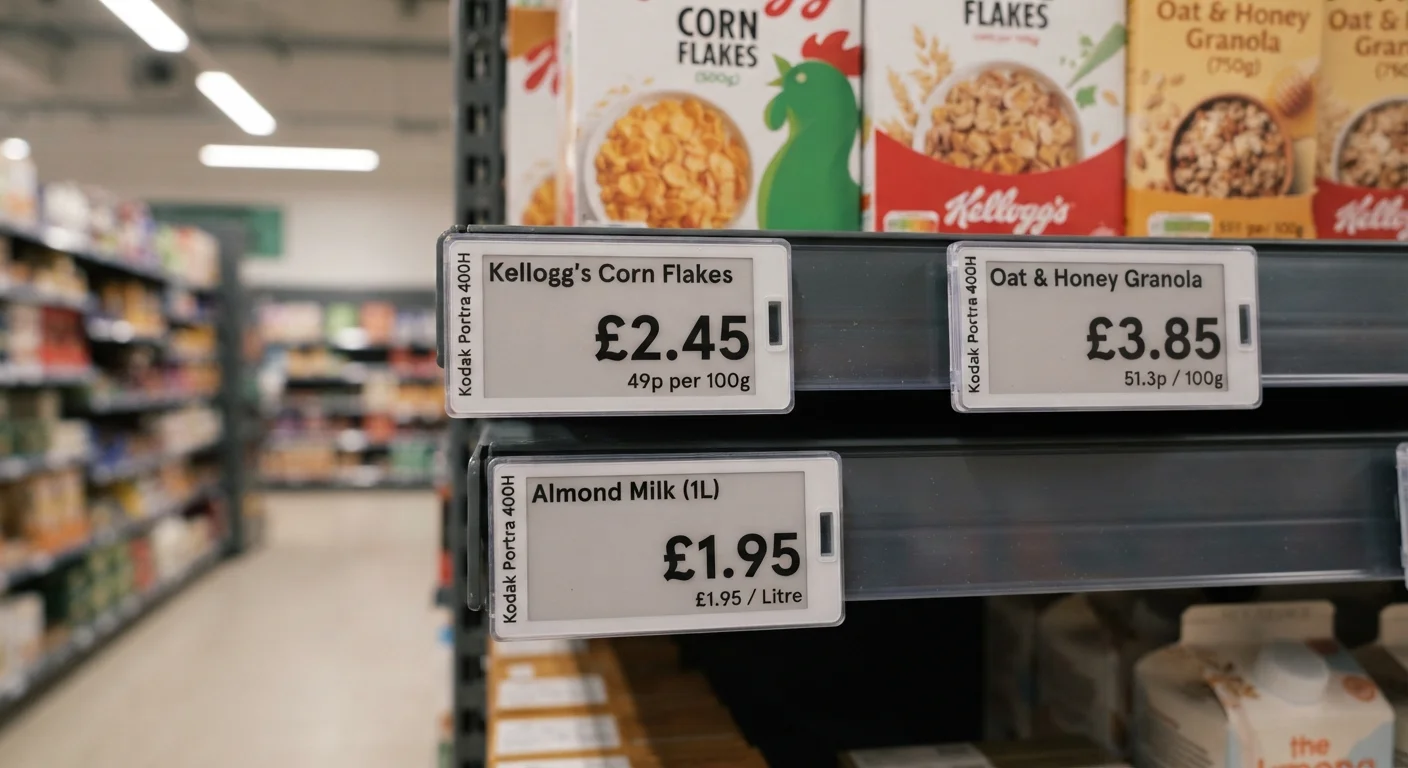
Most large grocery and mass-market retailers print a unit price - expressed as cost per ounce, per count, per fluid ounce, per square foot, or another standard measure - directly on the shelf tag, usually in smaller text below the total price. Look for a label section that includes a per-unit measure like $0.18/oz or $0.04/ct.
If you are shopping at a smaller retailer, discount grocer, or specialty store, unit pricing may be absent or inconsistent. In those cases, move directly to Step 3.
Confirm the unit of measure is consistent across competing products
Before comparing two shelf tags, verify that both use the same unit. Retailers sometimes display one product per ounce and a competing product per pound, or one item per count and another per pack. A mismatch makes the numbers look incomparable when they could be directly converted.
Common conversions to keep handy: 1 pound = 16 ounces; 1 liter ≈ 33.8 fluid ounces. When units differ, use your calculator to normalize to a single common measure before comparing.
Calculate unit price manually when labels are missing or unclear
Divide the total shelf price by the quantity shown on the package:
Unit Price = Total Price ÷ Total Quantity
Example: A 32 oz bottle priced at $4.79 has a unit price of $4.79 ÷ 32 = $0.15 per ounce. A 20 oz bottle priced at $3.49 works out to $3.49 ÷ 20 = $0.17 per ounce. The larger bottle is cheaper per ounce despite the higher sticker price.
Apply unit pricing to sale and bulk items
Promotional tags rarely make it easy to compare value - they emphasize the discount percentage or the new total price, not the per-unit cost. Run the same division on sale prices and bulk quantities as you would on any standard item.
Bulk warehouse quantities and multi-pack deals deserve particular scrutiny. Bundle deals don't always win on unit price - a standard supermarket size on sale can match or beat a warehouse club pack once you do the math.
Factor in realistic usage before committing to the lowest unit price
The lowest unit price is only a genuine saving if you will actually use the full quantity before the product expires, deteriorates, or becomes inconvenient to store. A per-ounce cost advantage disappears if half the product is discarded.
For non-perishables with long shelf lives - paper goods, canned staples, cleaning supplies - unit price is often the dominant variable. For perishables, weigh unit cost against your realistic consumption pace. This connects to a broader idea covered in total cost of ownership thinking: the cheapest unit price at purchase is not always the lowest total cost.
When Unit Prices Mislead
Unit pricing assumes you are comparing equivalent products - same formulation, same quality, same intended use. A paper towel priced at $0.02 per sheet may be thinner than one at $0.03 per sheet, making the cheaper option require more sheets per task. Unit price is a reliable starting point, not a complete substitute for reading the product label.
Shelf Tag Errors Are More Common Than Expected
Retail shelf tags are updated manually or through systems that lag behind inventory changes. A tag may reflect a prior package size, an outdated price, or a mismatched product. If a unit price looks dramatically lower than competing products, verify it by calculating from the package's listed weight or count rather than trusting the tag alone.
Size Increases Don't Guarantee Better Value
Manufacturers and retailers periodically shrink package sizes while holding prices steady - a practice sometimes called 'shrinkflation.' This can make a formerly good unit price look unchanged on the tag while the actual cost per ounce has risen. Recalculate manually on products you buy regularly rather than assuming historical value still holds.
After you have identified the lowest legitimate unit price for a given product, consider pairing that insight with price history research. A low unit price at a moment in time may still be above that product's typical price range - context that unit pricing alone cannot provide.