

Key Takeaways
Ultra-Processed Foods
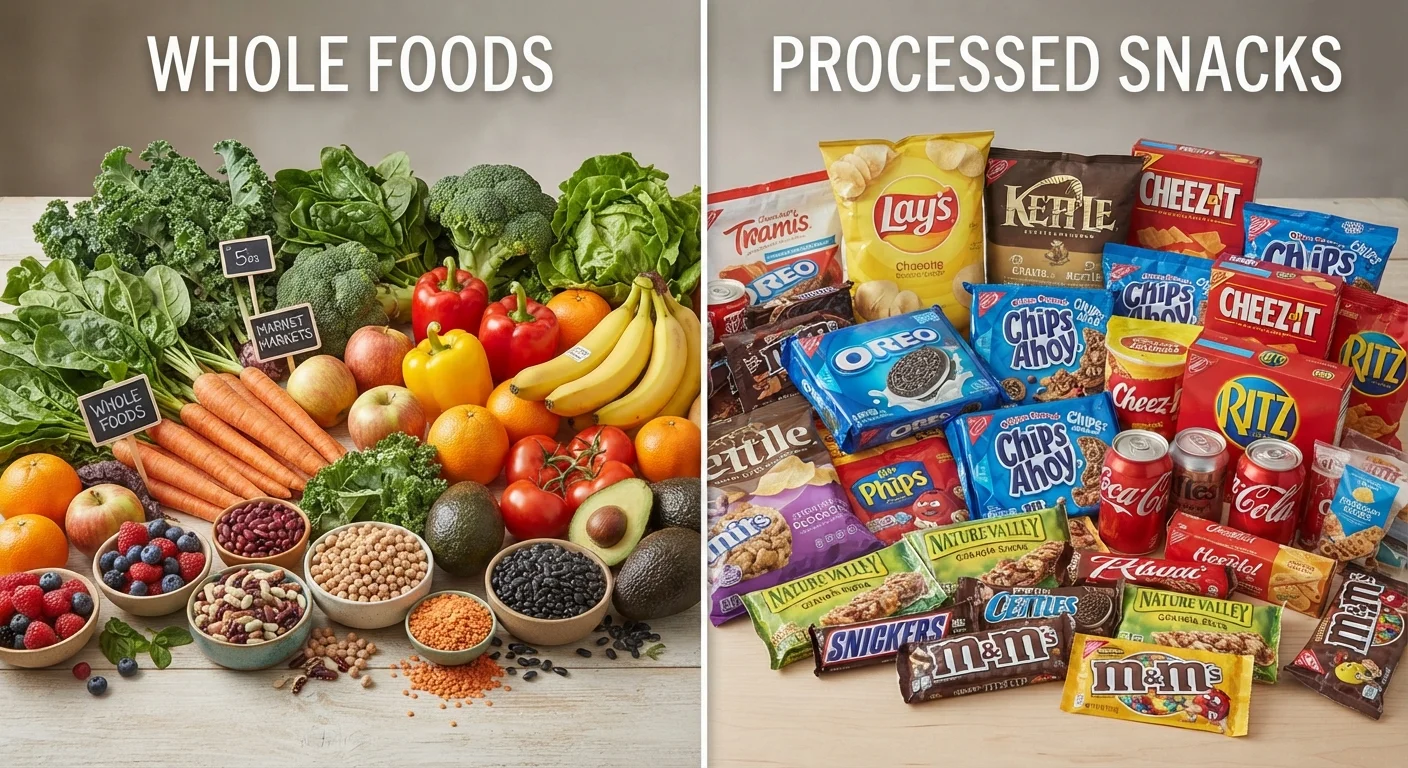
Ultra-processed foods are industrial formulations made mostly from refined ingredients and additives - such as colorings, emulsifiers, flavor enhancers, and preservatives - with little or no whole food content. They go far beyond basic food preservation or preparation, often engineered to be hyper-palatable. Examples include packaged snacks, instant noodles, carbonated soft drinks, and reconstituted meat products.
The NOVA classification system, developed by researchers at the University of São Paulo, formally defines ultra-processed foods as Group 4 - distinguished not merely by nutrients, but by the industrial nature of their ingredients and manufacturing processes.
What Food Processing Actually Means
The word "processed" gets used loosely, which creates genuine confusion. In nutritional science, food processing simply refers to any deliberate change made to a food before it reaches your plate - and that includes washing, chopping, fermenting, pasteurizing, freezing, and cooking. By that definition, almost everything we eat has been processed to some degree.
The meaningful distinction is not whether a food was processed, but how and why. Freezing spinach to preserve its nutrients is a very different act from engineering a snack product from fractionated corn, flavoring compounds, and stabilizers. Understanding this spectrum is essential for making sense of nutrition research and food guidance. See our guide to what food labels actually tell you for related insight into packaging claims.
The NOVA Framework: A Four-Group Classification
The NOVA system, developed by Carlos Monteiro and colleagues at the University of São Paulo, offers a structured way to categorize foods by their degree and purpose of processing. It is not a nutrient-based framework - it focuses on industrial processes and the nature of ingredients used.
- Group 1 - Unprocessed or minimally processed foods: Whole or near-whole foods altered only to make them edible, safe, or storable. Examples include fresh vegetables, plain frozen fruit, unsalted nuts, eggs, and plain yogurt with no additives.
- Group 2 - Processed culinary ingredients: Substances extracted from Group 1 foods and used in home cooking, such as flour, olive oil, butter, salt, and sugar. Rarely eaten alone, they transform whole foods into meals.
- Group 3 - Processed foods: Whole foods combined with Group 2 ingredients to extend shelf life or enhance flavor. Canned fish in brine, cheese, cured meats, and freshly baked artisan bread fall here.
- Group 4 - Ultra-processed foods: Industrial formulations with five or more ingredients, often including substances derived from food processing (like hydrogenated oils or maltodextrin) and additives with no culinary equivalent - colorings, emulsifiers, artificial flavors, and stabilizers.
57%
Share of US calories from ultra-processed foods
A nationally representative dietary analysis published in BMJ Open found that ultra-processed foods accounted for approximately 57% of total energy intake among US adults.
500+
Additional calories consumed daily on ultra-processed diet
A 2019 randomized controlled trial by the National Institutes of Health found participants ate roughly 500 more calories per day when assigned to an ultra-processed diet versus an unprocessed one.
4 groups
NOVA classification categories
The NOVA framework assigns all foods to one of four groups based on the degree and purpose of processing, independent of individual nutrient content.
NOVA's framework has been adopted in nutrition studies worldwide, and its distinctions increasingly inform public health policy in countries including Brazil, France, and Canada.
How Ultra-Processed Foods Are Different in Practice
Ultra-processed foods differ from minimally processed ones in three key ways: their ingredient sourcing, their additive content, and their nutritional structure.
First, their core ingredients are rarely whole foods. Manufacturers often start with refined carbohydrates, hydrogenated fats, or protein isolates - fractions of original foods stripped of their natural nutritional matrix. This is fundamentally different from, say, rolled oats that are simply flattened whole oat groats.
Second, ultra-processed products contain additives that serve industrial rather than culinary purposes. Emulsifiers improve texture and shelf stability; artificial sweeteners replace sugar; color additives restore appearance lost during refining. None of these appear in a standard home pantry. For a closer look at how ingredients are labeled on packaging, explore our nutrition labeling terms glossary.
Third, the nutritional profile of ultra-processed foods often reflects what has been removed as much as what has been added. Fiber, micronutrients, and beneficial phytochemicals present in whole ingredients are largely lost during industrial refining - sometimes partially replaced through fortification, though not always in bioequivalent forms. This parallels the differences seen between whole and refined grains in terms of blood sugar response and fiber content.
What the Research Suggests - and Its Limits
A growing body of epidemiological research associates high ultra-processed food consumption with elevated risk of obesity, type 2 diabetes, cardiovascular disease, and certain cancers. Large cohort studies conducted in Europe, the United States, and Brazil have consistently found these associations even after adjusting for overall calorie intake and socioeconomic factors.
However, causation has not been definitively established in most cases. Observational studies can identify associations but cannot fully rule out confounding - people who eat more ultra-processed foods may also engage in other health-affecting behaviors. Randomized controlled trial evidence remains limited, though a notable 2019 NIH study found that participants consumed significantly more calories when offered an ultra-processed diet compared to an unprocessed one, even when the diets were matched for total nutrients.
“The problem is not processing per se, but a specific category of products manufactured through a series of industrial processes, many of which have no culinary equivalent, using ingredients largely or entirely unknown in domestic kitchens.”
— Carlos Monteiro, Professor of Nutrition and Public Health, University of São Paulo; lead developer of the NOVA classification system
What researchers broadly agree on is that dietary patterns emphasizing whole and minimally processed foods are associated with better long-term health outcomes. This does not require perfection or elimination of all processed foods - it reflects the cumulative effect of everyday food choices over time.
This article is for general informational and educational purposes only and does not constitute medical or dietary advice. Consult a registered dietitian or qualified healthcare professional for guidance specific to your health needs.