

Key Takeaways
Food Label
A food label is the standardized panel of information printed on packaged food, required by the FDA to include nutrition data, ingredient lists, and certain health claims. It's designed to give consumers a snapshot of a product's nutritional content relative to a standard daily diet. However, labels only disclose what regulations require - leaving out context about food quality, processing level, and overall dietary fit.
The current Nutrition Facts panel format was updated by the FDA in 2016 and fully phased in by 2021, with changes including added sugars disclosure and updated daily value benchmarks based on more recent dietary guidance.
The Nutrition Facts Panel: What It Covers
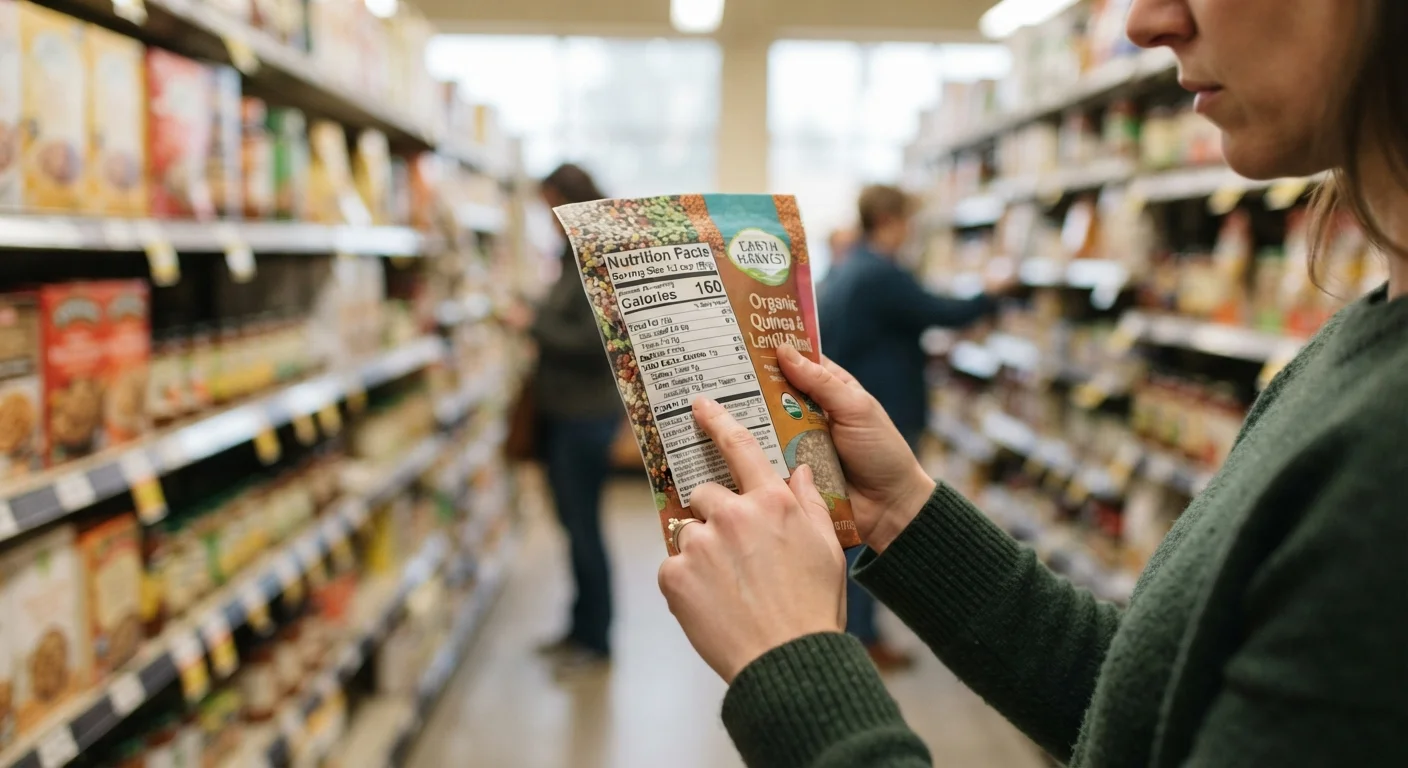
The Nutrition Facts panel is the rectangular box on most packaged foods in the US, and it's the most regulated part of any food label. It must disclose calories, macronutrients (fat, carbohydrates, protein), certain micronutrients (sodium, potassium, vitamins D and C, calcium, iron), and - since the 2016 FDA update - added sugars separately from total sugars.
The starting point is serving size. This figure shapes every number that follows: a product with 150 calories per serving but three servings per container contains 450 calories if you eat the whole thing. Serving sizes are supposed to reflect typical consumption, but they don't always match how people eat in practice. For a section-by-section walkthrough of the panel itself, see our guide to reading a Nutrition Facts panel without getting overwhelmed.
2021
Year all manufacturers completed FDA label update
The FDA's updated Nutrition Facts panel - requiring added sugars disclosure and revised daily values - was fully phased in by January 2021 for all food manufacturers.
~70%
Americans who read food labels at least sometimes
According to FDA consumer research, a majority of US adults report using the Nutrition Facts panel when making food purchasing decisions, though comprehension varies.
Top 3
Ingredients to check first on any label
Nutrition educators commonly advise focusing on the first three ingredients in the list, as they represent the largest proportion of a food's composition by weight.
Daily Value Percentages: A Reference, Not a Rule
Each nutrient on the panel includes a percent Daily Value (%DV), calculated against a standardized 2,000-calorie diet. These percentages are useful orientation points: 5% DV or lower generally signals a low source of a nutrient; 20% DV or higher indicates a high source. Nutrients you typically want more of include fiber, potassium, and vitamins D and calcium. Nutrients where lower is generally better include sodium, saturated fat, and added sugars.
The 2,000-calorie baseline is a population-level reference, not a prescription. Individual needs vary substantially based on age, sex, body size, activity level, and health status. Daily Values are a tool for comparing products, not a personal dietary target. If you're considering whether tracking these numbers closely is right for you, our article on when nutrition tracking helps and when it gets in the way offers a balanced look at the trade-offs.
Use %DV to Compare, Not to Calculate
Rather than trying to hit specific daily value targets, use %DV percentages to compare similar products side by side. A bread with 15% DV of sodium versus one with 5% DV offers a quick relative signal without requiring you to do any math. This comparative approach is one of the most practical uses of the Nutrition Facts panel.
The Ingredient List: Where to Focus Your Attention
Ingredients must be listed in descending order by weight - the first ingredient makes up the largest proportion of the product. If refined flour or added sugar appears among the first three ingredients in a product marketed as nutritious, that context matters. The ingredient list also reveals things the Nutrition Facts panel doesn't, including specific types of oils used, the presence of artificial additives, and whether whole or refined grains were used.
However, the ingredient list doesn't tell you how much of each ingredient is present, only its relative rank. A product can list 'whole wheat flour' first and still contain substantial added sugars further down. Reading both the ingredient list and the Nutrition Facts panel together gives a more complete picture than either alone.
What Food Labels Don't Tell You
Labels are a regulatory snapshot, not a complete nutritional portrait. Several important dimensions are absent. First, processing level: a product can have a relatively clean nutrient profile and still contain dozens of additives and refined components. Understanding this gap is important - our piece on how ultra-processed foods differ from minimally processed ones explains how classification systems like NOVA approach this distinction.
Second, labels don't capture dietary context. A single food's label says nothing about how it fits into your overall eating pattern, which matters far more to long-term health than any individual product. Third, front-of-package marketing language - terms like 'natural,' 'wholesome,' or 'clean eating' - is largely unregulated. Our nutrition labeling terms glossary distinguishes between claims that carry legal definitions and those that don't.
Labels also say little about fat quality beyond total and saturated fat. The difference between unsaturated fats in olive oil and saturated fats in certain processed foods is nutritionally significant - a nuance our article on the misunderstood role of dietary fat explores in depth.
Labels Reflect a Single Food, Not Your Whole Diet
No individual food label captures whether a product is a good fit for your overall dietary pattern. Public health research consistently shows that dietary patterns - the full combination of what you eat over time - matter more to health outcomes than any single food or nutrient. A label can inform a choice, but it can't evaluate your diet as a whole.
This article is for general informational and educational purposes only and is not a substitute for professional medical or dietary advice. For guidance specific to your health needs, consult a qualified healthcare provider or registered dietitian.