

Key Takeaways
Why the Nutrition Facts Panel Exists
The Nutrition Facts panel is a federally regulated label required on most packaged foods sold in the United States. The Food and Drug Administration (FDA) oversees its format, and the current version - updated in 2020 - was designed specifically to make nutritional information easier to use at a glance. Even so, many shoppers find it confusing or skip it entirely.
Learning to read this label isn't about obsessing over every number. It's about building a practical framework so you can make more informed choices without needing a nutrition degree. For a broader look at what labeling can and cannot tell you, see our guide on what food labels actually tell you.
What you will need
Step-by-Step: How to Read the Panel
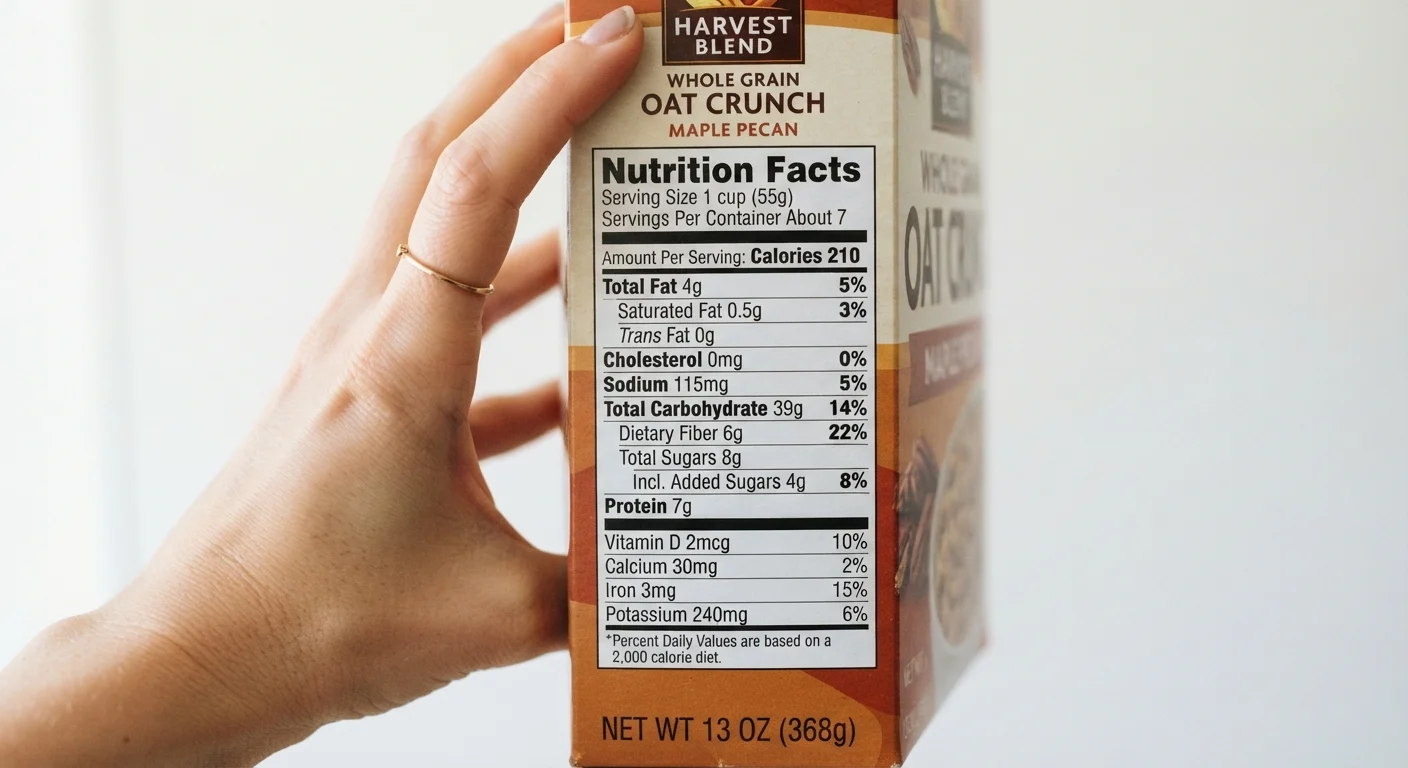
Work through the label from top to bottom. Each section builds on the one before it, so skipping around tends to create confusion. The steps below walk you through each part in the order it appears.
Find the Serving Size
The serving size is printed at the very top of the panel, and it's the most important number on the label. Every other value - calories, fat, sodium - applies to that one serving, not the entire package.
Serving sizes are standardized by the FDA based on amounts people typically consume, expressed in both common household units (e.g., "2/3 cup") and grams. If you eat two servings, you double every number on the label.
Read the Calorie Count
Calories are displayed in a large, bold font directly below the serving size. This number reflects the total energy provided by one serving from all macronutrients: fat (9 calories per gram), carbohydrates (4 per gram), and protein (4 per gram).
Calories are a useful reference point for energy balance, but they don't indicate nutritional quality on their own. A 200-calorie food can be nutrient-dense or nutritionally sparse depending on what else is in it.
Review the Nutrients to Limit
The middle section of the panel lists nutrients most Americans tend to overconsume. These include:
- Total fat - further broken down into saturated fat and trans fat
- Saturated fat - dietary guidelines recommend limiting this
- Trans fat - no safe level has been established; aim for as little as possible
- Cholesterol
- Sodium - most adults consume well above recommended amounts
- Added sugars - distinguished from naturally occurring sugars since the 2020 update
These aren't foods to avoid entirely, but awareness of your intake is useful for long-term health. For more on front-of-package terms related to these nutrients, see our nutrition labeling terms glossary.
Look at the Nutrients to Get Enough Of
Below the nutrients to limit, the panel lists nutrients that many Americans tend to fall short on:
- Dietary fiber - supports digestive health and is linked to reduced chronic disease risk
- Vitamin D
- Calcium
- Iron
- Potassium
Higher values here are generally favorable. Our companion guide on vitamins and minerals explains why each of these matters.
Use the % Daily Value Column
The right-hand column shows each nutrient as a percentage of its Daily Value (DV) - the recommended daily intake based on a 2,000-calorie reference diet established by the FDA. The rule of thumb endorsed by the FDA:
- 5% DV or less = low in that nutrient
- 20% DV or more = high in that nutrient
Use these benchmarks to compare products quickly. For nutrients to limit (sodium, saturated fat, added sugars), lower % DVs are preferable. For nutrients to get enough of (fiber, calcium, iron), higher % DVs are preferable.
Putting It All Together
Reading a Nutrition Facts panel becomes faster with practice. Within a few grocery trips, checking serving size and scanning a few key values will feel routine rather than time-consuming.
Keep in mind that Daily Values are reference points, not personal targets. Factors like age, activity level, health status, and any existing conditions all affect what nutrients matter most to you individually. A registered dietitian can help you interpret labels in the context of your own health goals - especially if you're managing a chronic condition or navigating specific dietary needs.
Use the Label for Comparison, Not Perfection
The Nutrition Facts panel is most practical as a comparison tool - useful for choosing between two similar products rather than judging any single food in isolation. No one food makes or breaks a diet. Context and overall eating patterns matter far more than any individual number.
If you'd like to understand the macronutrients - carbohydrates, protein, and fat - that make up the bulk of any label, our plain-language guide to macronutrients covers each one in depth. And once you feel comfortable reading labels, you may be ready to apply that knowledge to building a grocery list that reflects balanced eating.
This article is for general informational and educational purposes only and is not a substitute for professional medical or dietary advice. Consult a qualified healthcare provider before making significant changes to your diet.