

Key Takeaways
Whole Grains vs. Refined Grains
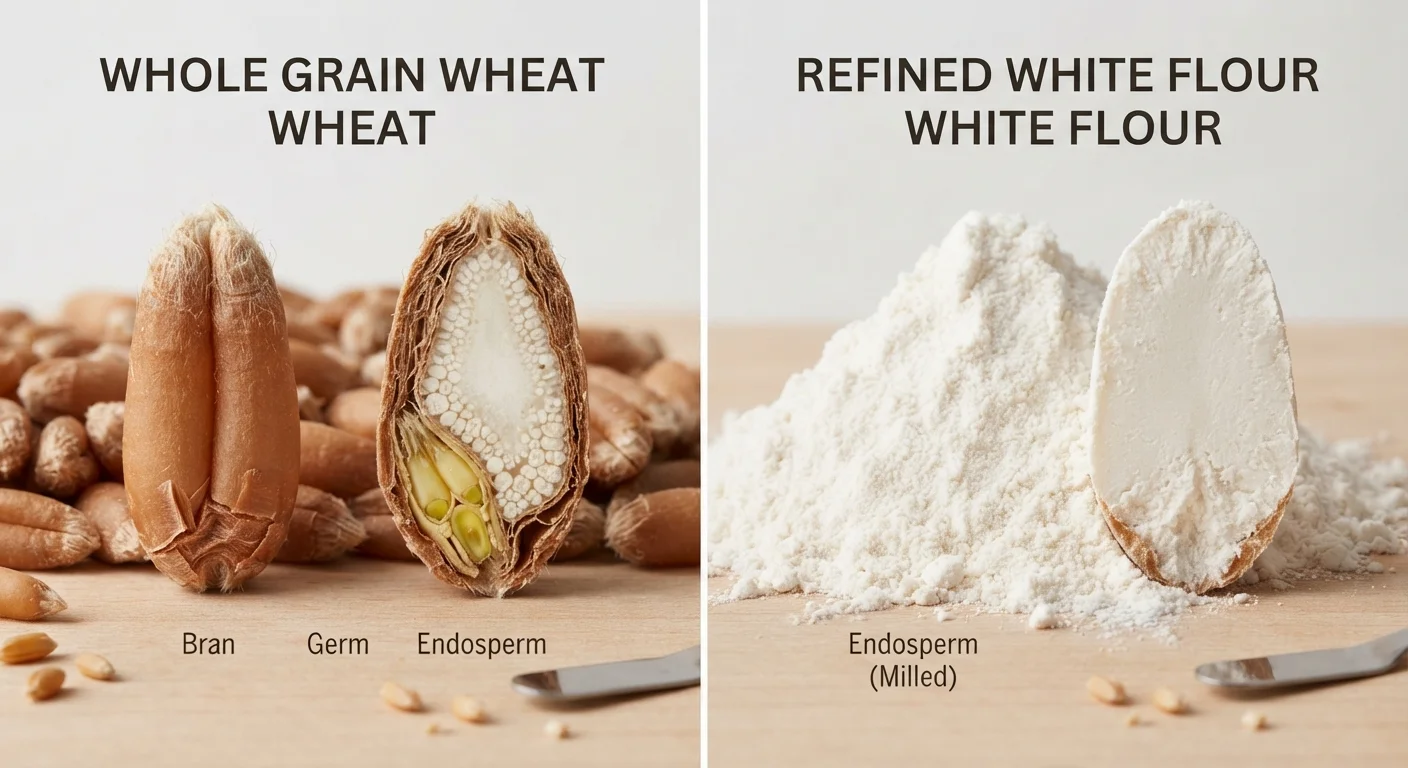
Whole grains contain all three parts of the original grain kernel: the bran (outer layer), the germ (nutrient-rich core), and the endosperm (starchy center). Refined grains have been milled to remove the bran and germ, leaving primarily the starchy endosperm. This processing changes both the nutritional profile and the way the body digests and responds to the grain.
The glycemic index (GI) of a grain food is directly influenced by how much of the fiber-rich bran and germ remain intact, since these components slow enzymatic breakdown of starch into glucose.
What Happens to a Grain During Refining
A grain kernel in its natural state is a three-part structure. The bran is the fibrous outer shell, packed with dietary fiber, B vitamins, and antioxidants. The germ is the small embryo at the kernel's core, rich in healthy fats, vitamin E, and additional B vitamins. The endosperm - the largest portion - is primarily starch and protein, providing energy but relatively few micronutrients on its own.
Milling strips away the bran and germ to produce refined flour or grain. The result is a product with a lighter texture, longer shelf life, and milder flavor - but significantly fewer nutrients. Research published by the American Journal of Clinical Nutrition and summarized by the Whole Grains Council estimates that refining wheat removes roughly 25% of its protein and strips away more than half of most B vitamins, along with the majority of its fiber and magnesium.
Enrichment - a mandatory process for many refined grain products in the US - adds back certain B vitamins and iron. But fiber, vitamin E, magnesium, zinc, and numerous phytochemicals are not restored. This is why the nutritional gap between whole and refined grains persists even when a product is labeled "enriched."
Blood Sugar, Digestion, and the Fiber Factor
One of the most clinically significant differences between whole and refined grains is how quickly the body converts them to glucose. Without bran and germ, refined starch is rapidly broken down by digestive enzymes, sending glucose into the bloodstream quickly. Whole grains, with their intact fiber matrix, slow this process considerably.
~25%
Protein lost during wheat refining
Estimates from Whole Grains Council research indicate refining removes approximately a quarter of wheat's protein alongside the majority of its fiber and micronutrients.
3+
Daily whole grain servings recommended
The Dietary Guidelines for Americans advise that at least half of total daily grain intake - roughly three or more servings - should come from whole grain sources.
~20-30%
Lower cardiovascular disease risk with high whole grain intake
Multiple large prospective cohort meta-analyses have found this approximate risk reduction in individuals with the highest whole grain consumption compared to the lowest.
This difference in digestion speed is reflected in a grain's glycemic index (GI) - a measure of how quickly a food raises blood glucose relative to pure glucose. White bread typically has a GI around 70-75, while whole grain bread generally falls in the 50-60 range, depending on preparation. Lower GI responses are associated with more stable energy and reduced strain on insulin regulation over time.
Fiber's role extends beyond blood sugar. Soluble and insoluble fibers both found in whole grains, support digestive regularity, help feed beneficial gut bacteria, and contribute to feelings of satiety after eating.
What the Long-Term Research Shows
Population-level evidence consistently links higher whole grain consumption to meaningful health outcomes. Meta-analyses examining data from large prospective cohort studies - including the Nurses' Health Study and the Health Professionals Follow-up Study - have found that individuals who consume the most whole grains have lower rates of cardiovascular disease, type 2 diabetes, and colorectal cancer compared to those who consume the least.
“The evidence that whole grain consumption is associated with lower risk of cardiovascular disease, type 2 diabetes, and certain cancers is among the most consistent in nutritional epidemiology.”
— Walter Willett, Professor of Epidemiology and Nutrition, Harvard T.H. Chan School of Public Health
These associations hold after controlling for other lifestyle factors, suggesting that whole grain intake itself - rather than simply being a marker of a health-conscious lifestyle - contributes to the observed benefits. The mechanisms are thought to include fiber's effect on cholesterol absorption, the anti-inflammatory properties of grain phytochemicals, and improved glycemic control.
It's worth noting that most of this research reflects dietary patterns rather than isolated food choices. As explored in the context of eating patterns linked to long-term health, whole grain consumption is often part of broader diets - like the Mediterranean and DASH patterns - that share other health-supporting characteristics.
Reading Labels Without Getting Misled
Food marketing around grains is notoriously confusing. Terms like "multigrain," "made with whole grain," "stone-ground," or "7-grain" do not guarantee that a product is predominantly whole grain. A multigrain bread, for instance, may contain several types of refined flour with only a small proportion of whole grain included.
The most reliable approach is to read the ingredient list. The first ingredient should name a specific whole grain: whole wheat flour, whole oat flour, brown rice, or similar. If "enriched flour" or "bleached flour" appears first, the product is primarily refined grain regardless of what the front of the package claims.
The Whole Grain Stamp, issued by the Whole Grains Council, is a verified label that indicates a minimum of 8 grams of whole grain per serving ("Basic" stamp) or that all grain ingredients are whole grain ("100%" stamp). This can be a useful shortcut when evaluating packaged products.
For context on how grain processing fits into broader food classification, see how ultra-processed foods differ from minimally processed ones.
This article is for general informational purposes only and does not constitute medical or dietary advice. Consult a registered dietitian or qualified healthcare professional for guidance tailored to your individual health needs.