

Key Takeaways
Why Companion Planting Deserves a Closer Look
Companion planting - the practice of growing different plants in proximity for mutual benefit - has roots in Indigenous agricultural traditions and centuries of home garden observation. The concept is appealing: let plants do some of the work of pest control, soil improvement, and pollinator attraction. But enthusiasm has outpaced evidence in many popular gardening books and websites, leading to pairings that sound plausible but have little rigorous support.
This doesn't mean companion planting is ineffective. Several combinations have been tested in university extension trials and peer-reviewed research. Understanding which pairings have documented mechanisms helps you make planting decisions grounded in something more reliable than lore. If you're still establishing your garden space, our first-timer's walkthrough covers the foundational steps before you consider advanced planting strategies.
Myth
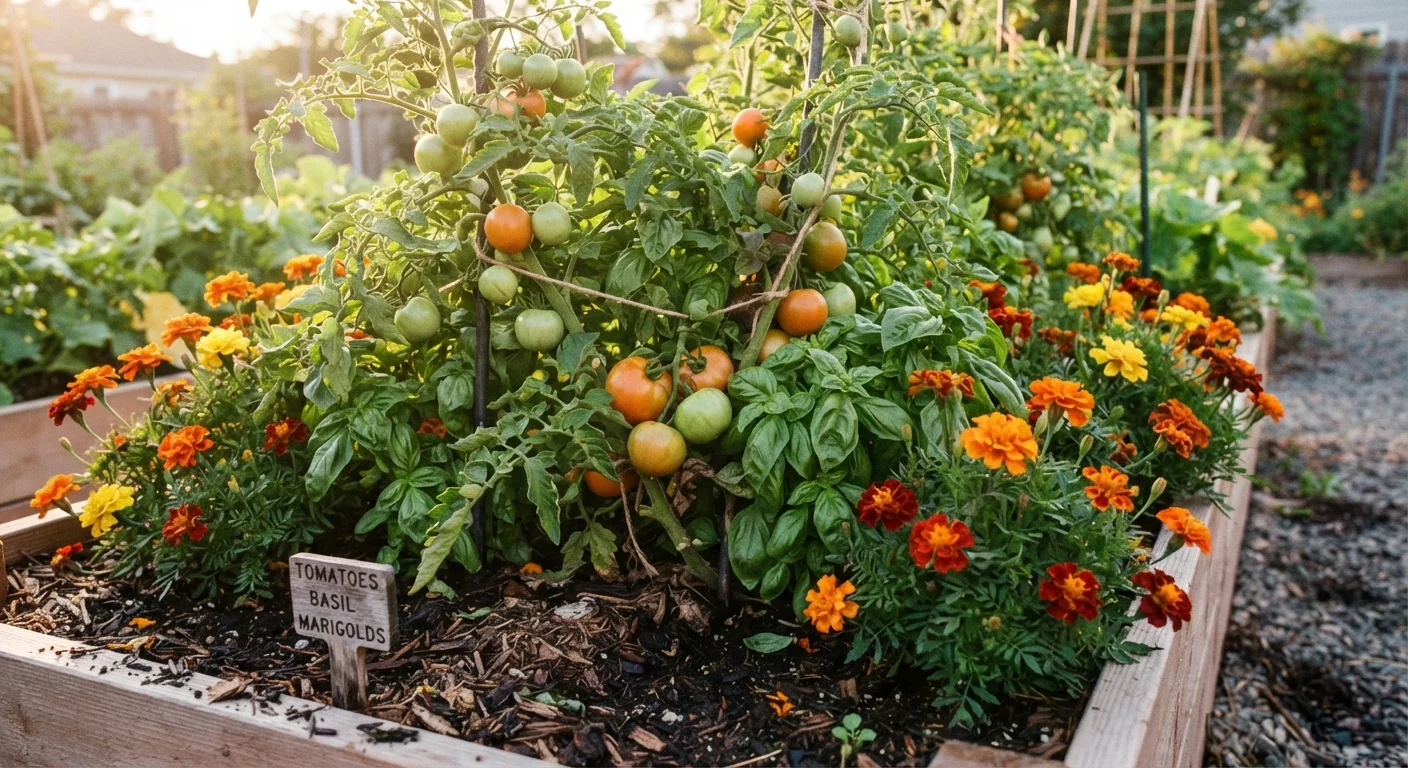
Planting basil next to tomatoes repels pests and dramatically improves tomato flavor.
Fact
Basil may deter some insects in small-scale settings, but evidence for flavor improvement is anecdotal, and pest-repellent effects are inconsistent across studies.
This is one of the most repeated companion planting claims, and it has a partial basis in reality. Basil does emit volatile compounds that some research suggests can deter thrips and aphids under controlled conditions. However, field results in home gardens are highly variable - dependent on planting density, variety, and local pest populations. The flavor-improvement claim has no credible scientific backing; tomato flavor is primarily determined by genetics, soil nutrition, water management, and sun exposure. Growing basil near tomatoes is not harmful and makes culinary sense, but expecting dramatic pest control or flavor enhancement sets up unrealistic expectations.
Myth
Marigolds repel all garden pests when planted anywhere in the garden.
Fact
French marigolds have documented effects on specific soil nematodes when planted densely, but they do not broadly repel insects throughout a garden.
The marigold-as-universal-pest-repellent idea oversimplifies what the research actually shows. French marigolds (Tagetes patula) produce a root exudate called alpha-terthienyl, which has demonstrated suppressive effects on root-knot nematodes - but only when planted thickly and left in place for a full growing season or more. Their effect on above-ground insects like aphids, whiteflies, or beetles is much weaker and less consistent. Placing a few marigolds at garden corners won't protect crops across a 20-foot bed. If nematode pressure is your goal, dense, sustained planting in affected soil areas is the approach with the most support.
Myth
Roses grow better when planted with garlic because garlic repels aphids.
Fact
There is limited controlled evidence that garlic interplanting reliably reduces aphid pressure on roses at home garden scale.
Garlic's reputation as an aphid deterrent stems largely from the use of garlic-based sprays, which have some documented contact-repellent properties. Whether garlic planted in soil releases enough volatile sulfur compounds through the air to deter aphids on nearby roses is much less established. Some small-scale studies show modest effects; others show none. Garlic and roses do not compete strongly for resources, so the pairing is unlikely to cause harm - but treating it as a reliable pest management strategy rather than a hopeful experiment overstates what the evidence supports.
Myth
Carrots and onions protect each other from their respective flies when planted together.
Fact
Interplanting carrots and onions has shown some ability to reduce pest incidence in research settings, but results depend heavily on planting ratios and local conditions.
This is one of the more credibly studied companion planting combinations. The theory is that carrot fly (Psila rosae) and onion fly (Delia antiqua) are confused or deterred by the scent of the other crop. Some UK and European field trials found modest reductions in pest damage when the crops were interplanted in alternating rows. However, the effect was inconsistent and often smaller than other management strategies like row covers or crop rotation. It's a reasonable practice to try, especially in gardens where these pests are a known problem, but it shouldn't replace other proven protective measures.
Myth
Nasturtiums are a reliable trap crop that keep aphids away from vegetables.
Fact
Nasturtiums do attract aphids strongly, which can serve as a trap crop - but this concentrates pests rather than eliminating them, requiring active follow-up.
Nasturtiums are genuinely attractive to aphids, particularly black bean aphids. This makes them useful as a trap crop - a sacrificial plant that draws pests away from crops you want to protect. The mechanism is real and observable. The misconception is in expecting this to reduce overall pest pressure without intervention. Once aphids colonize the nasturtiums, they can spread if populations grow large enough or if natural predators don't keep up. Effective trap cropping means inspecting the trap plants regularly and removing or destroying heavily infested growth before aphids migrate. Used with that follow-through, nasturtiums offer a practical and low-cost companion strategy.
What the Evidence Actually Supports
The strongest documented benefits in companion planting fall into three categories: nitrogen fixation, trap cropping, and physical structure. Legumes - beans, peas, clover - form symbiotic relationships with soil bacteria that fix atmospheric nitrogen into plant-available form. This is well-established biology, not gardening myth. Pairing legumes with nitrogen-hungry crops like corn or leafy greens can meaningfully reduce the need for supplemental fertilizer over time, though the benefit builds across seasons rather than delivering immediate results.
Trap cropping involves planting a sacrificial species that attracts pests away from your main crop. Blue Hubbard squash, for example, has been studied as a trap crop for squash vine borers and cucumber beetles, drawing them away from more desirable varieties. This works best when the trap crop is planted around the perimeter and monitored actively - it requires follow-through, not just placement.
60-80%
Reduction in cucumber beetle damage with Blue Hubbard trap cropping
University extension research in the northeastern US has documented significant pest reduction when Blue Hubbard squash is used as a perimeter trap crop.
3-4x
More nitrogen fixed with legume cover crops versus bare soil
USDA Natural Resources Conservation Service data shows legume cover crops can fix substantial nitrogen, reducing synthetic fertilizer needs over successive seasons.
Physical structure is the third reliable mechanism. The Three Sisters system - corn, climbing beans, and sprawling squash - illustrates all three categories at once: the corn provides a trellis, beans fix nitrogen, and squash leaves shade the soil to suppress weeds and retain moisture. Documented in agricultural research and validated by generations of Indigenous farmers, this combination offers genuine, multi-layered benefit.
Soil health is a related factor worth considering alongside any planting plan. Our guide to soil amendments explains how compost and other inputs interact with the root environment your companion plants depend on.
Competition Can Outweigh Cooperation
Placing plants too close together in hopes of companion benefits can create more competition for water, nutrients, and light than any mutual benefit provides. Always check spacing requirements for each species in a pairing. A combination that works in theory can underperform if overcrowding stresses both plants.
For gardeners working with limited space, companion planting strategies require careful spacing decisions. Dense planting can create competition rather than cooperation if not planned well. See our resource on growing vegetables in small spaces for spacing strategies that apply directly to mixed plantings.