

Key Takeaways
Our Verdict
No single garage storage system wins outright - the right choice depends on your ceiling height, the types of items you're storing, and how frequently you need to access them. Shelving suits everyday-access needs, overhead racks handle seasonal bulk, and wall panels keep hand tools organized and visible. Layering all three is the most effective strategy for a typical two-car US garage.
| Best for | Recommended |
|---|---|
| Frequent access to tools, bins, and household supplies | Freestanding or wall-mounted shelving |
| Storing bulky seasonal gear like holiday décor or camping equipment | Overhead ceiling racks |
| Organizing hand tools and small accessories without losing floor space | Wall panels (slatwall or pegboard) |
| Maximizing a full garage with varied storage needs | A layered combination of all three systems |
How to Think About Garage Storage Before You Buy Anything
Garages present a unique organization challenge: they absorb everything that doesn't fit elsewhere - power tools, holiday bins, sports gear, lawn equipment - while still needing to function as a workspace or parking area. Before settling on a storage system, take inventory of what you're actually storing and how often you reach for it. Items retrieved weekly need a very different home than camping gear used twice a year.
Two structural factors shape what's possible: your ceiling height and the location of wall studs and ceiling joists. Most US attached garages have ceiling heights between 8 and 10 feet, which opens up overhead options, but older homes or garages with attic conversions may be more limited. Identifying stud and joist locations before purchasing any wall-mounted or ceiling-mounted system isn't optional - it determines load capacity and safety. When in doubt, consult a contractor before hanging heavy loads.
For a broader look at how storage orientation affects your options, see our guide to vertical vs. horizontal storage.
Shelving Units: Reliable, Accessible, Space-Hungry
Freestanding and wall-mounted shelving remains the most common garage storage choice for good reason: it's straightforward to set up, easy to reconfigure, and provides immediate visual access to everything stored on it. Steel wire shelving and heavy-duty resin units handle moderate loads well and resist the temperature swings common in uninsulated garages.
Wall-mounted shelving brackets free up floor space compared to freestanding units but require secure anchoring into studs - a step that's easy to skip and costly to regret if a loaded shelf fails. Weight limits vary significantly by shelf material and bracket design, so always verify the manufacturer's rating before stacking heavy items.
| Shelving Units | Overhead Ceiling Racks | Wall Panels | |
|---|---|---|---|
| Best for storing | Bins, boxes, everyday supplies | Bulky seasonal items | Hand tools, small accessories |
| Floor space impact | Moderate to high | None | None |
| Accessibility | Easy, at eye level | Low, requires ladder | High, items are visible |
| Installation difficulty | Low to moderate | Moderate to high | Low to moderate |
| Ceiling height required | None | 8+ feet typically | None |
| Relative cost range | Low to moderate | Moderate | Low to moderate |
| Weight capacity | Moderate to high (varies) | High (joist-dependent) | Low to moderate |
The main trade-off with shelving is square footage. A 6-foot run of shelving along a garage wall is space that can't be used for parking or a workbench. Households storing a large volume of everyday-use items will find this worthwhile; those with lighter storage needs may prefer a leaner system.
Overhead Ceiling Racks: Smart Use of Dead Space
The area between your car's roofline and the garage ceiling is almost always unused - and overhead storage platforms are designed specifically to claim it. Ceiling-mounted rack systems typically suspend from ceiling joists and can hold substantial weight when installed correctly, making them ideal for bins of holiday décor, off-season sports equipment, or luggage.
Measure Clearance Before You Order
Before purchasing overhead racks, measure the height from the floor to the lowest ceiling obstruction (joists, pipes, or door tracks) and subtract the clearance your tallest vehicle needs when the door is open. A margin of at least 2-3 inches of buffer below the rack is a reasonable minimum. Write these measurements down before shopping so you can match them to product specifications.
The non-negotiable requirement is ceiling height. You generally need at least 8 feet of clearance to mount overhead racks while still fitting a standard vehicle beneath them - and taller trucks or SUVs require more. Measure twice before purchasing. Garage doors with low-profile tracks can also limit usable overhead depth near the door opening.
Installation involves drilling into ceiling joists, which must be located accurately. Because overhead racks carry loads directly above people and vehicles, this is an area where hiring a professional installer is a reasonable consideration, especially for systems rated above 500 pounds. Misaligned or under-secured mounts are a serious hazard. For items that rotate seasonally, overhead racks pair well with the rotation strategies described in our seasonal storage guide.
Wall Panels: Pegboard, Slatwall, and Track Systems
Wall panel systems - including classic pegboard, injection-molded slatwall panels, and metal track systems with interchangeable hooks - turn bare garage walls into configurable tool storage. Their key strength is density: a 4×8-foot slatwall panel can hold dozens of hooks, bins, and brackets in customizable arrangements without consuming any floor space.
Pegboard is the most economical entry point but requires backing material when installed over drywall (hooks can pull out without a solid surface behind them). Slatwall panels are heavier and more expensive but hold greater weight per hook and look more finished. Metal track systems sit between the two in cost and are highly adjustable.
These systems work best for hand tools, garden implements, extension cords, and small parts bins - items used regularly and benefiting from visual organization. They're less suited for heavy power tools or bulky items, which need shelf or floor support. The same accessibility-versus-coverage trade-off that applies to kitchen storage decisions applies here; our open shelving vs. closed cabinets comparison explores similar principles in a different room context.
Combining Systems for Maximum Efficiency
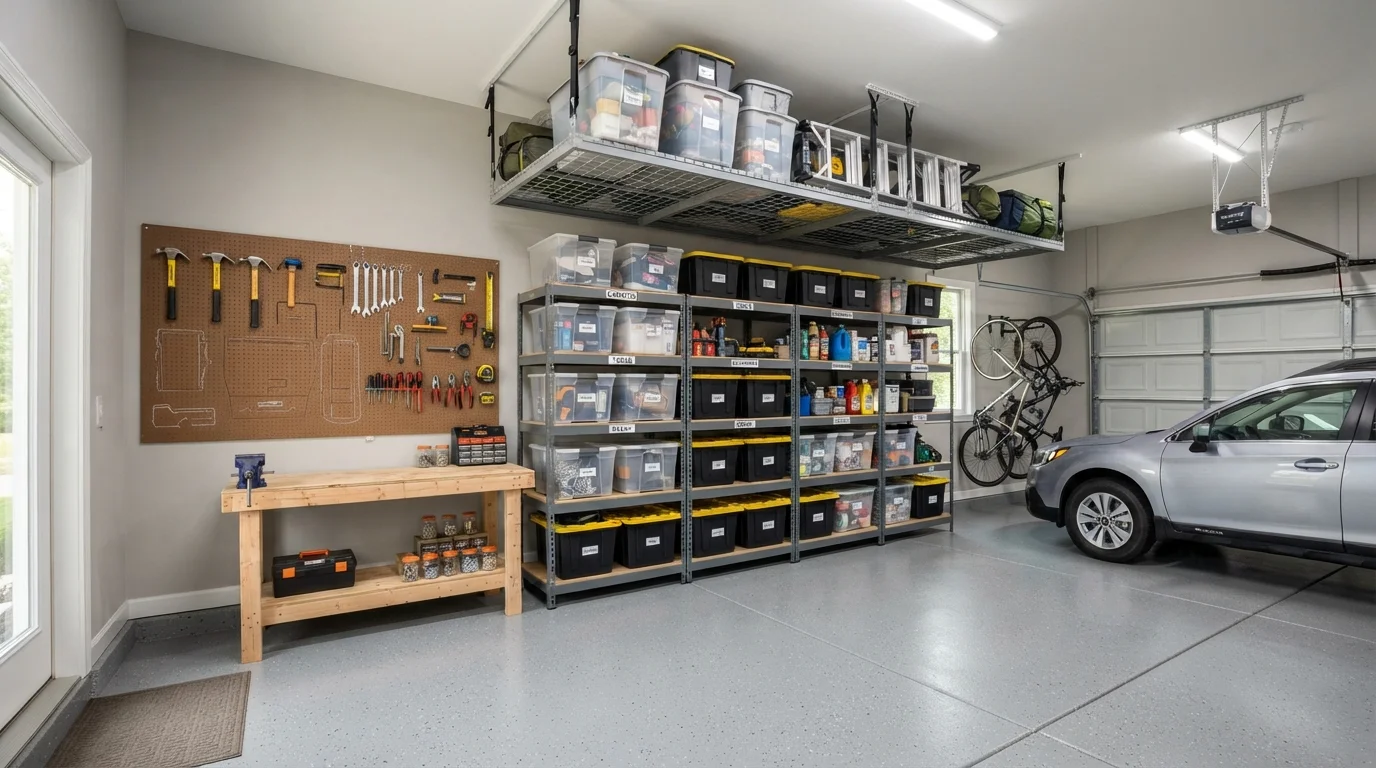
The most functional garages typically layer all three approaches: shelving along one wall for bins and household overflow, overhead racks above the parking area for bulky seasonal items, and a wall panel section flanking the workbench for tools. Each system covers what the others can't.
When planning a combined layout, start by mapping the floor and ceiling zones separately. Park your vehicle and note where overhead clearance is constrained. Then designate wall sections by use frequency - tools used weekly near the main entry point, seasonal items toward the back or overhead. Label bins before they go up, especially on overhead racks where you can't easily scan contents.
Budget realistically. A modest shelving setup might run $100-$300 in materials. Overhead rack systems vary widely based on size and weight rating. Slatwall panels with a full hook kit represent a meaningful but durable investment. Doing it in phases - starting with shelving, adding overhead racks once you know your clearance - is a practical approach for most households.