

Key Takeaways
Why Seasonal Rotation Goes Wrong
Most households don't have a storage problem - they have a system problem. Items go into bins in a hurry, labels get skipped, and by the following season nobody remembers which box holds the holiday tablecloths versus the Halloween decorations. The result: hours of rummaging, duplicated purchases, and a growing pile of things that never quite make it back to where they belong.
The fix isn't more storage space. It's a repeatable process that treats rotation as a scheduled event rather than a reactive scramble. If you haven't yet built out your primary closet storage, see our first-timer's closet walkthrough - a solid foundation there makes seasonal rotation far easier.
Schedule Your Rotation Like an Appointment
Treat seasonal rotation as a household task with a fixed date, not a vague intention. Blocking two to three hours on a specific weekend makes it far more likely to happen before the season change catches you off guard. Pair it with a task you already do annually - like replacing smoke detector batteries - to make it a predictable household rhythm.
The Audit-First Rule
Before anything goes into a storage container, run a fast audit. Pick up each item and ask: Did I use this last season? Is it in good condition? Would I miss it if it were gone? Anything that fails two of those three questions should be donated, discarded, or repaired - not stored. This single habit prevents your storage from quietly accumulating items nobody actually wants.
Apply this to all three categories equally: clothing, seasonal décor, and activity gear. A winter coat that no longer fits, a box of ornaments you replaced two years ago, and a kayak paddle for a kayak you sold all share the same problem - they consume prime space while delivering no value. Adopting a one-in-one-out mindset before each rotation keeps the stored inventory lean year over year.
Container and Labeling Standards That Actually Work
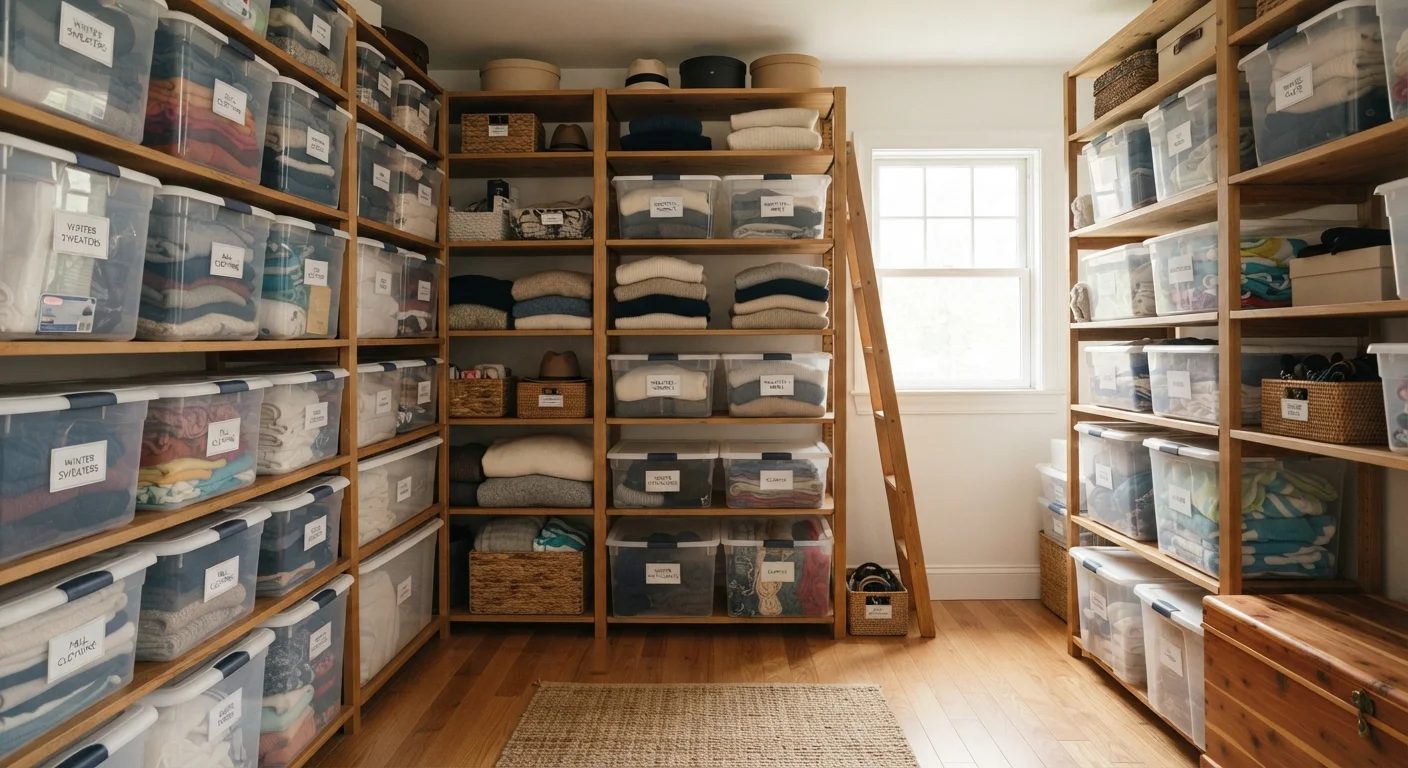
Consistent containers are more important than expensive ones. Uniform bin sizes stack cleanly and maximize vertical space - a real advantage if you're working with a garage, basement, or attic. Clear-sided bins allow a visual scan without pulling everything down; opaque bins require reliable labeling to be useful at all. Choose one approach and stick with it across all seasonal categories.
Labeling should answer three questions: What's inside? Which season? Which room does it belong to? A label reading "Winter - Bedroom - Sweaters & Thermal Layers" retrieves in seconds; a label reading "Clothes" does not. For décor especially, noting the storage year on a small sticker inside the lid can help you track items that haven't been touched in multiple seasons. If your garage is where most of this lands, garage storage systems like overhead racks and wall panels can dramatically increase usable space without eating floor area.
80%
Of stored items rarely or never retrieved
Home organization research consistently finds that the majority of household storage holds items that haven't been accessed in over a year, underscoring the value of pre-storage audits.
2-3 hrs
Average time lost per unplanned seasonal swap
Households without a defined rotation system typically spend two to three hours searching for, sorting, and re-packing seasonal items each transition, compared to under one hour with a structured approach.
Room-by-Room Rotation Strategies
Clothing: Sort by climate need rather than calendar month - US households in Georgia swap at a different rhythm than those in Minnesota. Vacuum-seal bags work well for bulky winter items like down jackets and heavy wool blankets; they compress volume significantly without harming fabric, provided items are completely dry before sealing. Hang-worthy off-season pieces (blazers, formalwear) do better in a breathable garment bag than folded in a bin.
Décor: Holiday and seasonal décor benefits from dedicated bins that never get repurposed. Fragile items like ornaments and ceramic figurines should be wrapped in tissue or packed in divided containers - cardboard egg-style inserts work well and can be reused many times. Group décor by occasion, not by color or material, so the "Fourth of July" bin holds everything needed for that event in one place.
Gear: Sporting and outdoor equipment presents the biggest footprint challenge. Skis, bikes, camping gear, and lawn tools often can't be containerized - they need dedicated wall hooks, ceiling mounts, or floor racks. Map out your storage zone before the swap rather than fitting gear wherever it lands. See how vertical versus horizontal storage affects accessibility and capacity for larger items.
Building the Rotation Into Your Calendar
Seasonal rotation works best when it's scheduled rather than triggered by a crisis (finding the Halloween bin in December, or pulling out summer gear mid-heatwave). A simple approach: set two recurring calendar reminders - one in late March or early April for the spring/summer swap, and one in late September or early October for the fall/winter transition. Tie the reminder to a concrete trigger, like a long weekend or a day you've already blocked for household tasks.
Keep a short checklist - even just a note in your phone - that lists the steps in sequence: audit, sort donations, clean items before storing, pack with labels, update the storage map. A storage map is simply a rough diagram or list noting which bins live where, updated each season. It takes five minutes to maintain and eliminates the guessing-game retrieval problem entirely. For gardeners coordinating outdoor storage alongside garden bed prep, our seasonal garden calendar aligns well with these same rotation windows.