

Key Takeaways
Why Shared Rooms Fail at Staying Tidy
A shared kids' room has built-in friction: two or more children with different ages, interests, and tolerance for mess competing for the same square footage. Most tidying breakdowns aren't a motivation problem - they're a systems problem. When a child can't tell where something belongs, or has to ask an adult to reach it, it will land on the floor instead.
The goal here isn't a picture-perfect bedroom. It's a room organized in a way that children can actually maintain, with minimal reminders. That requires intentional layout decisions, storage chosen for kid-level independence, and a realistic ceiling on how much stuff the room holds at any given time. For a broader look at how this fits into whole-home organization, see our room-by-room organization checklist.
What You'll Need Before You Start
Gather your tools and do an honest inventory of the room before moving anything around. This prevents mid-project trips to the store and helps you make storage decisions based on what actually needs a home.
What you will need
Low open shelving unit
Provides accessible storage at child height so kids can retrieve and return items independently.
Stackable bins or baskets
Corrals loose toys, art supplies, and accessories into clearly defined categories.
Label maker or pre-printed picture labels
Marks each storage container so children know exactly where items belong.
Hanging closet organizer or shelf dividers
Separates each child's clothing section within a shared closet.
Over-the-door organizer
Adds vertical storage for small items like shoes, accessories, or craft supplies without using floor space.
Removable wall hooks
Gives each child a designated spot for backpacks, jackets, or frequently used items near the door.
Step-by-Step: Building a System That Sticks
Follow these steps in order. Skipping the declutter phase and jumping straight to buying organizers is the most common reason shared-room systems collapse within weeks.
Declutter before organizing
Remove everything from shelves, closets, and floor storage. Sort into four groups: keep in this room, relocate to another room, donate, and discard. Be honest about volume - a storage system can only hold what it was designed to hold. Involve the children in age-appropriate decisions; they're more likely to maintain a system they helped create.
Define each child's personal zone
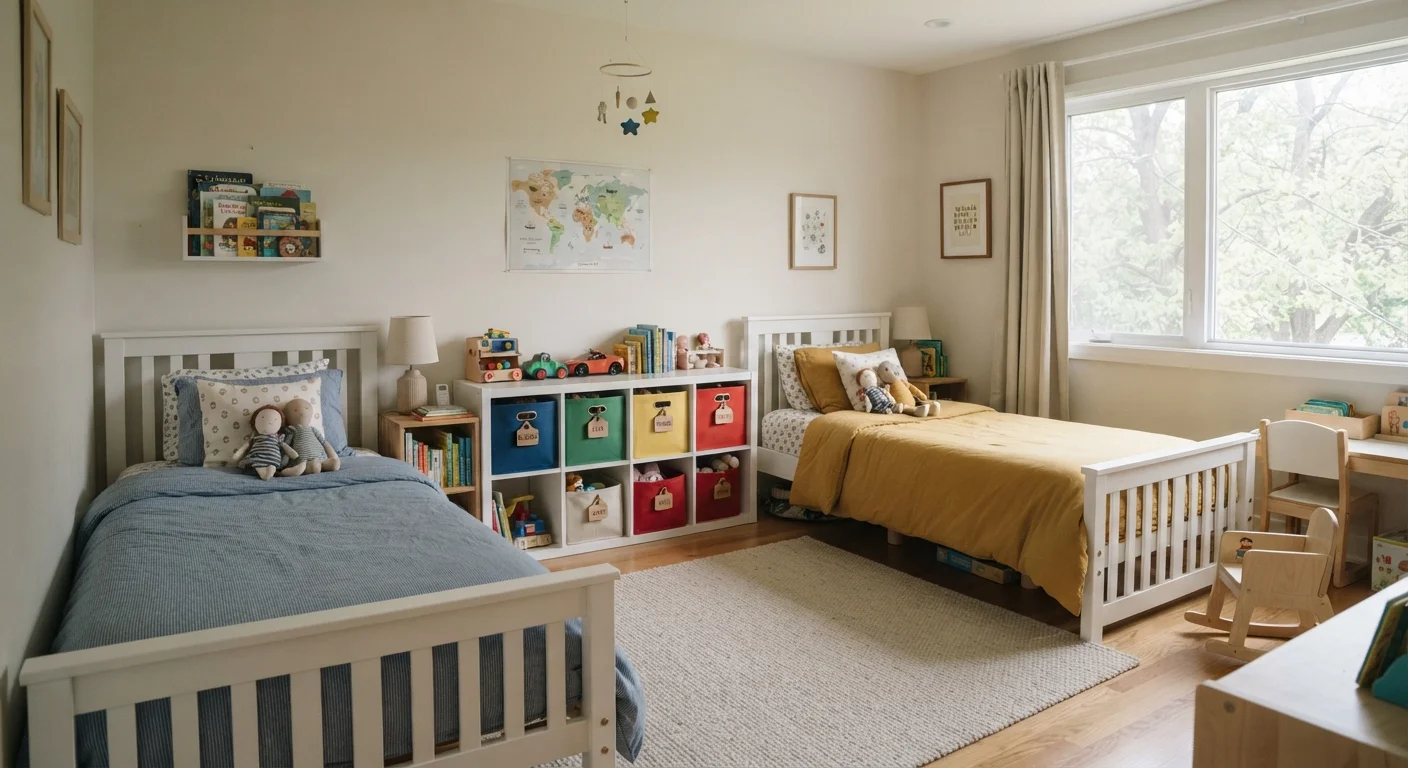
Even in a small room, each child benefits from a clearly bounded space - typically anchored by their bed and immediate storage. Use a rug, wall color, or simply the position of furniture to signal ownership. Personal zones reduce conflict over belongings and give each child accountability for their own area. Avoid forcing symmetry if the children's ages or needs differ significantly.
Set up low, open storage within each zone
Position shelving and bins so the child who uses them can reach everything without climbing or asking for help. Aim for storage tops no higher than the shortest child's shoulder height. Open-front bins outperform lidded boxes for everyday items - fewer steps to put something away means it's more likely to actually happen.
Categorize and label every container
Assign one category per bin: LEGOs, stuffed animals, art supplies, books, and so on. Use picture labels for children who aren't yet reading and add words as they grow. Consistent labeling removes ambiguity - the number one reason items end up on the floor is that the child doesn't know where they go. Keep categories broad enough that sorting isn't a puzzle.
Organize the shared closet by child
Divide the closet rod clearly so each child has their own section. Use a physical divider, different-colored hangers, or a label on the rod itself. Place each child's dresser or folding shelf directly below their hanging section where possible. If children are different heights, adjust the hanging rod height within each section to match their reach.
Create a simple shared play zone
If the room includes a shared floor area for play, apply the simplest storage here: large open bins, a low bookshelf, or a rolling cart. The fewer steps it takes to put something away, the more often it will actually happen. Limit the shared zone to a manageable number of toy categories - complexity here is where most room systems break down.
Establish a short daily reset routine
Set a consistent time - before dinner, after homework, or at bedtime - for a five-minute tidy. Frame it as a non-negotiable part of the day rather than a punishment. Each child is responsible only for their personal zone; the shared play zone is a joint effort. Keeping the routine brief and predictable is what makes it sustainable over weeks and months.
Maintaining the System Long-Term
Even the best-designed room will drift toward chaos without a lightweight maintenance habit. A five-minute end-of-day reset - each child returns items to their labeled home - is more effective than a weekly deep clean. Keep the bar low: the goal is "good enough to function," not spotless.
Twice a year, reassess the volume of toys and clothes in the room. As children grow, interests shift and clothing sizes change rapidly. Pairing a seasonal rotation with a donation pass keeps the system from overflowing. Our guide on seasonal storage rotation walks through that process in detail.
Habit-building matters as much as physical setup. The one-in-one-out rule is particularly useful in a kids' room: when a new toy or book arrives, an old one leaves. Applied consistently, it prevents the storage system from being perpetually overwhelmed. The same organizational thinking translates to other high-friction spots in your home - if kitchen drawers are your next challenge, our kitchen drawer organization guide covers comparable strategies.