
Bird Species for Indoor Life: Matching Temperament and Care Demands to Your Household

Key Takeaways
Our Verdict
No single pet bird species is universally superior - the right choice depends entirely on how much daily time, noise tolerance, and social engagement your household can reliably provide. Budgies and cockatiels are generally the most forgiving starting points, while conures and lovebirds reward experienced, highly engaged owners. Matching species temperament to your actual lifestyle - not your ideal one - is the single most important decision you will make.
| Best for | Recommended |
|---|---|
| First-time bird owners or households with limited daily time | Budgerigar (Budgie) |
| Those wanting a quiet, affectionate companion with moderate interaction needs | Cockatiel |
| Experienced owners who can commit several hours of daily engagement | Green Cheek or Sun Conure |
| Owners wanting a bold, bonded bird in a pair or solo with high stimulation | Lovebird |
Why Species Selection Matters More Than You Think
Choosing a pet bird based primarily on appearance is one of the most common mistakes prospective owners make. A sun conure's vivid plumage rarely prepares a new owner for its piercing vocalizations, just as a lovebird's small size can mask its outsized demand for attention. Species selection should be driven by temperament, noise output, social requirements, and realistic daily time availability - not aesthetics alone.
Pet birds in the parrot family (Psittaciformes) range from highly independent to almost completely dependent on human interaction for psychological wellbeing. Getting that match wrong often leads to feather-destructive behaviors, excessive screaming, or aggression - outcomes that are difficult to reverse and stressful for both bird and owner. The species comparisons below are designed to help you apply an honest filter before committing.
If you're weighing birds against other small pets entirely, the considerations are fundamentally different - see our look at how hamsters and gerbils compare as household companions for another angle on small-pet decision-making.
Species-by-Species Breakdown
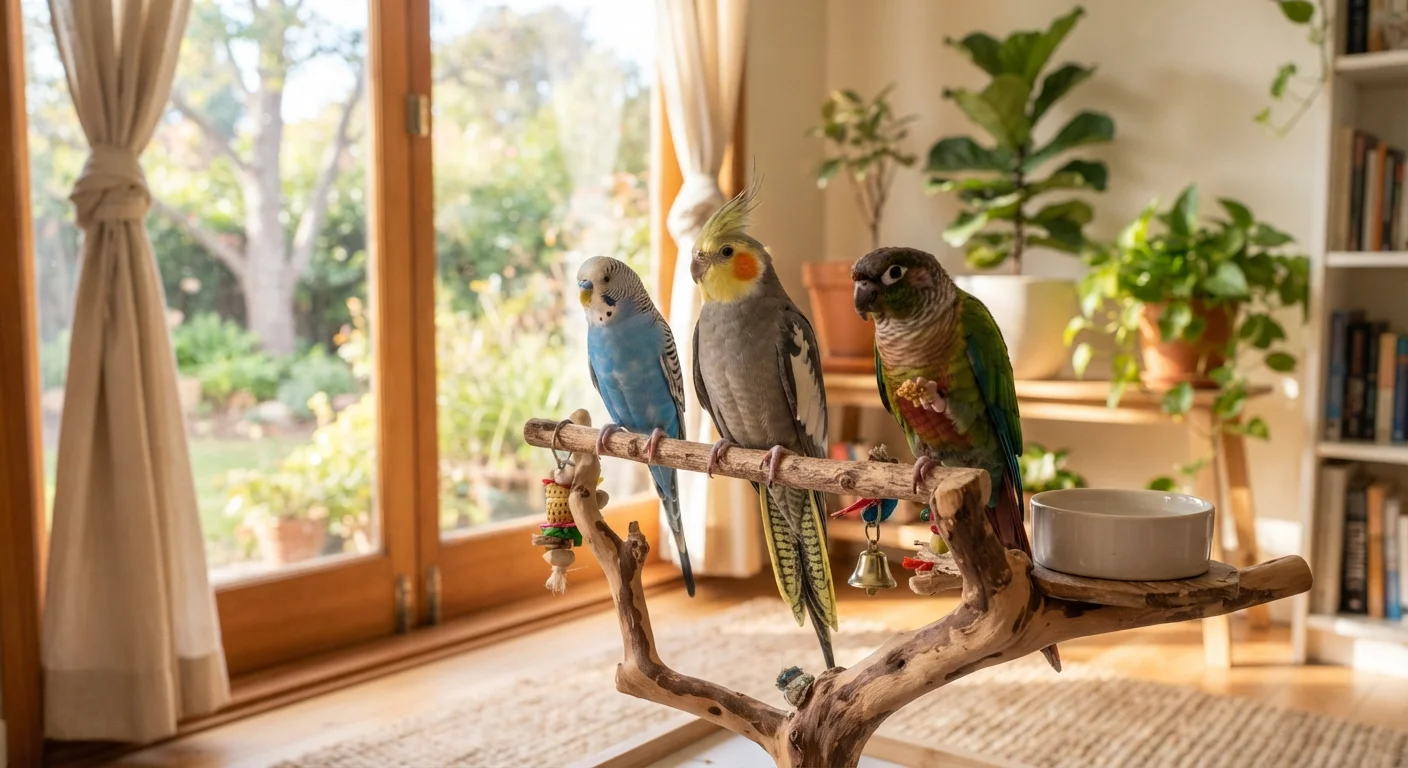
The four species below represent the most commonly kept small-to-medium pet birds in US households. Each profile covers the traits that matter most for daily indoor life.
| Budgie | Cockatiel | Green Cheek Conure | Sun Conure | Lovebird | |
|---|---|---|---|---|---|
| Noise Level | Low - soft chirping | Low-Moderate - melodic whistles | Moderate - occasional calls | High - loud contact calls | Moderate-High - sharp chirps |
| Daily Interaction Needed | 1-2 hrs (less if kept in pairs) | 1-2 hrs minimum | 2-4 hrs | 3-4 hrs | 2-3 hrs (solo bird) |
| Beginner Suitability | High | High | Moderate | Low-Moderate | Low-Moderate |
| Typical Lifespan | 7-10 years | 15-20 years | 15-20 years | 20-25 years | 10-15 years |
| Apartment Friendly | Yes | Generally yes | Usually yes | Not typically | Use caution |
| Handling Tolerance | Moderate with socialization | High when hand-raised | High with consistent handling | High with consistent handling | Variable - can be nippy |
Budgerigar (Budgie)
Budgies are among the most adaptable pet birds available. They are naturally flock-oriented, which means a single budgie housed without significant daily human contact will become bored and anxious. Kept in pairs, they are more self-sufficient, though they may bond primarily to each other rather than to their owner. Noise level is relatively low - pleasant chirping rather than screaming. Lifespan averages 7-10 years with proper care.
Cockatiel
Cockatiels are widely regarded as the ideal intermediate-level pet bird. They are affectionate, trainable, and produce melodic whistles rather than shrieks. Males tend to be more vocal and song-oriented; females are generally quieter. Cockatiels benefit strongly from daily out-of-cage time and human interaction of at least one to two hours. Lifespan commonly reaches 15-20 years, making this a long-term commitment. Diet quality is critical - seed-only diets cause preventable nutritional deficiencies in this species.
Conures
Conures are playful, curious, and intensely social - but the noise variable is significant. Sun conures in particular are documented as among the loudest small parrots, capable of contact calls that carry through walls. Green cheek conures are measurably quieter and may suit apartment living better. Both variants need mental enrichment, foraging opportunities, and substantial daily handling. Expect a lifespan of 15-25 years depending on subspecies.
Lovebirds
Despite their small size, lovebirds are assertive, territorial, and form intensely strong pair bonds - either with another lovebird or, if kept singly with significant investment, with a human owner. Solo lovebirds that are under-stimulated frequently develop behavioral problems. They are not ideal for handling by young children. Lifespan averages 10-15 years.
Pair Housing Changes the Dynamic Significantly
Two lovebirds or budgies kept together are generally more emotionally stable than a solo bird with limited human contact - but they will likely bond primarily to each other. If your goal is a hand-tame bird that actively seeks human interaction, plan for a solo bird with substantial daily engagement rather than a pair. This trade-off is worth clarifying before purchase.
Noise, Space, and Daily Time: The Three Practical Filters
Before narrowing a species choice on temperament alone, three practical constraints should serve as non-negotiable filters.
Noise tolerance
Apartment dwellers, those with shared walls, or households with infants or young children should treat noise output as a hard filter. Sun conures and some lovebirds will reliably generate complaints in multi-unit buildings. Budgies and cockatiels are objectively quieter and present fewer noise conflicts in close-quarters living.
Available space
Cage footprint matters less than in-cage complexity and available out-of-cage flight space. A larger cage with varied perch heights, foraging toys, and safe flight area produces meaningfully better welfare outcomes than a spacious cage with bare perches. Our guide on setting up a safe bird enclosure covers placement, perch variety, and common hazards in detail.
Daily time commitment
All parrot-family birds require more than passive presence. Active interaction - talking, training, supervised out-of-cage time - is a genuine welfare need, not an optional enrichment. If your schedule is unpredictable or you regularly work long hours, a pair of budgies is a more honest choice than a solo conure. Building trust and handling confidence also takes consistent effort; our resource on socialization and trust-building in small pets applies directly to birds as well.
Health, Lifespan, and Veterinary Realities
Pet birds are long-lived relative to most small pets, and their healthcare needs are often underestimated by first-time owners. Avian medicine is a specialized field - general-practice veterinarians may have limited experience with psittacine species. Identifying an avian-experienced vet before acquiring a bird, rather than after an emergency arises, is strongly advisable.
Common health concerns across species include respiratory infections, nutritional deficiencies from seed-heavy diets, feather destructive behavior (often stress-linked), and Psittacosis (Chlamydia psittaci infection), which is a zoonotic condition reportable in many US states. Routine annual wellness exams are recommended even for apparently healthy birds, as prey-species instincts mean birds frequently mask illness until it is advanced.
Birds are sensitive to airborne toxins at concentrations that are harmless to humans. Non-stick cookware containing polytetrafluoroethylene (PTFE) releasing fumes at high heat, scented candles, aerosol sprays, and cigarette smoke are documented causes of acute respiratory distress and death in birds. These hazards require permanent household modification, not just situational caution.
This article is for general informational purposes only and does not constitute veterinary advice. Consult a qualified avian veterinarian for health concerns specific to your bird.