

Key Takeaways
The Hidden Cost of a Bare Cage
When most people picture a pet rabbit, guinea pig, or hamster at home, they picture a cage - perhaps a water bottle, a food dish, and some bedding. That image is widespread, but it falls far short of what small animals actually need to thrive. Research in animal welfare science consistently shows that environmental impoverishment - a technically plain term for a boring, unstimulating living space - leads to chronic stress, suppressed immune function, and the development of abnormal repetitive behaviors called stereotypies.
Stereotypies are involuntary, repetitive actions with no obvious goal: bar-chewing, repetitive circling, head-weaving, or excessive self-grooming. They emerge when animals cannot perform natural behaviors their neurology is wired to execute. Recognizing them early is one of the most important welfare skills a small-pet owner can develop.
The good news is that enrichment doesn't require expensive equipment. Most of the strategies below are low-cost, DIY-friendly, and immediately actionable. This list covers the core categories of enrichment that matter most - and why each one addresses a genuine biological need rather than mere novelty.
Enrichment Needs Differ by Species
This article covers general principles applicable across common small pets. However, species differences are significant: a Syrian hamster's needs differ markedly from a rabbit's, and a rat's from a guinea pig's. Always research the specific behavioral ecology of your animal, and consult an exotic animal veterinarian if you're unsure whether your current setup is adequate.
Seven Enrichment Strategies That Make a Real Difference
Foraging Opportunities That Mimic Natural Feeding
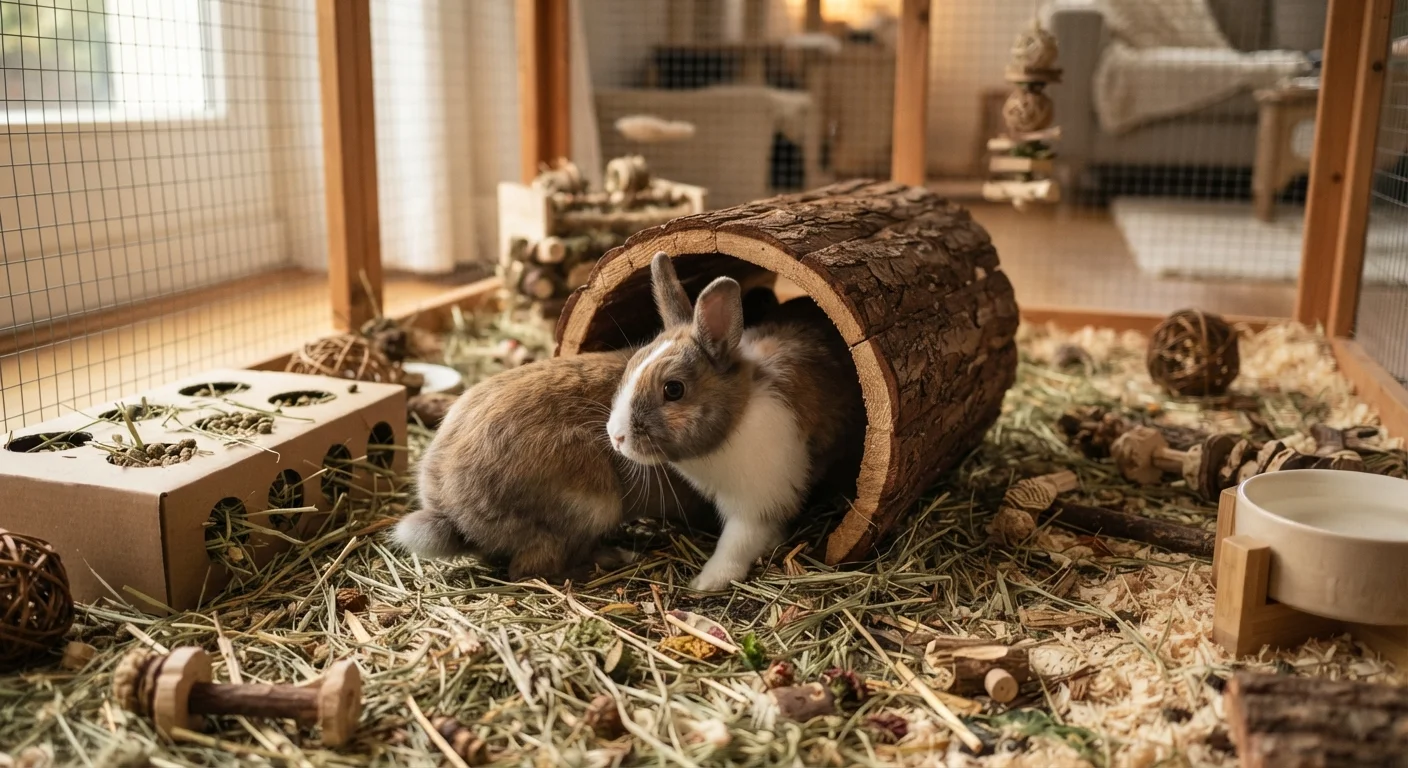
In the wild, small herbivores and omnivores spend a large portion of their waking hours searching for food. Delivering all nutrition in a single dish eliminates this behavior entirely, leaving animals with no outlet for seeking and problem-solving drives. Scatter feeding - spreading pellets or vegetables through hay, inside cardboard tubes, or under foraging mats - restores some of that engagement. Hay-stuffed paper bags, wooden foraging boxes with hidden vegetables, and puzzle feeders (available in many formats or easy to make from cardboard) all support this need. For rabbits, whose diet is primarily hay, our rabbit diet guide covers how to balance nutrition while incorporating foraging approaches.
Scatter feeding and puzzle feeders restore the seeking behavior that dish-feeding eliminates entirely.
Tunnels and Hides for Prey-Species Security
Rabbits, guinea pigs, hamsters, gerbils, and rats are all prey species whose baseline stress level is directly influenced by how safe they feel. Open, exposed environments trigger vigilance responses - the animal is never fully at rest. Providing multiple hides and tunnels allows prey animals to regulate their own sense of safety, which is foundational to calm, exploratory behavior. Cardboard tubes (untreated, no staples), wooden hides, willow tunnels, and even paper bags with entrances cut out all work well. Aim for at least two hides per animal so subordinate individuals in group housing aren't excluded.
Prey animals can't fully relax - or explore - unless they have reliable access to shelter.
Chewing and Gnawing Materials
Rodents and lagomorphs (rabbits) have continuously growing teeth. Gnawing isn't recreational - it's a physical necessity. Without appropriate materials, animals will redirect this behavior to cage bars, water bottles, or other surfaces, which can damage dentition and cause injury. Safe gnawing materials include untreated wood blocks and branches (apple, willow, and hazel are widely recognized as suitable), dried herb bundles, loofahs, and compressed hay blocks. Avoid painted, varnished, or chemically treated wood, and always verify species-specific safety since some woods are inappropriate for certain animals.
Gnawing is a dental health necessity - appropriate materials must always be available.
Supervised Free-Roaming Time Outside the Enclosure
No matter how thoughtfully designed, an enclosure places a ceiling on the scale and novelty of an animal's environment. Regular supervised time outside the enclosure - in a securely pet-proofed room or purpose-built exercise pen - is widely recommended by exotic animal veterinarians and welfare organizations for rabbits, guinea pigs, and many rodents. Free-roaming allows animals to exercise at speed, explore unfamiliar smells and textures, and express locomotor behaviors (running, jumping, burrowing into blankets) that cages physically prevent. The duration appropriate varies by species; rabbits, for instance, generally benefit from several hours of out-of-enclosure time daily.
Supervised free-roaming expands behavioral possibilities in ways no enclosure design can fully replicate.
Digging and Burrowing Substrates
Burrowing is a core behavioral need for hamsters, gerbils, mice, and to a lesser extent rats and guinea pigs. Studies in hamster welfare, in particular, have shown that deep substrate - consistently recommended at a minimum of 6 inches for hamsters, with deeper being better - significantly reduces stress indicators and stereotypic bar-chewing. Paper-based bedding, chemical-free topsoil, and coconut coir can be layered to create burrowing opportunities. Even for species less dedicated to digging, a tray of loose substrate or sand adds textural variety and sensory stimulation that a bare cage floor cannot provide.
Deep, loose substrate isn't comfort - for burrowing species, it's a behavioral necessity.
Social Enrichment and Companionship
For social species, the most powerful enrichment isn't a toy - it's another member of their own kind. Guinea pigs, rats, gerbils, and rabbits are all species for which solitary housing carries documented welfare costs. Companion animals provide grooming, play, allogrooming (mutual grooming), and a safe presence that reduces overall stress levels. Species that are typically solitary in the wild - Syrian hamsters being the clearest example - have different needs and should generally be housed alone. Understanding your animal's social biology is therefore a prerequisite to providing appropriate companionship. Guinea pig housing requirements are a useful reference point for sizing enclosures to accommodate pairs or groups.
For social species, a suitable companion delivers enrichment that no object or toy can replicate.
Sensory Enrichment Through Novelty and Scent
Small animals experience their environment primarily through smell, sound, and touch rather than vision. Rotating novel objects into the enclosure - a new cardboard shape, a different textured mat, a sprig of fresh herbs - activates exploratory behavior and prevents habituation-related apathy. Scent enrichment is particularly effective: placing a clean object that carries the scent of a safe herb (such as dried lavender for some species, or fresh parsley) in a new location gives animals a genuine investigative task. Equally, rotating which area of the enclosure holds food or hides shifts the spatial challenge regularly. Keep changes gradual enough to avoid overwhelming prey-species caution.
Rotating novel scents and objects keeps the environment mentally engaging without requiring new equipment.
Start with One Category at a Time
If your animal's enclosure is currently minimal, resist the urge to overhaul everything at once - abrupt changes can stress prey animals. Introduce one new enrichment element every few days, observe how your pet responds, and build from there. Watch for increased exploration and calmer resting posture as positive indicators.
For owners just getting started, see our new small pet arrival checklist - it covers enclosure prep and first-week monitoring alongside enrichment essentials. And if your animal shares space or interests with a feline family member, the parallel guide on keeping an indoor cat mentally stimulated shows how enrichment principles scale across species.
Making Enrichment a Daily Habit
Enrichment works best when it's woven into your daily routine rather than treated as an occasional activity. Rotate toys every few days so novelty is maintained - animals habituate quickly to static objects. Introduce new foraging challenges at the same time as regular feeding so your pet associates meals with mental engagement. Monitor closely for signs that enrichment is working: active exploration, relaxed body posture, varied behaviors, and normal social interaction (in species that live in pairs or groups).
Social species deserve particular attention. Guinea pigs, for example, are highly social animals whose stress responses are meaningfully reduced by companionship. Our guide on why guinea pigs get lonely explains why solitary housing is a welfare concern even in otherwise enriched enclosures. For hands-on interaction, handling and socialization guidance outlines how to make human contact a positive part of enrichment rather than a stressor.
This article provides general educational information about small animal care and is not a substitute for advice from a qualified exotic animal veterinarian. If your pet shows persistent abnormal behaviors or signs of distress, consult a veterinary professional familiar with your species.