

Key Takeaways
Guinea Pig Loneliness
Guinea pigs are highly social herd animals that experience genuine psychological and physiological stress when kept alone. Loneliness in this context refers to the absence of regular, meaningful contact with other guinea pigs-not just a lack of human interaction. Without a companion of the same species, a guinea pig cannot engage in the natural social behaviors-mutual grooming, vocalizing, and foraging together-that regulate its stress response and sense of security.
In ethological terms, guinea pigs (Cavia porcellus) are obligate social animals. Research on cavy behavior indicates that isolated individuals show elevated cortisol levels and increased stereotypic behaviors, markers of chronic stress in prey species.
The Herd Animal Wired Into Every Guinea Pig
Wild cavies-the South American ancestors of domestic guinea pigs-live in fluid social groups, staying close together to detect predators, share warmth, and navigate their environment. Domestication has not removed this drive. Every guinea pig carries the same neurological wiring: safety feels like being surrounded by others of its kind, and isolation feels like danger.
This means that solitary housing is not simply suboptimal-it actively works against how the animal is built to function. A guinea pig kept alone must manage its stress response without the social buffering that herd life provides. Over time, this can manifest as behavioral changes and measurable physical stress markers.
Understanding this wiring is the foundation of responsible guinea pig care. It shifts the question from "does my guinea pig seem fine alone?" to "what does this animal actually need to thrive?"
What Chronic Loneliness Actually Does to a Guinea Pig
The effects of social isolation in guinea pigs are not abstract. Behaviorally, isolated individuals commonly develop stereotypic behaviors-repetitive, apparently purposeless actions such as pacing, bar-chewing, or repeated circling. These are recognized signs of chronic psychological stress in captive animals.
Isolated guinea pigs also tend to be less active overall, less willing to explore, and may show reduced appetite. Because guinea pigs are prey animals that instinctively mask illness, subtle behavioral changes can be easy to miss until the problem is entrenched.
2+
Minimum recommended group size for guinea pigs
Animal welfare organizations, including Switzerland's national animal protection law, formally require guinea pigs to be housed with at least one companion.
~65%
Pet guinea pigs estimated to be housed alone in the US
Survey data from small animal welfare researchers suggest the majority of pet guinea pigs in North America are kept singly, despite species-wide social requirements.
24/7
Social contact guinea pigs need from conspecifics
Unlike human visits, same-species companions provide continuous passive companionship that supports a guinea pig's baseline sense of security.
Physiologically, chronic stress affects immune function, digestion, and cardiovascular health. While precise long-term outcome studies in pet guinea pigs are limited, the evidence from companion animal science and exotic animal veterinary practice consistently supports social housing as a welfare baseline-not an optional enhancement.
Why Human Interaction Is Not a Substitute
Many owners assume that frequent, affectionate handling bridges the companionship gap. Human interaction genuinely matters-it builds trust, provides stimulation, and contributes to a guinea pig's wellbeing. But it cannot replicate what a conspecific (same-species companion) provides.
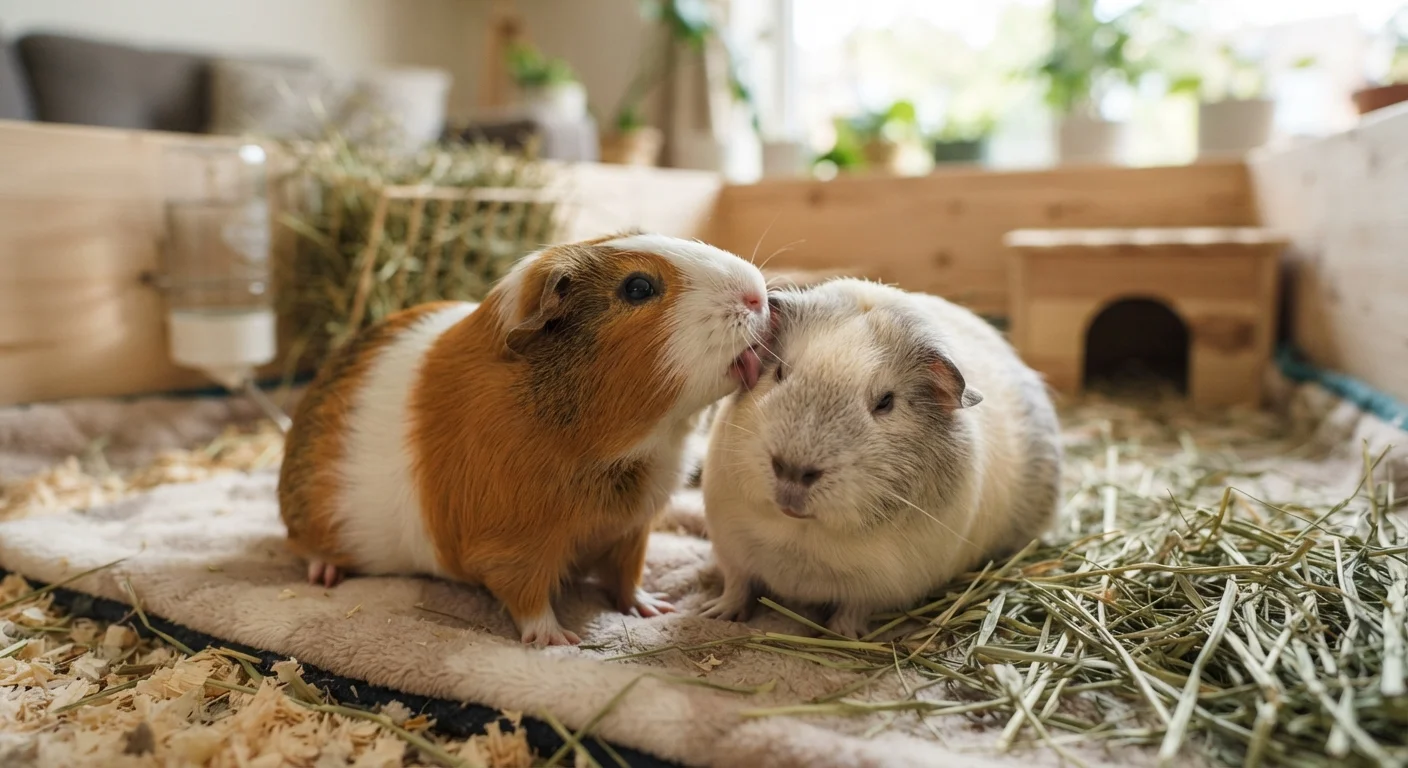
Guinea pigs communicate through a rich vocabulary of vocalizations, body postures, and touch. They engage in allogrooming-mutual grooming that reinforces social bonds and provides tactile reassurance no human hand can replicate in the same way. They also benefit from continuous passive companionship: the simple comfort of sleeping against another warm body, or foraging side by side.
Humans leave. Guinea pigs need around-the-clock social presence. Regular, gentle handling should be part of any guinea pig's life, but it works best as a supplement to, not a replacement for, same-species housing.
How to Introduce a Second Guinea Pig Safely
Adding a companion requires thoughtful planning. The goal is a bonded pair or small group; the risk is territorial conflict, particularly in inadequate space. See our guide on appropriate enclosure sizing before adding a second animal-more guinea pigs need proportionally more space.
Key steps for a successful introduction
- Quarantine first: A new guinea pig should be housed separately for two to three weeks to rule out illness before any contact with a resident animal.
- Neutral territory: First meetings should happen in a space neither animal has claimed-a clean playpen or bathtub works well.
- Supervise closely: Rumblestrutting (low vibrating vocalizations), mild chasing, and mounting are normal dominance behaviors. Biting that draws blood requires immediate separation.
- Slow integration: Allow short daily sessions before moving both animals into a thoroughly cleaned, rearranged enclosure so neither feels it is defending existing territory.
Consult the new pet arrival checklist for a broader framework on preparing your home before a second guinea pig comes home.
Enrichment as a Supporting-Not Standalone-Strategy
Even in a well-bonded pair, environmental enrichment plays a meaningful role in guinea pig welfare. Foraging opportunities, tunnels, varied textures, and supervised free-roaming time all reduce boredom and encourage natural behavior. Enrichment reduces stress and stereotypic behavior even in socially housed animals-it is not a fix for loneliness, but it is an essential layer of good husbandry.
Think of enrichment and companionship as working together: a bonded pair in a well-enriched, appropriately sized enclosure represents the gold standard. Either element alone leaves a gap.
This article provides general educational information about guinea pig behavior and welfare. It is not a substitute for advice from a qualified exotic animal veterinarian, who can offer guidance specific to your animals' health and circumstances.